Transcription of Depression: Screening and Diagnosis
1 depression : Screening and Diagnosis Douglas M. Maurer, DO, MPH; Tyler J. Raymond, DO, MPH; and Bethany N. Davis, MD. Madigan Army Medical Center, Tacoma, Washington depression affects an estimated 8% of persons in the United States and accounts for more than $210 billion in health care costs annually. The Preventive Services Task Force (USPSTF) and American Academy of Family Physicians recommend Screening for depression in the general adult population. Additionally, the USPSTF recommends Screening children and ado- lescents 12 to 18 years of age for major depressive disorder. All Screening should be implemented with adequate systems in place to ensure accurate Diagnosis , effective treatment, and appropriate follow-up. The two-item and nine-item Patient Health Questionnaires (PHQs) are commonly used validated Screening tools.
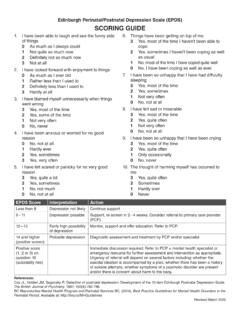
2 The PHQ-2 has sensitivity comparable with the PHQ-9 in most populations; however, the specificity of the PHQ-9 ranges from 91% to 94%, compared with 78% to 92% for the PHQ-2. If the PHQ-2 is positive for depression , the PHQ-9 or a clinical interview should be administered. Screening all postpartum women for depression is recommended by the USPSTF, American Academy of Family Physicians, American Acad- emy of Pediatrics, and American College of Obstetricians and Gynecologists. Women should be screened for depression at least once during the perinatal period using the PHQ-2, PHQ-9, or Edinburgh Postnatal depression Scale. In older adults, the Geriatric depression Scale is also an appropriate Screening tool for depression . If Screening is positive for possible depres- sion, the Diagnosis should be confirmed using Diagnostic and Statistical Manual of Mental Disorders, 5th ed.
3 , criteria. (Am Fam Physician. 2018;98(8):508-515. Copyright 2018 American Academy of Family Physicians.). Major depression is one of the most common mental costs. The burden is significant in the ambulatory care set- health disorders in the United States. Prevalence is esti- ting, with depression accounting for 10% of physician office mated at 8% in persons 12 years and In 2015, an esti- visits in mated million adults 18 years and older had at least Screening for depression is the cornerstone of early rec- one major depressive episode in the previous year, and the ognition, Diagnosis , and management. Despite the high condition accounted for of all disability-adjusted prevalence of depression and recommendations for screen- life Globally, more than 300 million persons of all ing, a recent survey of 33,653 physician-patient encounters ages have depression , which is the leading cause of disabil- ity If left untreated, depression may lead to suicide.
4 Persons WHAT IS NEW ON THIS TOPIC . with an affective disorder have a to 4% increased lifetime risk of suicide compared with the general depression depression is a major risk factor for suicide in older men, with The economic burden of major depressive disorder is suicide rates increasing with age in this population. A recent estimated at $ billion per year, with a increase study showed that men older than 75 years had the highest from 2005 to Approximately one-half of the costs are annual incidence of suicide. attributed to the workplace and one-half to direct medical The Preventive Services Task Force, American Academy of Family Physicians, American Academy of Pediatrics, and Ameri- can College of Obstetricians and Gynecologists recommend CME This clinical content conforms to AAFP criteria for Screening all postpartum women for depression .
5 Evidence continuing medical education (CME). See CME Quiz on supports the use of the two- or nine-item Patient Health page 484. Questionnaire or the Edinburgh Postnatal depression Scale. Author disclosure: No relevant financial affiliations. A 2016 systematic review including three randomized trials Patient information: Handouts on this topic are available with more than 6,500 women found a lower prevalence of at https:// w and postpartum depression at follow-up for those screened four https:// family to eight weeks after delivery. 508 American Downloaded Family from the Physician American Family Physician website at Copyright 2018 American AcademyVolume of Family98, Physicians. NumberFor8 the private, 15, October noncom- mercial use of one individual user of the website.
6 All other rights reserved. Contact for copyright questions and/or permission requests. 2018. depression . SORT: KEY RECOMMENDATIONS FOR PRACTICE. Evidence Clinical recommendation rating References showed that less than 5% of adults are The USPSTF recommends Screening for depression in the B 16. screened for depression in the primary general adult population. Screening must be implemented with adequate systems in place to ensure accurate diagno- care sis, effective treatment, and appropriate follow-up. Risk Factors The PHQ-2 is accepted as an initial Screening instrument C 22, 23. for depression in all age groups. If depression is identified The risk factors for depression are by the PHQ-2, completion of the PHQ-9 or a clinical inter- multifactorial but can be split into view is recommended.
7 The three broad categories of internal The USPSTF recommends Screening adolescents 12 to 18 B 24. factors, external factors, and adverse years of age for major depressive disorder in the pri- life events (Table 1). Risk factors 7-9. mary care setting. Screening must be implemented with have been evaluated independently in adequate systems in place to ensure accurate Diagnosis , men and women with no significant effective treatment, and appropriate follow-up. differences. 7-9. Pregnant women should be screened for depression at least C 23, 34, 35. Risk factors for late-life depression once during the perinatal period using a validated Screening include female sex, social isolation, instrument such as the Edinburgh Postnatal depression Scale or the PHQ-9. Consider Screening at least once during death of a spouse, being divorced or pregnancy and again four to eight weeks after delivery.
8 Separated, lower socioeconomic sta- tus, comorbid general medical con- Older adults can be screened for depression using an B 42. ditions, uncontrolled pain, insomnia, instrument such as the PHQ-2, PHQ-9, Cornell Scale for depression in Dementia, or Geriatric depression Scale. and cognitive and functional impair- ments. 10. For noninstitutionalized When Screening is positive for possible depression , the C 31. older patients, rates of depression are Diagnosis should be confirmed using criteria from the Diag- nostic and Statistical Manual of Mental Disorders, 5th ed. thought to be similar to those of the general adult population; however, as PHQ = Patient Health Questionnaire; USPSTF = Preventive Services Task Force. many as 50% of nursing home resi- A = consistent, good-quality patient-oriented evidence; B = inconsistent or limited-quality dents may be depression is patient-oriented evidence; C = consensus, disease-oriented evidence, usual practice, expert opinion, or case series.
9 For information about the SORT evidence rating system, go to https:// . a major risk factor for suicide in older men, with suicide rates in this popu- lation increasing with age. A study showed that men older than 75 years have the highest annual incidence of suicide at 39 deaths There are numerous medical conditions associated with per 100,000 men, compared with four deaths per 100,000 depression , as mimics of depression or coexisting condi- women older than 75 tions. Associated neurologic conditions include epilepsy, multiple sclerosis, Alzheimer disease, Parkinson disease, cerebrovascular disease, and traumatic brain injury. Other TABLE 1 associated conditions include human immunodeficiency virus infection or AIDS, neurosyphilis, cardiomyopathy, Risk Factors for depression ischemic heart disease, heart failure, hypothyroidism, dia- Internal factors Adverse life events betes mellitus, vitamin deficiencies, parathyroid disorders, Female sex Childhood sexual abuse irritable bowel syndrome, collagen vascular diseases, and History of anxiety Chronic medical conditions chronic liver Low self-esteem Disturbed family environment Neuroticism* History of divorce Symptoms Lifetime trauma Symptoms of depression are commonly known by the External factors Low educational status SIGECAPS mnemonic.
10 Sleep disorders (either increased Conduct disorder Low social support Substance use or decreased sleep); interest deficit (anhedonia); guilt Parental loss (worthlessness, hopelessness, regret); energy deficit; con- * A dimension of temperament marked by elevated stress reactiv- centration deficit; appetite disorder (either decreased or ity resulting in frequent negative increased); psychomotor retardation or agitation; and Information from references 7 through 9. suicidality. Depressed mood and anhedonia are the two cardinal symptoms of depression . The presence of four October 15, 2018 Volume 98, Number 8 American Family Physician 509. depression . SIGECAPS symptoms plus depressed mood or anhedonia suggests depres- TABLE 2. sion, and further Screening should be PHQ-2 Screening Instrument for depression considered.