Transcription of Developing clinical guidelines - The Centre for Evidence ...
1 Developing clinical guidelines Dr Kamal R. Mahtani BSc PhD MBBS PGDip MRCGP GP and Deputy Director Centre for Evidence Based Medicine University of Oxford Dec 2015 Understand the key stages of guideline development Use GRADE to assess the quality of Evidence Learn how to develop a recommendation using the available Evidence Key objectives of this session What is a guideline? Systematically developed document designed to help healthcare providers and patients decide on appropriate healthcare for specific circumstances Enable individuals with diverse backgrounds to come to an agreement about healthcare and devise a quality framework, against which such care can be measured Assists policy makers with making informed decisions about useful frameworks for assessing healthcare costs What are the key steps in Developing a guideline? Summary of key stages of NICE guideline development identification What is the optimal way to manage atrial fibrillation?
2 Developing /updating local guidelines 2. Scope review carried out by the developer defines the population(s) and setting(s) that will and will not be covered describes what the guideline will consider identifies the key issues and lists the key questions that will be considered describes the economic perspective(s) to be used. Carrying out the scope - sources identify related NICE guidance Related guidance websites NHS England, Public Health, Royal Colleges Policy and legislation: , Regulatory GMC Evidence reviews: Cochrane, HTA, The Campbell Collaboration Information on current practice: Audit Commission, Care Quality Commission Statistics: Health and Social Care Information Centre User experience: Websites/databases of people's experiences of health and social care Local? What does a scope look like? checking the population and selected key issues with stakeholders Who are the key stake holders?
3 3. Decision-making Committees (GDC) draws on its expertise to develop recommendations in the areas defined by the guideline scope Specifically: may refine and agree the review questions may advise on Developing the review protocol and alternative analyses considers the Evidence develops the recommendations considers factors that may help or hinder implementation ( levers and barriers ) Therefore the Committee needs to be Factors to consider for committee members MDT specialists and generalists, and/or academics Service users Conflicts of interest Training needs of your committee How often will you meet How will you record your meetings 4. Developing review questions and planning the Evidence review Turn key issues in scope into review questions How many? How much time do you have? Are they focused? Scope of review questions: interventions that work mechanisms of action likely to explain behavior or effects of proposed change views and experiences of people using services of affected by guidance practitioners or providers views, experiences and working practices (including any factors hindering the implementation of the intervention and factors supporting implementation) costs and resource use potential for an intervention to do harm or have unintended consequences Developing focused questions and key outcomes from Antiplatelet Anticoagulant PICO?
4 Key outcomes Prioritising outcomes Sources of Evidence Scientific Evidence explicit, transparent and replicable Evidence reviews or meta-analyses of quantitative studies, qualitative, cost-effective, individual studies or theoretical models Colloquial Evidence can complement scientific Evidence or provide missing information on context expert testimony members of the Committee reference group of people using services registered stakeholders Other sources of Evidence reports, audits, and standard operating procedures 5. Identifying the Evidence : literature searching and Evidence submission Systematic literature searches should be Thorough Transparent Reproducible Develop search protocol Sources Databases, websites, others Stakeholders Evidence Key terms 6. Reviewing research Evidence identifying and selecting relevant Evidence extracting and synthesizing the results assessing quality interpreting the results deriving Evidence statements.
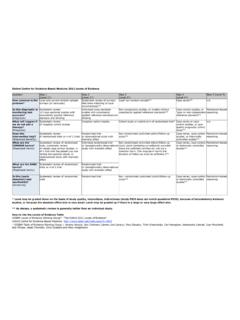
5 Assessing the quality of Evidence Quality assessment by outcome - the GRADE approach to assessing and rating quality Presenting and summarizing Evidence summary of the Evidence , including the summary of findings section from the GRADE profile Evidence statements full GRADE profiles or links to the profiles in an appendix (if GRADE has been used) Evidence tables Cost effectiveness? Evidence statements What would you recommend in your draft guideline? 7. Consultant and review guideline Who will you consult with? Guideline development group 8. Making recommendations from the Evidence using a range of scientific Evidence and other Evidence Committee must use its judgement to decide what the Evidence means in context Summarise relative value placed on: Outcomes benefits and harms resource use overall quality of the Evidence other considerations of the Committee Strength of recommendation the Evidence is high quality and the desirable effects clearly outweigh the undesirable effects there is a close or uncertain balance The GRADE system offers two grades of recommendations: strong and weak Strength of recommendation NICE has chosen not to do this, but to reflect the strength in the wording of the recommendation Strong recommendation offer measure , advise , commission or refer Weaker recommendation consider 9.
6 Sending your draft guideline for review/consultation Who will you send to? How will you deal with comments? 10. Implementing guideline How will you help users take up the guidance? impl mentation consultants support local organisations 11. Maintaining guidance How often will you update? How much resource will you have? Summary guidelines can take months-years to develop Adequate time taken in the steps to formulate Specific areas to consider: Scope of guidance Key stakeholders Key questions Evidence review Rating the quality of Evidence Strength of recommendation and wording in guidance Implementation of guidance Thank you