Transcription of DiabetesCanadaClinicalPracticeGuidelinesExpertCommittee ...
1 2018 Clinical Practice GuidelinesMonitoring Glycemic ControlDiabetes Canada Clinical Practice Guidelines Expert CommitteeLori D. BerardRN, CDE,Rick SiemensBSc Pharm, CDE,Vincent WooMD, FRCPCKEY MESSAGES Glycated hemoglobin (A1C) is a valuable indicator of glycemic treatmenteffectiveness and should be measured at least every 3 months when gly-cemic targets are not being met and when antihyperglycemic therapy isbeing adjusted. In some circumstances, such as when significant changesare made to therapy or during pregnancy, it is appropriate to check A1 Cmore frequently. Awareness of all measures of glycemia self-monitored blood glucose results,including self-monitored blood glucose (SMBG), flash glucose monitoring(FGM), continous glucose monitoring (CGM) and A1C provides the bestinformation to assess glycemic control.
2 Self-monitoring of blood glucose, FGM and CGM should not be viewed asglucose-lowering interventions, but rather as aids to assess the effective-ness of glucose-lowering interventions and to prevent and detecthypoglycemia. Timing and frequency of SMBG may be determined individually based onthe type of diabetes, the type of antihyperglycemic treatment prescribed,the need for information about blood glucose levels and the individual scapacity to use the information from testing to modify healthy behavioursor self-adjust antihyperglycemic agents. SMBG, FGM and CGM linked with a structured educational and therapeu-tic program designed to facilitate behaviour change can improve bloodglucose levels and prevent MESSAGES FOR PEOPLE WITH DIABETES A1C is a measurement of your average blood glucose control for the last2 to 3 months.
3 Approximately 50% of the value comes from the last 30 days. You should have your A1C measured every 3 months when your bloodglucose targets are not being met or when you are making changes to yourdiabetes management. In some circumstances, such as when significantchanges are made to your glucose-lowering therapy or during pregnancy,your health-care provider may check your A1C more frequently. Checking your blood glucose with a glucose meter (also known as self-monitoring of blood glucose) or using a flash glucose meter or continu-ous glucose monitor will: Determine if you have a high or low blood glucose at a given time Show how your health behaviours and diabetes medication(s) affectyour blood glucose levels Help you and your diabetes health-care team to make health behaviourand medication changes that will improve your blood glucose levels.
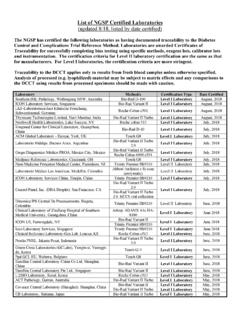
4 Discuss with your diabetes health-care team how often you should checkyour blood glucose TestingGlycated hemoglobin (A1C) is a reliable estimate of mean plasmaglucose (PG) levels over the previous 8 to 12 weeks(1). The meanblood glucose (BG) level in the 30 days immediately preceding theblood sampling (days 0 to 30) contributes 50% of the result and theprior 90 to 120 days contributes 10%(2,3). In uncommon circum-stances, where the rate of red blood cell turnover is significantlyshortened or extended, or the structure of hemoglobin is altered,A1C may not accurately reflect glycemic status (Table 1).A1C is the preferred standard for assessing glycated hemoglo-bin, and laboratories are encouraged to use assay methods that arestandardized to the Diabetes Control and Complications Trial (DCCT)reference(4 6).
5 A1C is a valuable indicator of treatment effective-ness and should be measured at least every 3 months when gly-cemic targets are not being met and when diabetes therapy is beingadjusted or changed. Testing at 6-month intervals may be consid-ered in situations where glycemic targets are consistently achieved(4,7). In some circumstances, such as when significant changes aremade to therapy, or during pregnancy, it is appropriate to check A1 Cmore frequently (see Diabetes and Pregnancy chapter, p. S255).A1C may also be used for the diagnosis of diabetes in adults (seeScreening for Diabetes in Adults chapter, p. S16). In Canada, A1 Cis reported using the National Glycohemoglobin StandardizationProgram (NGSP) units (%).
6 In 2007, a consensus statement from theAmerican Diabetes Association, European Association for the Studyof Diabetes and the International Diabetes Federation called for A1 Creporting worldwide to change to dual reporting of A1C with theInternational Federation of Clinical Chemistry and Laboratory Medi-cine (IFCC) SI units (mmol/mol) and derived NGSP units (%) withthe hope of fully converting to exclusive reporting in SI units(8).However, this has not been adopted worldwide, and both Canadaand the United States still use the NGSP units (%)(9). Although thereare some advantages to reporting in SI units, the most notable dis-advantage is the massive education effort that would be requiredto ensure recognition and adoption of the new units.
7 Canada is cur-rently not performing dual reporting; therefore, throughout thisdocument, A1C is still written in NGSP units (%). For those who wishto convert NGSP units to SI units, the following equation can be used:IFCC= (NGSP) (10)(see Appendix 15. Glycated Hemo-globin Conversion Chart for conversion of A1C from NGSP units toIFCC SI units).Point-of-care A1C analyzers are bench-top instruments that usea finger-prick capillary blood sample. They are designed for use ina health-care provider s office, a treatment room or at a blood is applied to a test cartridge and the sample is analyzedConflict of interest statements can be found on page J Diabetes 42 (2018) S47 S53 Contents lists available atScienceDirectCanadian Journal of Diabetesjournal 2018 Canadian Diabetes Canadian Diabetes Association is the registered owner of the name Diabetes several minutes(11).
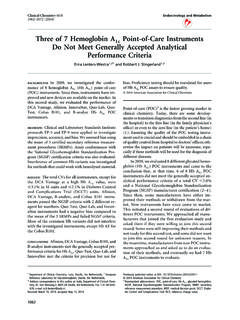
8 Point-of-care A1C testing has severalpotential advantages over laboratory A1C testing, including rapidtest results to expedite medical decision-making, convenience forpeople with diabetes, potential improved health system efficiencyand improved access to testing for underserved populations(12).A number of point-of-care A1C devices are commercially avail-able for monitoring glycemic control; however, a United Kingdomsystematic review concluded that evidence of the impact of usingpoint-of-care A1C testing on medication use, clinical decision-making and participants outcomes is lacking, and that a random-ized trial with economic evaluation is needed(13).
9 Currently, nopoint-of-care A1C analyzers are approved for the diagnosis studies have shown that A1C concentrations are higherin some ethnic groups (African, Asian, Hispanic) than in Cauca-sian persons with similar plasma glucose concentrations(14 19).In 1 cross-sectional study, A1C was to percentage pointshigher in African American than in Caucasian persons, with the dif-ference increasing as glucose intolerance worsened. However, allof these studies estimated mean glucose levels on the basis of verylimited measurements and, as a result, it is not clear whether thehigher A1C observed in certain ethnic groups is due to worse gly-cemic control or racial variation in the glycation of hemoglobin.
10 Ifdifferences in A1C between ethnic groups exist, the differencesappear to be small and have not been shown to significantly modifythe association between A1C and cardiovascular outcomes(20), reti-nopathy(21)or nephropathy(22).Self-Monitoring of Blood GlucoseMonitoring blood glucose levels, whether using traditional selfmonitoring of blood glucose (SMBG) devices or more recent flashglucose monitoring (FGM), can serve as a useful adjunct to othermeasures of glycemia, including A1C. Most people with diabetesbenefit from monitoring BG for a variety of reasons(23,24). Moni-toring BG is the optimal way to confirm and appropriately treathypoglycemia.