Transcription of Dictators Threaten World Peace
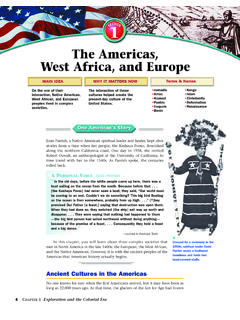
1 Terms & NamesTerms & NamesMAIN IDEAMAIN IDEA Joseph Stalin totalitarian Benito Mussolini fascism Adolf Hitler Nazism Francisco Franco Neutrality ActsThe rise of rulers with totalpower in Europe and Asia ledto World War ll. Dictators of the 1930s and1940s changed the course ofhistory,making World leadersespecially watchful for theactions of Dictators today. WHY IT MATTERS NOWWHY IT MATTERS NOW528 CHAPTER16 One American's StoryMartha Gellhorn arrived in Madrid in 1937 to cover the brutal civil war that had broken out in Spain the yearbefore. Hired as a special correspondent for Collier s Weekly,she had come with very little money and no special protec-tion. On assignment there, she met the writer ErnestHemingway, whom she later married.
2 To Gellhorn, a youngAmerican writer, the Spanish Civil War was a deadly strug-gle between tyranny and democracy. For the people ofMadrid, it was also a daily struggle for PERSONALVOICEMARTHA GELLHORN You would be walking down a street, hearing only the citynoises of streetcars and automobiles and people calling toone another, and suddenly, crushing it all out, would be thehuge stony deep booming of a falling shell, at the corner. There was no place torun, because how did you know that the next shell would not be behind you, orahead, or to the left or right? The Face of WarLess than two decades after the end of World War I the war to end allwars fighting erupted again in Europe and in Asia. As Americans read about dis-tant battles, they hoped the conflicts would remain on the other side of the Grips Europe and AsiaThe seeds of new conflicts had been sown in World War I.
3 For many nations, Peace had brought not prosperity but revolution fueled by economic depressionand struggle. The postwar years also brought the rise of powerful Dictators drivenby the belief in nationalism loyalty to one s country above all else and dreamsof territorial ThreatenWorld Peace Martha Gellhorn,one of the firstwomen warcorrespondents,began her careerduring theSpanish Civil OF THE World WAR I Peace SETTLEMENTI nstead of securinga just and secure Peace , the Treaty of Versailles caused anger and saw nothing fair in a treaty that blamed them for starting the war. Nordid they find security in a settlement that stripped them of their overseas coloniesand border territories. These problems overwhelmed the Weimar Republic, thedemocratic government set up in Germany after World War I.
4 Similarly, theSoviets resented the carving up of parts of Russia. (See map, Chapter 11, p. 400.) The Peace settlement had not fulfilled President Wilson s hope of a World safe for democracy. New democratic governments that emerged in Europe afterthe war floundered. Without a democratic tradition, people turned to authoritar-ian leaders to solve their economic and social problems. The new democraciescollapsed, and Dictators were able to seize power. Some had great STALIN TRANSFORMS THE SOVIET UNIONIn Russia, hopes fordemocracy gave way to civil war, resulting in the establishment of a communiststate, officially called the Soviet Union, in 1922. After V. I. Lenin died in 1924,Joseph Stalin,whose last name means man of steel, took control of the coun-try.
5 Stalin focused on creating a model communist state. In so doing, he madeboth agricultural and industrial growth the prime economic goals of the SovietUnion. Stalin abolished all privately owned farms and replaced them with collec-tives large government-owned farms, each worked by hundreds of families. Stalin moved to transform the Soviet Union from a backward rural nation intoa great industrial power. In 1928, the Soviet dictator outlined the first of several five-year plans, to direct the industrialization. All economic activity was placedunder state management. By 1937, the Soviet Union had become the World s sec-ond-largest industrial power, surpassed in overall production only by the UnitedStates.
6 The human costs of this transformation, however, were enormous. In his drive to purge, or eliminate, anyone who threatened his power, Stalindid not spare even his most faithful supporters. While the final toll will never beknown, historians estimate that Stalin was responsible for the deaths of 8 millionto 13 million people. Millions more died in famines caused by the restructuringof Soviet 1939, Stalin had firmly established a totalitariangovernment that triedto exert complete control over its citizens. In a totalitarian state, individuals haveno rights, and the government suppresses all opposition. World War Looms529 ABGermany was expected to pay off hugedebts while dealing with widespreadpoverty. By 1923, an inflating economymade a five-million German mark worthless than a penny.
7 Here children buildblocks with stacks of useless Germanmarks. MAIN IDEAMAIN IDEAAI dentifyingProblemsWhy did thenew democraciesset up after WorldWar I fail?MAIN IDEAMAIN IDEABS ummarizingWhat are thecharacteristics ofa totalitarianstate?CTHE RISE OF FASCISM IN ITALYW hile Stalin was consolidating his power inthe Soviet Union, Benito Mussoliniwas establishing a totalitarian regime inItaly, where unemployment and inflation produced bitter strikes, some commu-nist-led. Alarmed by these threats, the middle and upper classes demandedstronger leadership. Mussolini took advantage of this situation. A powerful speak-er, Mussolini knew how to appeal to Italy s wounded national pride. He played onthe fears of economic collapse and communism.
8 In this way, he won the supportof many discontented Italians. By 1921, Mussolini had established the FascistParty. Fascism(fBshPGzQEm) stressed nationalism andplaced the interests of the state above those of individ-uals. To strengthen the nation, Fascists argued, powermust rest with a single strong leader and a small groupof devoted party members. (The Latin fasces a bundleof rods tied around an ax handle had been a symbol ofunity and authority in ancient Rome.)In October 1922, Mussolini marched on Rome withthousands of his followers, whose black uniforms gave them the name BlackShirts. When important government officials, the army, and the police sidedwith the Fascists, the Italian king appointed Mussolini head of the himself Il Duce, or the leader, Mussolini gradually extended Fascistcontrol to every aspect of Italian life.
9 Tourists marveled that Il Ducehad even made the trains run on time. Mussolini achieved this efficiency, however, bycrushing all opposition and by making Italy a totalitarian Italy wants Peace ,work, and calm. I will give thesethings with love ifpossible, with forceif necessary. BENITO MUSSOLINIRomeBerlinLondonParisMoscowToky oMadridYellowSeaSea ofJapanEastChinaSeaMediterraneanSeaPACIF ICOCEANATLANTICOCEANT ropic of CancerArctic Circle45 E165 E0 75 N60 N45 NFRANCEITALYGERMANYJAPANCHINASOVIET UNIONSPAINGREATBRITAINF ascist dictatorshipCommunist dictatorshipImperialist military regime007501,500 kilometers7501,500 milesNSEWThe Rise of Nationalism, 1922 1941 GEOGRAPHY which countries did authoritarian leaders come to power?
10 Who were the leaders? geographic features might have led Japan to expand?Francisco Franco leads therebel Nationalist army to victor yin Spain and gains completecontrol of the countr y in Mussolini rises to powerin 1922 and attempts to restoreItaly to its former position as aworld Stalin grabs control of theSoviet Union in 1924 and squelchesall opposition after V. I. Lenin, founderof the communist regime, Tojo, the force behind Japanesestrategy, becomes Japan s prime minister in 1941. Emperor Hirohitobecomes a powerless Hitler offers economic stabilityto unemployed Germans during theGreat Depression and becomes chancellor in IDEAMAIN IDEACA nalyzingCausesWhat factorsled to the rise ofFascism in Italy?THE NAZIS TAKE OVER GERMANYIn Germany, Adolf Hitlerhad followeda path to power similar to Mussolini s.