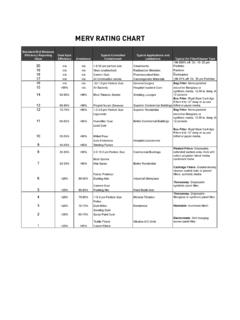
Transcription of DIELECTRIC MATERIALS CHART ECCOSTOCK Low …
1 HiKPowderFFPHiK3-15 >100> recognized global leader in microwave absorbing materialsPolyethlylenePolystyreneFusedSi licaFusedQuartzBoronNitrideMicaBeryllium OxideMagnesiumOxideAluminumOxideSoda-lim eGlassNylonTMEpoxySilicone RubberStrntiumTitanateBariumTitanatePure Water SteakZirconiaTitaniumDioxide(rutile)Magn esiumTitanateWollastoniteCTFEF louro-PolymerButylRubber(uncured)Natural Rubber(uncured)Jet FuelJP-4 MagnesiumCarbonateFirPlywoodStyrene-Buta dieneRubber(25/75)PyrexTMGlassMylarTMLex anTMParticle BoardZinc OxideMolybdenumSulfideNitrile RubberNeopreneTMGNR ubberSapphirePolypropyleneTeflonTMDIELEC TRIC CONSTANTLOSS TANGENTTYPICAL PROPERTIESDIELECTRIC MATERIALS CHART ECCOSTOCK Low Loss Dielectrics & Other Common MaterialsPhone: 800-650-5740 Fax: York Avenue, Randolph, MA 02368 BorosilicateGlassSteatite0005 CKProperties of common MATERIALS from Tables of DIELECTRIC MATERIALS ,Vols.
2 IV, V, and VI and Technical Reports AFML-TR-72-39 and 74-250 Laboratory for Insulation Research, Massachusetts Institute ofTechnology Measurements are 25 C and 1-10 GHz. Properties vary with frequency and DIELECTRIC is a medium having the propertythat the energy required to establish an elec-tric field within it is recoverable, in whole orin part, as electric energy. During energytransfer to and from the medium, there issome dissipation of energy in the form non-magnetic DIELECTRIC material isdefined by real and imaginary compo-nents of the Complex Permittivity * = j [farads/meter]Normalization of * with respect to theDielectric Permittivity of Free Space o = 10 9/36 [farads/meter]gives theComplex Relative Permittivity */ o = k* = k jk"k and tan indi-cate capability of storage of electric-field energy and dissipative charac-teristics for non-magneticdielectrics.
3 Magnetic dielectrics areadditionally characterized by meansof and tan _m which indicatecapability of storage of magnetic-field energy and of dissipation ofenergy via magnetic Constant- k is the relative permit-tivity or DIELECTRIC constant. It is the quantitygenerally referred to as DIELECTRIC Constant inthe literature. It is plotted vertically on thischart and is a dimensionless quantity since itis relative to free Factor (D), Loss Tangentandtan are identical. This is the quantity usual-ly reported to indicate the energy loss char-acteristic of a material. Plotted horizontallyon this CHART , it is dimensionless and definedas follows:D = tan = k"/k Loss Factor k" is the relative loss factor.
4 Inthe literature, it is usually given as LossFactor. It should not be confused withDissipation Factor or Loss Tangent. Notethat the Loss Factor is the product of theDielectric Constant and Dissipation DielectricLossy dielectrics are characterized by tan above (approximately). They may or maynot exhibit DC electrical conductivity. Dielectricproperties usually vary with frequency; in gen-eral, the lower the specific DC resistivity, thegreater the frequency sensitivity. A frequencyresponse advantageous in many applicationsof lossy dielectrics is increasing k and k" withdecreasing DielectricDielectrics with tan below (approxi-mately) are considered low-loss are electrical insulators.
5 DIELECTRIC prop-erties show relatively little variation with fre-quency over microwave DielectricOne-component homogeneous dielectricmaterial. Solid natural DIELECTRIC types includeplastics, metal oxides, glasses, semiconduc-tors (silicon, etc.) and pure single crystals(diamond, sapphire, quartz).Adjusted Property DielectricsComposite or mixture MATERIALS formulatedto specific values of DIELECTRIC constant andloss tangent. A wide variety of dielectricproperties is available to meet designrequirements covering a k range of to35 in low-loss and lossy DielectricsAdjusted property dielectrics containing rela-tively conductive particles. Artificialdielectrics are light in weight compared tonatural or other adjusted property dielectricsat the same DIELECTRIC constant.
6 FillersFine particle size powdered MATERIALS incorpo-rated in a plastic DIELECTRIC to improve physi-cal properties. Mica, silica, glass and woodflour are commonly