Transcription of Digestive: Practice Questions # 1
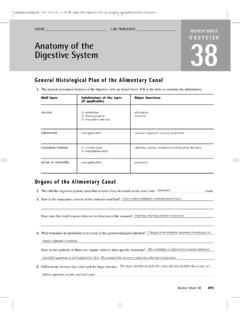
1 digestive : Practice Questions # 1 1. The end products of digestion enter the cells of a vertebrate by the process of A. absorption B. osmosis C. emulsification D. egestion 2. In humans, structures that release digestive secretions directly into the small intestine include both the A. salivary glands and the pancreas B. gall bladder and the lacteals C. villi and the salivary glands D. pancreas and the gall bladder 3. Select the organ, indicated in the diagram, that is most closely associated with the statement. This organ stores bile. A. structure 1 B. structure 2 C. structure 3 D. structure 4 E. structure 5 F. structure 6 4. In a human, the movement of glucose from the digestive tract to muscle cells is most directly a result of A. ingestion and digestion B. absorption and circulation C. anaerobic respiration D.
2 Protein synthesis 5. A student has a hamburger, french fries, and soda for lunch. Which sequence represents the correct order of events in the nutritional processing of this food? A. ingestion digestion absorption egestion B. digestion absorption ingestion egestion C. digestion egestion ingestion absorption D. ingestion absorption digestion egestion 6. The main function of the human digestive system is to A. rid the body of cellular waste materials B. process organic molecules so they can enter cells C. break down glucose in order to release energy D. change amino acids into proteins and carbohydrates 7. Which two systems are most directly involved in providing molecules needed for the synthesis of fats in human cells? A. digestive and circulatory B. excretory and digestive C. immune and muscular D.
3 Reproductive and circulatory 8. Which words best complete the lettered blanks in the two sentences below? Organic compounds, such as proteins and starches, are too A to diffuse into cells. Proteins are digested into B and starches are digested into C. A. A-large, B-simple sugars, C-amino acids B. A-small, B-simple sugars, C-amino acids C. A-large, B-amino acids, C-simple sugars D. A-small, B-amino acids, C-simple sugars 9. The diagram below represents a process that occurs in organisms. Which row in the chart indicates what A and B in the boxes could represent? Row A B A. starch proteins B. starch amino acids C. protein amino acids D. protein simple sugars 10. Experiments revealed the following information about a certain molecule: It can be broken down into amino acids. It can break down proteins into amino acids.
4 It is found in high concentrations in the small intestine of humans. This molecule is most likely A. an enzyme B. an inorganic compound C. a hormone D. an antigen 11. Three days after an organism eats some meat, many of the organic molecules originally contained in the meat would be found in newly formed molecules of A. glucose B. protein C. starch D. oxygen 12. The enzyme pepsin is produced in the cells of the stomach but not in the cells of the small intestine. The small intestine produces a different enzyme, trypsin. The reason that the stomach and small intestine produce different enzymes is that the gene that codes for pepsin is A. in the cells of the stomach, but not in the cells of the small intestine B. expressed in the stomach but not expressed in the small intestine C.
5 Mutated in the small intestine D. digested by the trypsin in the small intestine 13. The pancreas is an organ connected to the digestive tract of humans by a duct (tube) through which digestive enzymes flow. These enzymes are important to the digestive system because they A. form proteins needed in the stomach B. form the acids that break down food C. change food substances into molecules that can pass into the bloodstream and cells D. change food materials into wastes that can be passed out of the body 14. Which two organ systems provide materials required for the human body to produce ATP? A. reproductive and excretory B. digestive and respiratory C. respiratory and immune D. digestive and reproductive 15. Which order of metabolic processes converts nutrients consumed by an organism into cell parts?
6 A. digestion absorption circulation diffusion synthesis B. absorption circulation digestion diffusion synthesis C. digestion synthesis diffusion circulation absorption D. synthesis absorption digestion diffusion circulation 16. Base your answer to the question on the information in the diagram below and on your knowledge of biology. In an autotrophic organism, substance B functions as a A. source of energy B. hormone C. vitamin D. biotic resource Answer Key 1 digestive 1. A 9. C 2. D 10. A 3. E 11. B 4. B 12. B 5. A 13. C 6. B 14. B 7. A 15. A 8. C 16. A