Transcription of DIGITAL SYSTEMS & TECHNOLOGY - cognizant.com
1 Blockchain for power Utilities: A View on Capabilities and Adoption Blockchain networks promise to improve process efficiencies, reduce IT costs and elevate trust across the value chain for utilities that pilot new business models pivoting around shared infrastructure and collaborative 2018 DIGITAL SYSTEMS & TECHNOLOGY2 EXECUTIVE SUMMARYThe utilities landscape is evolving into a distributed and smart power grid. Customers (both residential and business) are leading initiatives toward distributed power generation. Simultaneously, utilities are investing in smart meters and upgrading grid infrastructures to turn the distributed and smart power grid into a reality. In short, the industry faces two fundamental challenges: The rapid move to distributed generation resources, with a focus on sustainability. The penetration of smart devices and appliances such as smart thermostats, electric vehicles, a result of these trends, along with the emergence of service providers focused on consumer empowerment and demand response aggregators, the utilities industry ecosystem is expanding.
2 In response, utilities are exploring new business models and technologies to address challenges to their continued relevance. As the grid expands and becomes more distributed with many disparate stakeholders establishing trust between stakeholders is fundamental to maintaining effective operations. Blockchain, a distributed ledger TECHNOLOGY built on a shared network infrastructure and public key encryption, is one way for utilities to provide a trustworthy and secure platform for distributed grid and smart device usage. While no individual TECHNOLOGY can do it all, it s vital to identify which technologies can help utilities address their current challenges. (For more on what blockchain is and how it works, see Quick Take, page 4.) Blockchain is already proving its ability to provide secure transactions by applying smart contract TECHNOLOGY . With its trustless network, blockchain can also be implemented when establishing trust is a key criteria for the success of the business model.
3 Considering this strength, the banking industry is leading the way with blockchain experimentation, primarily with permissioned, private networks focused on payments, fraud reduction, know your customer compliance and credit management. (For more on this topic, see our white paper Financial Services: Building Blockchain One Block at a Time and visit the blockchain section of our website.) In utilities, blockchain-based TECHNOLOGY (both permissioned and private ledgers) can be applied to numerous processes, such as energy credit management, the promotion of 2 DIGITAL SYSTEMS & TECHNOLOGY | Blockchain for power Utilities: A View on Capabilities and AdoptionIn utilities, blockchain-based TECHNOLOGY (both permissioned and private ledgers) can be applied to numerous processes, such as energy credit management, the promotion of green energy, asset optimization, payments within microgrids, prepaid smart meters and payments to distributed generation asset for power Utilities: A View on Capabilities and Adoption | green energy, asset optimization, payments within microgrids, prepaid smart meters and payments to distributed generation asset owners.
4 These are among the many use cases that industry players are exploring via pilot believe blockchain-based networks can help utilities disintermediate suppliers and even retailers throughout the electricity market. Over time, all import and export electricity meters could be fitted with blockchain nodes, and these meters will be able to plug into a single power exchange to directly transact electricity among themselves. This power exchange would run on top of a more scalable and permissioned blockchain platform, thus creating a more efficient market. Currently, blockchain scalability is a challenge for industry-wide embarking on any IT initiative , including blockchain, however, it is critical to understand the strengths and weaknesses of the TECHNOLOGY and how it can be best applied to solve business challenges and achieve strategic objectives. This whitepaper will evaluate blockchain as a TECHNOLOGY option for streamlining operations, decreasing costs and delivering on the promise of the distributed smart grid.
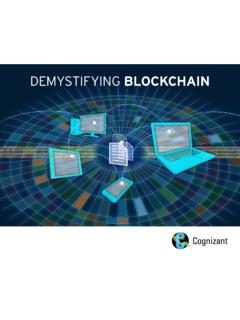
5 It also provides guidance on a framework approach that we believe will enable utilities to move forward with blockchain. 3 DIGITAL SYSTEMS & Technology4| Blockchain for power Utilities: A View on Capabilities and AdoptionDigital SYSTEMS & Technology4 QUICK TAKE Blockchain TECHNOLOGY at a Glance To dispel the confusion surrounding blockchain and the complexity of the TECHNOLOGY , we offer two definitions: (For more details on how blockchain works, also see our e-book Demystifying Blockchain. ) Blockchain is an incorruptible DIGITAL ledger of economic transactions that can be pro-grammed to record not just financial transactions but virtually everything of value. 1 A system in which a record of transactions made in Bitcoin or another cryptocurrency are maintained across several computers that are linked in a peer-to-peer network. 2 Blockchain is only one of many types of distributed ledgers that provide secure, dis-tributed transactions. Bitcoin is currently the largest blockchain network, followed by Ethereum, Bitcoin Cash, Ripple, Dash and has the potential to solve the following common business/IT pain points: Trust: Blockchain eliminates the need for intermediaries and enables direct trans-actions among organizations.
6 It establishes a distributed system that can be trusted inherently. Security: Blockchain ensures superior security for transactions compared with more traditional IT security mechanisms such as firewalls, encryption, intrusion detection SYSTEMS and packet filters. IT infrastructure overhead: Because disparate SYSTEMS today hold different copies of the same data, redundant effort is spent ensuring integration and reconciliation between IT SYSTEMS . Blockchain-based solutions hold the potential to reduce this overhead significantly. Integrated business process implementation challenges: Blockchain could enable the next level of integrated business processes. For example, a metering solution based on blockchain could ensure a meter-to-cash business process without third-party for power Utilities: A View on Capabilities and Adoption | DIGITAL SYSTEMS & TechnologyEXPLORING THE RELEVANCE OF BLOCKCHAIN FOR UTILITY BUSINESS FUNCTIONS To get started with exploring the use of blockchain within their organizations, utilities need to consider how the TECHNOLOGY could enhance business processes across the industry value chain.
7 By comparing and matching utility business process attributes and blockchain TECHNOLOGY capabilities, as well as evaluating the incremental business benefits, utilities can decide on whether blockchain is a viable TECHNOLOGY option for a particular business evaluation process can begin with a detailed business process view linked to incremental cost and benefits related to blockchain usage. This view will help utilities prepare a blockchain adoption s then important to define utility-specific capability levels for blockchain TECHNOLOGY to ensure sys-tematic and logical adoption BLOCKCHAIN CAPABILITY LEVELS FOR THE UTILITY INDUSTRYT here are three broad levels for how blockchain capabilities could meet utility industry requirements, for both permissioned and private ledgers (see Figure 1). These capability levels are defined in terms of distinct TECHNOLOGY attributes, which can drive mainstream utility Blockchain Capability LevelsFigure 1 Utility-Specific Capability LevelCapability DefinitionFlag1.
8 FOUNDATIONAL TECHNOLOGY Tested and proven TECHNOLOGY elements. More than sufficient for utility data security requirements. Ensures data reliability. Ensures process integrity and VIABLE FOR SUSTAINING BUSINESS Lower transaction costs; parity with existing transaction alternatives. Market players agree on interoperability standards. Regulatory compliance. Tested and proven integration with other utility ROBUST AND SCALABLE FOR BUSINESS Capable of serving utility scale of operations. Low cost of hardware and software components. High transaction speed/low completion time. Conformity with data privacy requirements. Achieves lower energy consumption for 1: Foundational TechnologyBlockchain can be viewed as a foundational TECHNOLOGY with great potential for disrupting the existing utilities industry ecosystem. Its core capability is transactional security and reliability, in the form of immutable records. As such, a permissioned blockchain TECHNOLOGY network can be readily adopted for relevant utility processes.
9 Blockchain applications relevant for utilities include: Bill pay: A number of start-up platforms have emerged to solve basic problems related to bill settlement and prepaid recharge of smart meters using cryptocurrencies. An example is Bitconnect-enabled utility bills using Solar renewable energy certificates: Blockchain can be effectively used for authenticating and trading renewable energy credit certificates. SolarCoin is an example of a cryptocurrency earned by generating solar Electric vehicle charging: BlockCharge is a company that s working on blockchain-based charging, authentication and billing for electric Similarly, Innogy enables DIGITAL payments for charging electric vehicles over Ethereum Customer switching: UK-based Electron has built a blockchain-based platform to facilitate faster switching of of these applications rely on blockchain s superior security and transaction traceability ( , vali-dation that parties are who they say they are, without the need for an intermediary).
10 In a traditional utility scenario, utilities must trust the market regulator and balancing/settlement mechanism. Thus, for the existing utility business (small and large), blockchain at a Level 1 capability will not significantly transform the existing business other than impacting financial transactions and customer contract benefits. This fact is equally applicable in regulated and deregulated markets. DIGITAL SYSTEMS & TECHNOLOGY | Blockchain for power Utilities: A View on Capabilities and AdoptionBlockchain can be viewed as a foundational TECHNOLOGY with great potential for disrupting the existing utilities industry for power Utilities: A View on Capabilities and Adoption | Level 2: Viable for Sustaining Business Blockchain (including permissioned, private ledgers) is viable for utilities that can envision a way to overcome the investment and SYSTEMS integration challenges inherent in implementing the tech-nology as a business-critical service. At this level, the traditional utility technologies must coexist with blockchain and drive customer/internal business units to sustain the investments made in the TECHNOLOGY .