Transcription of Direct Speech SmartPrep
1 Direct and indirect Speech ** Direct Speech and indirect Speech are ways people express how something was said. Direct Speech also called quoted Speech is said exactly how the speaker initially spoke the words. indirect Speech also called reported Speech is reported back not using the exact words as the original speaker. Direct Speech Direct Speech also called quoted Speech is said exactly how the speaker initially spoke the words. It is written with quotation marks to indicate the exact words that were used by the original speaker. A comma is used to separate the quoted Speech and the speaker.
2 He said, "I am not finished with the assignment." "I want to break up with you," she told me. indirect Speech indirect Speech also called reported Speech is reported back not using the exact words as the original speaker. It is written without quotation marks because it is not directly quoting word for word. When using indirect Speech the verb tense changes because we are reporting things that have happened in the past. A comma is not used. He said he was not finished with the assignment. She told me that she wanted to break up with me.
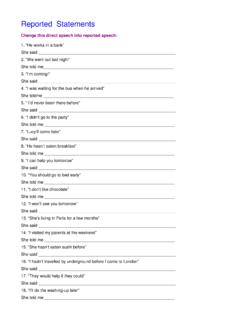
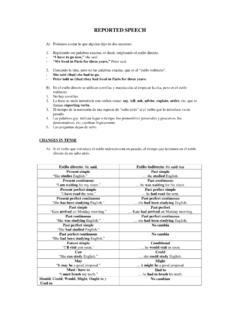
3 Tense Changes When Reporting Speech The verb tense changes when reporting Speech ( indirect Speech ) from a quoted Speech ( Direct Speech ). When using indirect Speech the verb tense changes because we are reporting things that have happened in the past. You do not have to use "that" when reporting Speech . It is optional. more information log on to Speech indirect Speech She said, "I like candy." She said she liked candy. "I am playing baseball," John said. John said he was playing baseball. Carol said, "I lived in England." Carol said that she had lived in England.
4 "I will help them tomorrow," she said. She said that she would help them tomorrow. Mark said, "We were studying all night." Mark said that they had been studying all night." "It has been raining all day," he said. He said that it had been raining all day. Bill told me, "I had been waiting for three hours." Bill told me that he had been waiting for three hours. Joe told me, "We will be joining you on Saturday." Joe told me that they would be joining us on Saturday. Changing Time and Place References Time and place can often change when going from Direct to indirect Speech .
5 When reporting something at a different time, the time word needs to be changed. When reporting something from a different location, the place word needs to be changed. Direct Speech indirect Speech "I went to the park today," he said. He said that he had gone to the park that day. She said, "I saw her yesterday." She said that she had seen her the day before. Kevin said, "I have a doctor's appointment next week." Kevin said that he had a doctor's appointment the following week." "I was in Hawaii last month," Jane told me. Jane told me she had been in Hawaii the previous month.
6 "We had lunch a week ago," she said. She said they had lunch a week before. more information log on to said, "I live in this house." John said that he lived in that house. Stacy said, "I work here." Stacy said she worked there. Reporting Speech Questions Direct Speech questions asking "who", "what", "when", "where", "why", and "how" can be rephrased in indirect Speech format. Question marks are not used in indirect Speech formats. Direct Speech indirect Speech "Who are you talking to?" she asked. She asked me who I was talking to.
7 My mom asked me, "What are you doing?" My mom asked me what I was doing. Craig asked, "When are we leaving?" Craig asked when we were leaving. My dad asked, "Where are you meeting?" My dad asked where we were meeting. My sister asked me, "Why are you so sad?" My sister asked me why I was so sad. "How are you doing?" Jane asked. Jane asked how I was doing. Reporting Speech Yes/No Questions Direct Speech questions asking for "yes" or "no" answers can be rephrased in indirect Speech format. "Yes or no" questions are reformatted by using "if".
8 The format for indirect Speech is "ask + if + clause". Direct Speech indirect Speech He asked, "Do you speak English?" He asked if I spoke English. My mom asked me, "Are you hungry?" My mom asked me if I was hungry. My mom asked, "Have you eaten?" My mom asked if I had eaten. Sally asked, "Can you ride a bike?" Sally asked if I could I ride a bike. John asked, "Is it raining?" John asked if it was raining. more information log on to Verbs Along with "say (said)", "tell (told)", and "ask (asked)", there are many other verbs that can be used to report what someone said.
9 These are some of the most commonly used reporting verbs. The format for these commonly-used reporting verbs is "reporting verb + infinitive (to + verb)". Advise (advised) - to suggest what should be done in a certain situation Beg (begged) - to ask or state in a serious or desperate way for something needed or wanted Demand (demanded) - to say or ask in a strong way Hope (hoped) - to want or desire something to happen Offer (offered) - to say you are willing to do something Order (ordered) - to tell someone what to do in a commanding way Promise (promised) - to make a strong statement saying that you will or will not do something Swear (swore)
10 - to make a strong promise to do or not do something The format for these commonly used reporting verbs is "reporting verb + that + clause". Answer (answered) - to give a reaction to a question Claim (claimed) - to say that something is true Command (commanded) - to give an order or show control over people Comment (commented) - to give an opinion or explanation about something Complain (complained) - to say that you are not happy about something Consider (considered) - to think about Declare (declared) - to say something in a strong and confident manner Demand (demanded) - to say or ask in a strong way Explain (explained)