Transcription of DIVISION OF HEMATOPATHOLOGY - UPMC
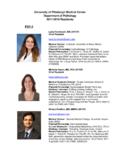
1 DIVISION OF HEMATOPATHOLOGY HEMATOPATHOLOGY FELLOWSHIP HANDBOOK Revised June 2017 SARAH E. GIBSON, DIRECTOR, HEMATOPATHOLOGY FELLOWSHIP PROGRAM ROBYN ROCHE FELLOWSHIP PROGRAM COORDINATOR This handbook can be found at More information about the HEMATOPATHOLOGY fellowship program can be obtained at: The handbook is supplemented by the resident/fellow handbook that can be found at 1 PRINCIPAL FACULTY Steven H. Swerdlow, MD, Director, DIVISION of HEMATOPATHOLOGY Nidhi Aggarwal, MD, General HEMATOPATHOLOGY , Molecular Diagnostics Nathanael G. Bailey, MD, Flow Cytometry, Lymph Node Pathology, Bone Marrow Pathology, Molecular HEMATOPATHOLOGY Grant C. Bullock, MD, PhD, Investigative HEMATOPATHOLOGY , Erythropoiesis, Molecular Cytogenetics Lydia L. Contis, MD, Medical Director, UPMC Shadyside, Hillman Cancer Center and Children s Hospital of Pittsburgh, Hematology Laboratory Sections, and Liaison for Pediatric HEMATOPATHOLOGY Miroslav Djokic, MD, Medical Director, Adult Bone Marrow Service, General HEMATOPATHOLOGY Sarah E.
2 Gibson, MD, Fellowship Program Director, General HEMATOPATHOLOGY , Molecular Cytogenetics Yen-Chun Liu, MD, PhD, MS, General HEMATOPATHOLOGY , Molecular HEMATOPATHOLOGY Sara A. Monaghan, MD, Medical Director, Flow Cytometry Laboratory, General HEMATOPATHOLOGY OTHER MAJOR FACULTY Franklin Bontempo, MD, Director, Institute for Transfusion Medicine Somak Roy, MD, PhD, Assistant Director, Molecular & Genomic Pathology Laboratory Svetlana A. Yatsenko, MD, Director, Pittsburgh Cytogenetics Laboratory Jennifer Picarsic, MD, Pediatric Pathology, Children s Hospital of Pittsburgh 2 TABLE OF CONTENTS HEMATOPATHOLOGY FELLOWSHIP: GENERAL DESCRIPTION AND OVERALL GOALS & OBJECTIVES (COMPETENCY BASED) 4 GENERAL COMPETENCY-BASED EXPECTATIONS FOR HEMATOPATHOLOGY FELLOWS 10 PROGRESSIVE GOALS AND OBJECTIVES BY YEAR OF TRAINING 12 SPECIFIC ROTATIONS AND EXPECTATIONS ADULT BONE MARROW 19 CHECKLIST ADULT BONE MARROW ROTATION BONE MARROW AFTER HOURS PROCEDURE ADULT CLINICAL BONE MARROW PROCEDURES AND HEMATOLOGY/ ONCOLOGY CLINICAL 23 BM ASPIRATE BIOPSY FORM SHADY-IHC ROTATION SCHEDULE LYMPH NODE 27 CHECKLIST LYMPH NODE ROTATION FLOW 31 CHECKLIST FLOW CYTOMETRY ROTATION PEDIATRIC 35 CHECKLIST PEDIATRIC HEMATOPATHOLOGY ROTATION MOLECULAR & GENOMIC 38 CHECKLIST MOLECULAR & GENOMIC PATHOLOGY ROTATION 41 CHECKLIST CYTOGENETICS ROTATION CYTOGENETICS CASE LOG ONCOLOGY REQUISITION LABORATORY 44 CHECKLIST LABORATORY HEMATOLOGY ROTATION HEMOGLOBIN ANALYSIS CASE LOG PB AND FLUID REVIEW CASE LOG 49 FOCUSED HISTIOCYTIC AND DENDRITIC CELL NEOPLASMS AND DISORDERS
3 53 CHECKLIST HISTIOCYTIC AND DENDRITIC CELL NEOPLASMS ROTATION HISTIOCYTIC AND DENDRITIC CELL NEOPLASM ROTATION SCHEDULE 56 IMMUNOHISTOCHEMISTRY ROTATION CHECKLIST IMMUNOHISTOCHEMISTRY STAIN INDEX: (SEE HEMATOPATHOLOGY DEPARTMENT FOR LOGIN) LABORATORY MANAGEMENT AND LABORATORY DECISION 59 ASCP LAB MANAGEMENT UNIVERSITY CHECKLIST HEMATOPATHOLOGY QUALITY IMPROVEMENT PROJECT GUIDELINES 63 HEMATOPATHOLOGY QUALITY IMPROVEMENT PROJECT REPORT FORM 64 SUMMARY OF EVALUATION METHODS 65 PORTFOLIO DESCRIPTION 67 UPMCME EDUCATIONAL POLICIES EXECUTIVE SUMMARY 69 3 FELLOWSHIP PROGRAM POLICIES 74 WEB RESOURCES: GME SITES 75 RESIDENT AND FELLOW ASSISTANCE PROGRAM AND TEST TAKING 75 UNIVERSITY OF PITTSBURGH SCHOOL OF MEDICINE OFFICE OF MEDICAL EDUCATION VIDEO GALLERY 76 4 HEMATOPATHOLOGY Fellowship: General Description of the HEMATOPATHOLOGY Educational Experience The HEMATOPATHOLOGY fellowship at UPMC-Presbyterian is a broad-based experience in all aspects of both clinical and anatomic HEMATOPATHOLOGY .
4 The program stresses a multiparameter approach to both bone marrow and solid tissue diagnostic HEMATOPATHOLOGY combining standard morphologic techniques with data obtained from ancillary immunohistologic, in situ hybridization, flow cytometric, molecular and cytogenetic investigations. Bone marrow sign out includes review of peripheral blood and marrow aspirate smears, marrow histologic preparations and other ancillary studies. The fellowship includes educational experiences in the following specific areas: adult bone marrow sign out, adult clinical bone marrow procedures, lymph node (and related tissue) pathology, flow cytometry, pediatric HEMATOPATHOLOGY , molecular & genomic pathology, cytogenetics, laboratory hematology, coagulation, histology and immunohistochemistry, and laboratory management and decision making. The precise duration of each rotation is flexible. Laboratory management and decision making is primarily a component of the laboratory-based rotations.
5 After the first two months, fellows also participate in the on-call schedule (with faculty back-up). The fellow is expected to actively participate in a variety of HEMATOPATHOLOGY teaching conferences. The fellow is also expected to participate in the informal and more formal teaching of medical students, pathology and non-pathology residents, hematology/oncology fellows, and medical technologists. He/she will also interact with hematologists, oncologists, and other interested clinicians. Fellows are expected to undertake at least one investigational project and are strongly encouraged to present at national meetings. Fellows are also expected to complete a Quality Assurance/Quality Improvement project. Fellows are expected to perform marrow aspirates and biopsies in the Internal Medicine Hematology Section. Conferences include a HEMATOPATHOLOGY Case Conference (weekly), a Patient Safety and Risk Management conference that alternates with a Journal Club (weekly), a Molecular & Genomic Pathology/ HEMATOPATHOLOGY Conference (monthly), a Pediatric HEMATOPATHOLOGY Slide Conference (approximately 2 weeks per month), a Pediatric Leukemia Tumor Board (monthly), an adult Hematologic Malignancy Conference (2 weeks per month), and other departmental AP or CP oriented conferences.
6 Fellows will also take advantage of multiple interactive electronic, web-based resources to access information, including laboratory information systems, on-line radiology image resources, and literature searches. Levels of responsibility (see HEMATOPATHOLOGY Progressive Goals and Objectives [Milestones] chart that follows): Because fellows will come to the program with a variable level of experience and because those from outside UPMC will not be familiar with many logistical aspects of our practice, it is expected that fellows will progress through the graded responsibility described for resident trainees, but at a more rapid pace, and progress to a level as indicated in the chart that exceeds that of a senior resident. The following 6 sections describe the general goals and objectives for the overall fellowship program in relation to the six core competencies as defined by the American Council on Graduate Medical Education (ACGME).
7 Goals and expectations that would be specific to individual rotations are further described in the rotation specific 5 descriptions that follow this section. Patient Care Goal Fellows must develop diagnostic competence to provide for effective patient care. Competencies (See also specific rotation descriptions.) 1. Demonstrate diagnostic decision-making skills appropriate to his/her level of training. 2. Manage appropriate laboratory staff. 3. Demonstrate ability to triage testing as to importance or urgency in a cost-effective and appropriately time-sensitive manner. Objectives (See also specific rotation descriptions.) 1. Construct appropriate written reports in language that other physicians, especially surgeons and oncologists, will understand. 2. Demonstrate ability to order appropriate ancillary testing through ancillary laboratories and HEMATOPATHOLOGY staff.
8 3. Order testing on a STAT basis when appropriate for patient care and/or limit testing to those studies needed to make the most specific diagnosis by current guidelines. Medical Knowledge Goal Fellows must demonstrate knowledge of established and evolving aspects of HEMATOPATHOLOGY diagnostic testing and state of the art HEMATOPATHOLOGY diagnosis and classification. Competencies (See also specific rotation descriptions.) 1. Demonstrate knowledge of the normal hematopoietic and lymphoid systems. 2. Demonstrate knowledge of both neoplastic and non-neoplastic disease entities that predominantly affect the hematopoietic/lymphoid systems. 3. Demonstrate an ability to apply this knowledge in varied clinical settings. Objectives (See also specific rotation descriptions.) 1. Obtain an acceptable score on written practical examinations, including those administered within the DIVISION (with score of competent) and the ASCP Fellow In-service examination (score above the 25th percentile).
9 2. Demonstrate an acceptable level of performance during daily sign-out activities, as assessed by milestone evaluations and multisource evaluations. 3. Demonstrate ability to decide what type of testing is needed to limit the differential diagnoses in most cases. Practice-Based Learning and Improvement Goal Fellows must be able to evaluate and adopt new knowledge as changes demand. This includes the development or refinement of skills that will be used long after fellowship training has ceased. Competencies Identify strengths, deficiencies and limits in one s knowledge and expertise. Systematically analyze practice, using quality improvement methods, and 6 implement changes with the goal of practice improvement Locate, appraise and assimilate evidence from scientific studies related to HEMATOPATHOLOGY . Use information technology to optimize learning Participate in the education of medical students, residents and other healthcare professionals, as documented by evaluations of a fellow s teaching abilities by faculty and/or learners.
10 Objectives 1. Demonstrate ability to search the medical literature to answer medically related questions that arise in daily practice. 2. Appropriately utilize available texts and self-learning resources, such as study sets, etc. 3. Construct and complete a quality improvement project with appropriate guidance. 4. Demonstrate ability to critically evaluate original publications at journal clubs, other conferences, and in the evaluation of diagnostic cases. 5. Demonstrate progression in skill level, as assessed on bi-annual review with fellowship director 6. Demonstrate effective and knowledgeable case presentation(s) at divisional conferences. 7. Demonstrate ability to perform appropriate biomedical literature searches through available electronic tools (example: Pub Med search). 8. Demonstrate ability to teach residents, students, and fellows from other departments while on-service.