Transcription of Do Rapid Response Teams Work? - ZOLL
1 Page | 1 Do Rapid Response Teams work ? Sheri Villanueva-Reiakvam, RN Introduction Do Rapid Response Teams work ? Broadly, yes. More accurately, yes .. but not in a vacuum. How can this be stated with such certainty while still being highly controversial? The proof is in the results achieved at the University of San Diego Medical Center (UCSD). In 2007, UCSD implemented an innovative program called Advanced Resuscitation Training, or ART. ART takes a new approach to resuscitation and thus Rapid Response by creating a framework that includes thorough training and defined roles and responsibilities for health care providers.
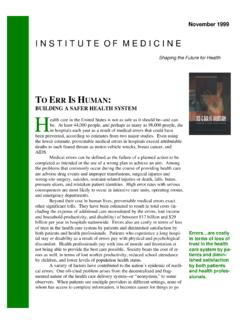
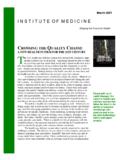
2 Challenges and obstacles to success are tackled head-on through the use of data, education, debriefing, and the principles of cognitive psychology. This edition of Code Communications will explore the history of Rapid Response programs, some of the hurdles hospitals face when trying to execute a successful Rapid Response system, and how UCSD has overcome these challenges and the corresponding improvement in patient survival. History of Rapid Response Systems In November 1999, The Institute of Medicine (IOM) published an alarming report called, To Err is Human: Building a Safer Health System (Figure 1), looking at the state of the health care system.
3 An IOM committee concluded that in the United States at least 44,000 people, and perhaps as many as 98,000, die in hospitals each year as a result of preventable medical 1 To Err Is Human The authors of the report suggested that these preventable medical errors cost between $17 billion and $29 billion per year nationwide. It was with the launch of the 100,000 Lives Campaign in 2005, by the non-profit Institute for Healthcare Improvement (IHI), that the term Rapid Response team (RRT) became commonplace within hospitals throughout the United States.
4 The goal of the campaign was to significantly reduce morbidity and mortality in American health care, as identified by the IOM report. More specifically, the IHI tried to answer the question, Could the implementation of proven best practices in hospitals throughout the country save 100,000 lives from unnecessary medical injuries in 18 months? The answer was a resounding yes. On June 14, 2006, the IHI announced that in the 18-month time frame, more than 122,300 lives were While the validity and data collection methods of this initiative have been called into question, the IHI was successful in drawing attention to the value of the role of a Rapid Response team and the potential benefits obtained by implementing an early responder system.
5 The publication of the Joint Commission National Patient Safety Goals in 2008 reinforced the need for a team of specially trained responders. Specifically, Goal 16 stated, Improve recognition and Response to Page | 2 changes in a patient s condition. The organization selects a suitable method that enables health care staff members to directly request additional assistance from a specially trained individual(s) when the patient s condition appears to be worsening. 3 While these guidelines did not require RRTs or mandate how they should be put into clinical practice, by 2008 the majority of hospitals in the United States had established a Rapid Response program.
6 This trend has continued globally, with hospitals in Canada, Australia, and the United Kingdom instituting some form of RRT, also known as a medical emergency team (MET). Utilization of RRTs The premise of the RRT is to assess a greater number of hospitalized patients at an earlier stage of clinical deterioration, with the aim of preventing cardiac arrest and other serious adverse events. The term, failure to rescue was coined in the 1990s by Jeffrey Silber, MD as a way to characterize patients who could potentially have been rescued if health care providers had responded earlier or differently.
7 The Rapid Response team aims to eliminate failure-to-rescue events from taking place. The team is trained to intervene during the critical period when the patient is presenting early warning signs, such as change in vital signs, but has yet to progress to a serious adverse event. Unpublished data from UCSD have documented that Rapid Response criteria are present in 80% of non-ICU in-patient arrests, with a median duration of five hours prior to loss of vital signs. Similar findings were published in the Journal of the American Medical Association (JAMA); in this study, researchers concluded that adult patients often exhibit detectible physiological changes up to eight hours before a cardiopulmonary If a health care provider notices these early warning signs and activates the RRT, the team can then appropriately assess, treat, and triage the patient prior to a code.
8 Because of the structure and reduction in patient monitoring, the Rapid Response team usually responds to patients on general medical or surgical wards. Rapid Response Teams may be confused with a Code Blue team ; however, there is a fundamental difference between the two. Table 1 compares the differences between a code team and a Rapid Response Traditionally, the Code Blue team is called for patients that are unresponsive, lacking a pulse, and/or loss of vital signs. A Rapid Response team intervenes when there has been a sudden change in the patient s condition.
9 Most institutions have a list of criteria that indicate when a health care provider, or in some instances a family member, should activate the RRT. Page | 3 Table 1 Traditional Code team versus Rapid Response team Jones D, et al. The New England Journal of Medicine. 2011;365:139-146. The construct of an RRT is dependent on hospital protocol; however, all Rapid Response systems utilize the same basic principles, typically thought of as four limbs: an afferent limb, an efferent limb, a quality improvement limb, and an administrative limb.
10 The afferent component is designed to identify clinical deterioration in patients and trigger a Response . This includes assessing the patient, identifying the personnel who trigger the system activation, determining the mechanism of activation, calling the Rapid Response team , and collecting pertinent data. The efferent limb is the Response to the activation, including both the personnel and equipment brought to the patient. The efferent limb can also be included in the patient safety and quality improvement limb. The goal is to provide specific feedback from the collecting and analyzing of Rapid Response and code data in order to improve Response , make changes to processes, and initiate education initiatives.