Transcription of Document Review: Centers for Medicare and …
1 Document review : Centers for Medicare and Medical Service (CMS) What Do I Need to Do to Assess personnel Competency? Assessment of lab personnel performing clia approved tests Olive Sturtevant & Andrew Patmos, Dana Farber Cancer Institute, Boston, MA, USA This Document was prepared for presentation to the AABB Cellular Therapies Quality Operations subsection for discussion among its members . It is not intended to be all-inclusive, relied upon as legal advice, representative of any specific business need or product, or to guide, direct or advise staff or procedures, or to be used for any other purpose.
2 AABB expressly disclaims any liability for any damage or loss that may arise from relying upon or using information contained in this presentation. Introduction: Clinical Laboratory Improvement Amendments ( clia ) The Centers for Medicare & Medicaid Services (CMS) regulates all laboratory testing (except research) performed on humans in the through the Clinical Laboratory Improvement Amendments ( clia ). In total, clia covers approximately 225,000 laboratory entities. The Division of Laboratory Services, within the Survey and Certification Group, under the Office of Clinical Standards and Quality (OCSQ) has the responsibility for implementing the clia Program.
3 The objective of the clia program is to ensure quality laboratory testing. REFERENCE: The authors reviewed the CMS Document . Their presentation covers the requirements for laboratory tests covered under clia . This presentation is focused on the CMS Document , please note your accrediting agency (Joint Commission or CAP for clia ) may have additional / more stringent requirements For the clia licensed Quality Control (QC) lab for cell processing (represented by these speakers) Sterility, CD34 and cell counts are required on their clia certificate.
4 CD34 is done as Peripheral Blood CD34 to determine if a donor should or should not be apheresed. The latter part of the presentation describes how the lab has incorporated / implemented the regulations into their training and assessment program clia Definition of Covered Tests Under clia , if one tests or examines human specimens and reports patient-specific results for the diagnosis, prevention or treatment of any disease or impairment, or the assessment of the health of individual patients/ human beings; then the tests do fall under clia .
5 Test system means the instructions and all of the instrumentation, equipment, reagents, and supplies needed to perform an assay or examination and generate test results Given this, performing Quality Control (QC) laboratory tests for the quality assessment of Cell Therapy (CT) Products are not covered. (May be different if your CT products ( , cord blood) are licensed. The exception is sterility cultures, since the reporting of a positive find may lead to the treatment of a Donor/patient). Cell Processing Quality Control Lab (Dana Farber Cancer Institute) Our clia certificate is for: Immunology (Peripheral blood CD34 to assess qualification for apheresis ) Microbiology (sterility cultures on products) Results of product sterility cultures are reported to the physicians and positive findings may lead to the treatment of a Donor/patient Hematology (TNC used for percentage method of CD34 tests) Competency vs.
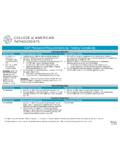
6 Proficiency Competency assessment Confirms Lab personnel can adequately perform laboratory duties Proficiency Testing Assesses the laboratory s ability to perform accurate and reliable testing of unknown samples Competency Assessment Training and personnel evaluation is not the same as competency assessment Competency is application of knowledge, skills and behaviors of performance after staff has been trained Six methods must be used Assess testing personnel for all clia required lab tests performed Frequency Semi-annually in the first year Annually thereafter Any time a method or instrument changes prior to reporting results 6 Methods for Assessment of clia Competency Direct observation Monitoring recording and reporting of results review of intermediate test results Direct observation of instrument maintenance and function
7 Checks Assessment of test performance Assessment of problem solving skills Which personnel ? Clinical Consultant (CC)* Technical Consultant (TC)* Technical Supervisor (TS)* General Supervisor (GS)* Testing personnel Lab Director *In addition to the six required assessments for testing performed, must also assess for competency based on their federal regulatory responsibilities Who is required to have a competency assessment? Documented competency assessment is required for individuals fulfilling the following personnel responsibilities outlined in Subpart M of the clia regulations: clinical consultant (CC), technical consultant (TC), technical supervisor (TS), general supervisor (GS) and testing personnel (TP).
8 Clinical consultants, technical consultants, technical supervisors, and general supervisors who perform testing on patient specimens are required to have the six required procedures in their competency assessment in addition to a competency assessment based on their federal regulatory responsibilities. Note: If the laboratory director (LD) is the only individual testing and reporting test results, (s)he must establish and Document a minimal level of proficiency in order to ensure that (s)he maintain the required competency for accurate and reliable testing and reporting.
9 Responsible Party for Performing the Assessment Moderate Complexity Technical Consultant High Complexity Technical Supervisor Delegate in writing to a General supervisor Peer Testing personnel (TP) cannot be designated to perform competency assessment if they do not qualify as General Supervisor (GS), Technical Consultant (TC), Technical Supervisor (TS) Lab Director ultimately responsible Who is responsible for performing the competency assessment? The Technical Consultant for moderate complexity testing (42 CFR (b)(8)) is responsible for performing and documenting competency assessments.
10 The competency assessments may also be performed by other personnel who meet the regulatory qualification requirements for TC for moderate complexity testing. The Technical Supervisor for high complexity testing (42 CFR (b)(8)) is responsible for performing and documenting competency assessments. This responsibility can be delegated, in writing, to a General Supervisor as long as the GS meets the regulatory qualifications as a GS for high complexity testing. Peer testing personnel who do not meet the regulatory qualifications of a TC, TS, or GS cannot be designated to perform competency assessments.