Transcription of DOE-I Basic Design of Experiments - nutek-us.com
1 Complimentary Copy: DOE-I Basic Design of Experiments (The Taguchi Approach) Nutek, Inc. Quality Engineering Seminar and Software Bloomfield Hills, MI, USA. Target Mean Target Page 2 Nutek, Inc. All Rights Reserved Basic Design of Experiments (Taguchi Approach) Version: 080617 DOE-I Basic Design of Experiments Presented By Nutek, Inc. 3829 Quarton Road Bloomfield Hills, Michigan 48302, USA. Phone and Fax: 248-540-4827 Web Site: , E-mail: N O T I C E All rights reserved. No part of this seminar handout may be reproduced or transmitted in any form or by any means, electronically or mechanically including photocopying or by any information storage and retrieval system, without permission in writing from NUTEK, INC. For additional copies or distribution agreement, contact: Nutek, Inc.
2 Page 3 Nutek, Inc. All Rights Reserved Basic Design of Experiments (Taguchi Approach) Version: 080617 Course Overview Design of experiment (DOE) is a powerful statistical technique for improving product/process designs and solving production problems. A standardized version of the DOE, as forwarded by Dr. Genichi Taguchi, allows one to easily learn and apply the technique product Design optimization and production problem investigation. Since its introduction in the in early 1980 s, the Taguchi approach of DOE has been the popular product and process improvement tool in the hands of the engineering and scientific professionals. This seminar will cover topics such as: Orthogonal arrays, Main effects, Interactions, Mixed levels, experiment planning, etc. Participants in this seminar learn concepts with practice problems and hands-on exercise. The goal of the seminar discussion will be to prepare the attendees for immediate application of the experimental Design principles to solving production problems and optimizing existing product and process designs.
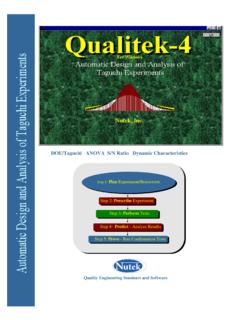
3 The afternoon of the third day of the class will be dedicated to demonstrating how Qualitek-4 software may be used to easily accomplish experiment Design and analysis tasks. Outline Overviews Standard experiment Designs Basic principles of DOE and orthogonal arrays Experiments Simple example showing experiment planning, Design , and analysis of results experiment planning steps Interaction Studies Understanding interactions Scopes of interaction studies and its effect on experiment Design Designing experiment to study interaction & Effect of interaction on the conduct of experiment Analyses for presence and significance of interaction Corrective actions for significant interactions Mixed Level Factor Design Upgrading & Downgrading column levels Scopes of array modifications Factor level compatibility requirements & Combination designs Design and Analysis Tasks using Software experiment designs Analysis tasks Principal Instructor s Background Ranjit K.
4 Roy, , (Mechanical Engineering, president of NUTEK, INC.), is an internationally known consultant and trainer specializing in the Taguchi approach of quality improvement. Dr. Roy has achieved recognition for his down-to-earth style of teaching of the Taguchi experimental Design technique to industrial practitioners. Based on his experience with a large number of application case studies, Dr. Roy teaches several application-oriented training seminars on quality engineering topics. Dr. Roy began his career with The Burroughs Corporation following the completion of graduate studies in engineering at the University of Missouri-Rolla in 1972. He then worked for General Motors Corp. (1976-1987) assuming various engineering responsibilities, his last position being that of reliability manager. While at GM, he consulted on a large number of documented Taguchi case studies of significant cost savings.
5 Dr. Roy established his own consulting company, Nutek, Inc. in 1987 and currently offers consulting, training, and application workshops in the use of Design of Experiments using the Taguchi approach. He is the author of A PRIMER ON THE TAGUCHI METHOD - published by the Society of Manufacturing Engineers in Dearborn, Michigan and of Design of Experiments Using the Taguchi Approach: 16 Steps to Product and Process Improvement published (January 2001) by John Wiley & Sons, New York. He is a fellow of the American Society for Quality and an adjunct professor at Oakland University, Rochester, Michigan. Page 4 Nutek, Inc. All Rights Reserved Basic Design of Experiments (Taguchi Approach) Version: 080617 SEMINAR SCHEDULE Design of Experiments Using Taguchi Approach DOE- I y Introduction y The Taguchi Approach to Quality Engineering y Concept of Loss Function y Basic Experimental Designs y Designs with Interactions y Application Examples y Basic Analysis y Designs with Mixed Levels and Interactions y Column Upgrading y Column Degrading y Combination Design DOE-II y Robust Design Principles y Noise Factors and Outer Array Designs y S/N Ratio Analysis y Learning ANOVA through Solved Problems y Computation of Cost Benefits Using LOSS FUNCTION y Manufacturer and Supplier Tolerances y Brainstorming for Taguchi Case Studies y Design and Analysis Using Computer Software y Group Reviews y Computer Software (Qualitek-4) Capabilities y Dynamic Systems y Class Project Applications y Project Presentations General Reference Taguchi, Genichi.
6 System of Experimental Design , UNIPUB Kraus Intl. Publications, White Plains, New York, 1987 Roy, Ranjit: Design of Experiments Using the Taguchi Approach: 16 Steps to Product and Process Improvement, John Wiley ISBN: 0471361011 INTERNET: For general subject references (Taguchi + Seminar + Software + Consulting + Case Studies + Application Tips), try search engines like Yahoo, Lycos, Google, etc. For Nutek products, services, and application examples, visit: Qualitek-4 Page 5 Nutek, Inc. All Rights Reserved Basic Design of Experiments (Taguchi Approach) Version: 080617 Table of Contents Section Headings Page# Module-1: Overview and Approach Role of DOE in Product Quality Improvement What is The Taguchi Approach and who is Taguchi? 1-1 1-3 New Philosophy and Attitude Toward Quality New Ways to Work Together for Project Applications New Definition for Quality of Performance New Way for Quantification of Improvement (The Loss Function) New Methods for experiment Design and Analysis Seminar Objectives and Contents Key Points in the Taguchi Approach 1-5 1-7 1-8 1-9 1-13 1-16 Review Questions 1-17-18 Module-2: Experiments Using Standard Orthogonal Arrays Basic Concept in Design of Experiments (DOE) experiment Designs with 2-Level Factors Full Factorial experiment Design With Seven 2-Level Factors Sample Demonstration of experiment Design and Analysis Example 1.
7 Plastic Molding Process Study Steps for experiment Planning (Brainstorming) Results with Multiple Criteria of Evaluation experiment Designs with Larger Number of Factors Common Terms and their Definitions Accuracy of Orthogonal Array Experiments (An Empirical Verification) Learning Check List and Application Tasks 2-1 2-4 2-9 2-10 2-17 2-17 2-24 2-29 2-30 2-32 2-33 Review Questions Practice Problems 2-35 2-42-50 Module-3: Interaction Studies Understanding Interaction Effects Among Factors Identification of Columns of Localized Interaction Guidelines for experiment Designs for Interaction Studies Steps in Interaction Analysis Prediction of Optimum Condition with Interaction Corrections 3-1 3-6 3-9 3-10 3-16 Review Questions Practice Problems 3-18 3-22-28 Module-4: experiment Designs with Mixed Level Factors Modification of Standard Orthogonal Arrays Upgrading Three 2-Level Columns to 4-Level Column Downgrading Columns Incompatible Factor Levels Combination Design (Special Technique) 4-1 4-2 4-6 4-10 4-11 Review Questions Practice Problems 4-13 4-19-22 (Modules 5, 6 & 7 are part of DOE-II Seminar) Module-8: Application Steps Description of Application Phases Considerations for experiment Planning (Brainstorming) Opportunities for the Overall Evaluation Criteria (OEC) Attributes of Taguchi Approach and Classical DOE Application and Analysis Check List 8-1 8-2 8-4 8-6 8-7 Review Questions & Practice Problems 8-8-8-11 Reference Materials (Appendix): Arrays, TT, References, Application Guidelines, Case Study, Answers, Course Evaluation, etc.
8 A-1-23 Page 6 Nutek, Inc. All Rights Reserved Basic Design of Experiments (Taguchi Approach) Version: 080617 Things you should learn from discussions in this module: Where DOE fits into quality improvement efforts. How is Taguchi approach relates to DOE What did Dr. Genechi Taguchi introduce that is new? How is quality defined by Taguchi and what is the approach to achieve performance improvement? Overview Slide ContentsNutek, Inc. Acceptance Sampling - 1910s Economic Control of Quality of manufcd. products - 1920s Design of Experiments (DOE) - 1930s Statistical quality control - 1940s Management by objectives - 1950s Zero Defects - 1960s Participative problem solving, SPC, and quality circle - 1970s Total quality control (TQM)History of Quality Activities Nutek, Inc. Module-1 DOE Fundamental, Overview and Approach There are a number of statistical techniques available for engineering and scientific studies.
9 Taguchi has prescribed a standardized way to utilize the Design of Experiments (DOE) technique to enhance the quality of products and processes. In this regard it is important to understand his definition of quality, the method by which quality can be measured, and the necessary discipline for most application benefits. This module presents an overview of Taguchi s quality improvement methodologies. Things you should learn from discussions in this module: What is DOE and why is the name Taguchi associated with it? What s new in the Taguchi version of DOE? Why should you learn it and how you and your company may benefit from it? What will this course cover? Role of DOE in Product Quality Improvement Before starting to learn the technique, it is important to have an understanding of what the technique is all about and how you can benefit your company products and processes from it.
10 Design of Experiments (DOE) is among the many techniques used in the practice of quality improvement. Historically, individually, or as part of the package, several techniques have been popular in the industry. Today, use of most tools and techniques known are employed under one or many names. Page 7 Nutek, Inc. All Rights Reserved Basic Design of Experiments (Taguchi Approach) Version: 080617 Where does DOE fit in the bigger Nutek, Inc. Source of Topic Titles Nutek, Inc. Disciplines like Six Sigma, TQM, ISO 9000, QS-9000 are common disciplines employed by businesses today. DOE, SPC, FME are special technical skills needed to accomplish the objectives of the any of the disciplines adopted by a company. Often, the quality disciplines employed (the umbrella) change over time, but the supporting techniques do not.