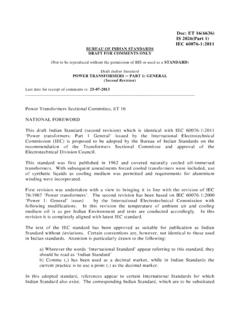
Transcription of Draft for Comments Only Draft Indian Standard …
1 1 Draft for Comments Only Draft Indian Standard LOW pressure regulators FOR USE WITH liquefied petroleum GAS (LPG) specification (Second Revision of IS 9798) ICS ; _____ Not to be reproduced without the permission of Last date for receipt of BIS or used as a Standard Comments is: 31 October 2008 _____ FOREWORD Adoption clause will be added later on. This Indian Standard was first published in 1981 and revised in 1995. Since then many suggestions were received for its improvement and with the result Amendments to 3 were issued. This Standard is revised to incorporate the amendments issued and the suggestions received from time to time. In this revision following modification has been incorporated: i) Figures for outlet threaded connection incorporated; ii) Material clause has been modified, and iii) Number of cycles in cycle test modified iv) Requirements for excess flow valve incorporated; v) Strength test incorporated; In the preparation of this Standard considerable assistance has been derived from EN 12864:2001 Low pressure non adjustable regulators having a maximum pressure of less than or equal to 200 m bar with a capacity of less than or equal to 4 kg/h and their associated safety devices for butane, propane or their mixtures The quantities in this Standard have been expressed in technical metric units.
2 However, in view of the introduction of International System (SI) units in the country, the relevant SI units and corresponding conversion factors are given below for guidance: 1 kgf/cm2 = 5 kPa (kilopascal) = 10 m of Water column (WC) = 665 MPa (megapascal) = 665 bar 1 Pa = 1 N/m2 Pressures indicated in the various requirements/clauses of this Standard are gauge pressure unless otherwise stated. For the purpose of deciding whether a particular requirement of this Standard is complied with, the final value, observed or calculated, expressing the result of a test or analysis, shall be rounded off in accordance with IS 2:1960 Rules for rounding off numerical values ( revised ) . The number of significant places retained in the rounded off value should be the same as that of the specified value in this Standard .
3 Doc: ME 16(0980)c August 2008 2 1 SCOPE This Standard specifies materials, construction, performance and testing requirements for low pressure single or two stage regulators and automatic change-over devices for use with liquefied petroleum gas mixtures in vapour phase up to [50gf/ cm2 or 500mm water column (WC)] outlet pressure . Note - Low pressure is considered to be any pressure below ( ). Domestic and commercial appliances normally operate at gas pressure of kN/m2 (30 gf/cm2 or 300mm water column). 2 REFERENCES The standards given in Annex A contain provisions, which through reference in this text, constitute provisions of this Standard . At the time of publication, the editions indicted were valid. All standards are subject to revision and parties to agreements based on this Standard are encouraged to investigate the possibility of applying the most recent editions of the standards indicated at Annex A.
4 3 TERMINOLOGY Commercial Butane A hydrocarbon product composed predominantly of butanes (n and iso), butylenes or their mixtures of maximum vapour pressures 980 kPa (10 kgf/cm2 ). Commercial Butane/Propane Mixture A hydrocarbon product composed predominantly of a mixture of butanes (n and iso) and/or butylenes with propane, and/or propylene of Max vapour pressure of 1653 kPa ( kgf/cm2). Commercial Propane A hydrocarbon product composed predominantly of a mixture of propane, propylene or their mixtures of maximum vapour pressure of 2548 kPa. (26 kgf/cm2). Lock-up pressure The outlet pressure of the regulator under no-flow conditions, which shall be achieved within 60 s after cessation of flow, with the inlet pressure to the regulator remaining on. Nominal outlet pressure The basic rated outlet pressure desirable in a regulator set at 50 percent rated capacity at a specific inlet pressure .
5 The nominal outlet pressure rating for domestic regulator is kN/m2 (30gf/cm2 or 300 mm water column). Rated capacity The Standard rated capacity for LPG regulators for domestic use is up to 500l/h of LPG vapour. For purpose other than domestic, higher capacity regulators could be used. For 3purposes of performance tests, the flows are rated in terms of percentages of rated capacity, so as to cover all low pressure whatever the rated capacity. Single Stage Regulator Regulator in which the reduction of inlet pressure down to the desired regulated outlet pressure is achieved in one stage only. Two Stage regulators In this configuration, the inlet pressure is reduced to the desired outlet pressure is two stages by an arrangement in the same regulator only. The first stage regulation governs the reduction of the inlet pressure to an intermediate pressure and the second stage regulation governs the reduction of this intermediate pressure to the desired outlet pressure .
6 Both stages may be incorporated in one body. Automatic Changeover Device A device to ensure continuity of gas supply where a reserve gas supply is brought into use automatically when the service gas supply is exhausted. This may or may not incorporate a second stage regulation. Note A typical automatic changer over device is illustrated in Fig. 1A. Indicators An indicator shall be fitted to show when the supply cylinder(s) or vessel(s) is empty and the reserve supply is being used. Non return valve shall be fitted to the inlet of automatic changeover device to prevent possible discharge of gas when changing cylinders. The arrangement shall be such that it cannot readily be disconnected from the device when changing cylinders. When pressure tested against the direction of flow, maximum leakage rates shall not exceed 4N mm3/s at Standard temperature and pressure .
7 The test shall be carried out at the following pressures: a) at kgf/cm2 minimum pressure ; and b) at 20 kgf/cm2 maximum pressure . 4 MATERIAL All component parts shall be manufactured from or be treated with materials compatible with LPG as well as be unaffected by chemical or thermal influences that may be encountered in normal use. Brass parts shall not be susceptible to season cracking. The susceptibility to season cracking shall be determined by the method in IS 2305. The body for all regulators of rated capacity 1000 l/h shall be manufactured from alloys of zinc by pressure die-casting. Chemical composition of material shall conform to IS 742. Doc: ME 16(0980)c August 2008 4 Finish The body and the cover of the regulator shall be electroplated or chemically treated (surface passivated) and painted or powder coated so as to resist the effect of atmospheric conditions to which the pressure regulator is exposed during its working life.
8 The type of finish shall be as agreed between the manufacturer and the customer. The surface finished components shall be subjected to test for corrosion resistance as per IS 9844. The criteria of acceptance after the test shall be the rating number as given in 6 of IS 6009. The painted or powder coated surfaces shall be tested for adhesion of paint by the method described in Annex H. Diaphragm Material The material of diaphragm shall be of synthetic rubber or other material equally suitable for the application and shall satisfy the following requirements. The material shall be free from porosity, pits and foreign particles and shall have a smooth, non-tacky surface with minimum talc or bloom. The material shall not show changes of more than 10 IRHD when subjected to ageing of 72 h at 70oC in accordance with the method prescribed in 3 or 4 of IS 3400 (Part 4).
9 Note For guidance purpose, comparison of Shore A and IRHD hardness are given below: Shore A 30 40 50 60 70 80 90 100 IRHD 50 70 80 100 The material shall be compatible of withstanding a clamping pressure of 490 kPa (5 kgf/cm2) whereby the material itself or the substance with which the fabric layer has been impregnated shall not be pressed away, flowed away or be bruised of otherwise damaged. The material shall be such that when an assembled regulator is subjected to the test as specified in Annex C, the diaphragm shall not pull out or burst at a pressure less than 275 kPa ( kgf/cm2) The material shall, after immersion In pentane of commercial LPG for 72 h, meet the appropriate requirements specified in Annex D.
10 Changes in hardness, before and after the immersion shall not exceed 15 IRHD [see IS 3400 (Part 2)]. Note The tests at to are work batch tests. On initial selection of a diaphragm material, it shall also be tested in commercial LPG in vapour phase for 72 h and shall not show a weight loss or volume change greater than 15 percent. The material shall be such that the flexibility of the diaphragm shall not be impaired after the samples of the same have recovered completely to ambient temperatures from cooling to -20oC or heating to 65oC. For these tests, assembled regulators are cooled to -20oC or heated to 65oC and maintained at these temperatures for 10 min and then kept in atmosphere to recover completely to ambient temperature of its own (not by induced heating or cooling). After recovery, the setting and performance readings are taken.