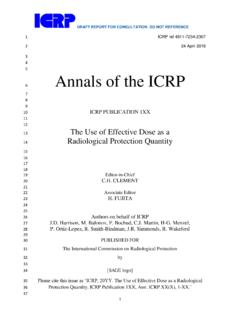
Transcription of DRAFT REPORT FOR CONSULTATION: DO NOT …
1 DRAFT REPORT FOR CONSULTATION: DO NOT REFERENCE 1 ICRP ref: 4828-8896-6249 13 June 2018 Annals of the ICRP ICRP PUBLICATION 1XX Radiological Protection in Therapy with radiopharmaceuticals Editor-in-Chief CLEMENT Associate Editor H. FUJITA Authors on behalf of ICRP PUBLISHED FOR The International Commission on Radiological Protection by [SAGE logo] Please cite this issue as ICRP, 20YY. Radiological Protection in Therapy with radiopharmaceuticals . ICRP Publication 1XX, Ann. ICRP XX (0). DRAFT REPORT FOR CONSULTATION: DO NOT REFERENCE 2 CONTENTS Editorial .. 3 ABSTRACT .. 4 PREFACE .. 5 MAIN POINTS .. 7 GLOSSARY .. 8 1. INTRODUCTION .. 12 2. RADIOPHARMACEUTICAL THERAPY METHODS: JUSTIFICATION AND OPTIMISATION .. 14 Introduction .. 14 Treatment of Hyperthyroidism and Other Benign Thyroid Conditions .. 15 Treatment of Differentiated Thyroid Cancer.
2 17 Treatment of Polycythaemia Vera and Essential Thrombocythaemia .. 20 Treatment of Skeletal Metastases .. 21 Treatment of Neuroblastoma in Children and Young Adults .. 24 Treatment with Radiolabelled Peptide Receptor .. 25 Radioimmunotherapy .. 28 Intra-arterial Treatment of Hepatocellular Carcinoma and Liver Metastases (Selective Internal Radiation Therapy: SIRT).. 31 Treatment of Arthritis (Radionuclide Synovectomy) .. 33 3. BIOKINETIC DATA 35 Whole-body Activity .. 35 Activity in the Blood .. 35 Organ and Tumour Activity .. 35 Quantitative Protocols .. 38 4. METHODS FOR ABSORBED DOSE CALCULATIONS .. 40 Purpose for Absorbed Dose 40 Data for Absorbed Dose Calculations .. 40 Absorbed Dose .. 42 Time-integrated Activity Coefficient in a Source Region .. 44 Uncertainties in Absorbed Dose Calculations .. 45 Biologically Effective Dose (BED).
3 46 5. SPECIFIC RADIATION PROTECTION ISSUES .. 49 Introduction .. 49 Requirements for Radiopharmaceutical Therapy Treatment Rooms and Wards .. 50 Patients (Medical Exposure) .. 51 Staff (Occupational Exposure) .. 54 Comforters and Carers (Medical Exposure), and Members of the Public (Public Exposure) .. 59 6. SUMMARY OF RECOMMENDATIONS .. 63 REFERENCES .. 64 DRAFT REPORT FOR CONSULTATION: DO NOT REFERENCE 3 EDITORIAL To be drafted DRAFT REPORT FOR CONSULTATION: DO NOT REFERENCE 4 ABSTRACT Radiological Protection in Therapy with radiopharmaceuticals ICRP Publication 1XX Approved by the Commission in ____ 201X Abstract-The use of radiopharmaceuticals for therapy using novel radionuclides, compounds, tracer molecules, and the administration techniques is increasing for the treatment of various tumours. The goal of radiation therapy, including therapy with radiopharmaceuticals , is to optimise the relationship between the probability of control of tumour/target tissue and complications in normal tissue.
4 Essential to this optimisation is ability to quantify radiation dose to both tumour/target tissue and normal tissue. This REPORT provides a framework for calculating radiation doses for various treatment approaches. In radiopharmaceutical therapy, the absorbed dose in an organ or tissue is governed by the radiopharmaceutical uptake, retention in and clearance from the various organs and tissues of the body, together with radionuclide physical half-life. These biokinetic data are based on measurements made using techniques that vary in complexity and the required accuracy will depend on the specific application. For treatment planning, absorbed dose calculations are performed prior to therapy using a trace-labelled diagnostic administration, or post-therapy on the basis of the therapy administration. Uncertainty analyses provide additional information about sources of bias and random variation and their magnitudes; these analyses show the reliability and quality of absorbed dose calculations.
5 Effective dose can provide a measure of lifetime risk of detriment attributable to the stochastic effects of radiation exposure, principally cancer, but effective dose does not apply to short-term deterministic effects associated with radiopharmaceutical therapy. Accident prevention in radiation therapy should be an integral part of the design of facilities, equipment, and administration procedures. Optimisation of staff exposures includes consideration of equipment design, proper shielding and handling of sources, and personal protective equipment and tools, as well as education and training to promote awareness and engagement in radiation protection. The decision to hold or release a patient after radiopharmaceutical therapy should take account of estimates of possible radiation dose to members of the general public and carers from residual activity in the patient.
6 In these situations, specific radiation protection guidance should be provided to patients and caregivers. 20YY ICRP. Published by SAGE. Keywords: Radiopharmaceutical therapy; Radionuclide; Dose estimation; Radiological protection AUTHORS ON BEHALF OF ICRP DRAFT REPORT FOR CONSULTATION: DO NOT REFERENCE 5 PREFACE Over the years, the International Commission on Radiological Protection (ICRP), referred below as the Commission , has issued many reports providing advice on radiological protection and safety in medicine. Publication 105 is a general overview of this area (ICRP, 2007b). These reports summarise the general principles of radiological protection, and provide advice on the application of these principles to the various uses of ionising radiation in medicine. The use of radiopharmaceuticals for therapy is increasing for the treatment of various tumours using novel radionuclides, compounds, tracer molecules, and the administration techniques.
7 Radiopharmaceutical therapy is of benefit for the patient; optimising patient benefit implies optimising the factors that are most likely to contribute to positive responses to therapy. The medical community currently does not have easy access to methods and protocols for the collection of useful biokinetic or dosimetric data on such approaches. The REPORT is intended to provide information on reasonable and practical approaches for the management of patient dose in therapy with radiopharmaceuticals as well as for protection of staff and members of the public. Although ICRP published various recommendations for the use of radiopharmaceuticals , there have been no reports specific to radiopharmaceutical therapy. At the meeting in Bethesda, 2011, the Committee 3 discussed the need for a new REPORT and proposed to establish a working party.
8 The Commission launched a Task Group on Radiological Protection in Therapy with radiopharmaceuticals in 2016. The membership of the Task Group 101 was as follows: Y. Yonekura (Chair) S. Mattsson (Co-chair) W. E. Bolch Dauer G. Flux Corresponding members were: C. Divgi M. Doruff D. R. Fisher M. Hosono M. Lassmann S. Palm P. Zanzonico The membership of the Working Party was: Y. Yonekura (Co-chair) S. Mattsson (Co-chair) W. E. Bolch Dauer Corresponding members were: C. Divgi D. R. Fisher G. Flux M. Hosono M. Lassmann S. Palm P. Zanzonico Committee 3 critical reviewers were: K. Kang C. J. Martin Main Commission critical reviewers were: DRAFT REPORT FOR CONSULTATION: DO NOT REFERENCE 6 C. Cousins J. Harrison The membership of Committee 3 during the period of preparation of this REPORT was: (2009-2013) E.
9 Va (Chair) Cosset (Vice-chair) M. Rehani (Secretary) Baeza Dauer I. Gusev Hopewell P-L. Khong P. Ortiz L pez S. Mattsson Miller K. hlstr m Riklund H. Ringertz M. Rosenstein Y. Yonekura B. Yue (2013-2017) E. Va (Chair) Miller (Vice-chair) M. Rehani (Secretary) K. Applegate M. Bourguignon Dauer S. Demeter K. Kang P-L. Khong R. Loose P. Ortiz L pez C. J. Martin K. hlstr m Riklund P. Scalliet Y. Yonekura B. Yue (2017-2021) K. Applegate (Chair) C. J. Martin (Vice-chair) M. Rehani (Secretary) Alsuwaidi L. Van Bladel M. Bourguignon Cantone S. Demeter M. Hosono K. Kang R. Loose Marti-Climent Y. Niu W. Small D. Sutton The authors wish to thank Katarina Sj green Gleisner for her valuable contribution to the document. DRAFT REPORT FOR CONSULTATION: DO NOT REFERENCE 7 MAIN POINTS 1 Treatment with radiopharmaceuticals requires the development of administration 2 protocols that justify and optimise the treatment.
10 Individual absorbed dose 3 estimates should be performed for treatment planning and post-administration 4 verification of doses received by tumour and normal tissues, as radiation delivered 5 to normal tissues can cause tissue reactions and there is a risk of secondary 6 malignancies. 7 Special consideration should be given to pregnant women (and children) exposed to 8 ionising radiation. Pregnancy is a strong contraindication to radiopharmaceutical 9 therapy, unless the therapy is life-saving. Breastfeeding should be discontinued in 10 radiopharmaceutical therapy patients. 11 Radiation sources used in radiopharmaceutical therapy can contribute significant 12 doses to medical personnel and others who may spend time within or adjacent to 13 rooms that contain such sources. Meaningful dose reduction and contamination 14 control can be achieved through the use of appropriate procedures, and facility and 15 room design, including shielding where appropriate, as well as education and 16 training to promote awareness and engagement in radiation protection.