Transcription of Drinking Water Standards
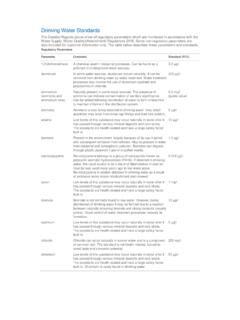
1 Drinking Water Standards The Detailed Reports above show all regulatory parameters which are monitored in accordance with the Water Supply ( Water Quality)(Amendment) Regulations 2018. Some non-regulatory parameters are also included for customer information only. The table below describes these parameters and Standards . Regulatory Parameters Parameter Comment Standard (PCV) 1,2-dichloroethane A chemical used in industrial processes. Can be found as a pollutant in underground Water sources. g/l aluminium In some Water sources, aluminium occurs naturally. It can be removed from Drinking Water by Water treatment. Water treatment processes may involve the use of aluminium sulphate and polyaluminium chloride. 200 g/l ammonium (ammonia and ammonium ions) Naturally present in some Water sources. The presence of ammonia can indicate contamination of sanitary significance.
2 Can be added following disinfection of Water to form chloramine to maintain chlorine in the distribution system. mg/l (guide value) antimony Antimony is very rarely detected in Drinking Water . Very small quantities may arise from brass tap fittings and lead free solders. 5 g/l arsenic Low levels of this substance may occur naturally in Water after it has passed through various mineral deposits and rock strata. The Standards are health-related and have a large safety factor built in. 10 g/l benzene Present in the environment, largely because of its use in petrol with subsequent emission from vehicles. May be present in Water from industrial and atmospheric pollution. Benzene can migrate through plastic pipework if petrol is spilled nearby. g/l benzo(a)pyrene Benzo(a)pyrene belongs to a group of compounds known as polycyclic aromatic hydrocarbons (PAHs).
3 If detected in Drinking Water , the usual source is as a result of deterioration of coal tar. Coal tar was used many years ago to line Water pipes. Benzo(a)pyrene is seldom detected in Drinking Water as a result of extensive Water mains refurbishment and renewal. g/l boron Low levels of this substance may occur naturally in Water after it has passed through various mineral deposits and rock strata. The Standards are health-related and have a large safety factor built in. 1 mg/l bromate Bromate is not normally found in raw Water . However during disinfection of Drinking Water it may be formed due to a reaction between naturally occurring bromide and strong oxidants (usually ozone). Good control of Water treatment processes reduces its formation. 10 g/l cadmium Low levels of this substance may occur naturally in Water after it has passed through various mineral deposits and rock strata.
4 The Standards are health-related and have a large safety factor built in. 5 g/l chloride Chloride can occur naturally in source Water and is a component of common salt. The standard is not health-related, but set to avoid taste and corrosion potential. 250 mg/l chromium Low levels of this substance may occur naturally in Water after it has passed through various mineral deposits and rock strata. The Standards are health-related and have a large safety factor built in. Chromium is rarely found in Drinking Water . 50 g/l Clostridium perfringens Is a type of bacterium which produces spores and can be present in the gut of warm blooded animals. Spores are particularly resistant to disinfection using chlorine and their presence in Drinking Water can be used to indicate a historic contamination. 0 per 100 ml coliform bacteria These bacteria are widely distributed in the environment and provide a sensitive measure of the microbiological quality of the Water supply.
5 0 per 100 ml colony counts - 2 day at 37 C - 3 day at 22 C Are general techniques for detecting a wide range of bacteria. They do not have any direct health significance and are used for trending purposes to assess the microbiological quality of Drinking Water . No abnormal change colour Water should be clear and bright, but natural organic matter may occasionally impart a slight yellowish tint to surface supplies. It can be removed by Water treatment. The standard is set for aesthetic reasons. 20 mg/l Pt/Co scale conductivity This is a measurement of the mineral salts dissolved in the Water . 2500 S/cm at 20 C copper Copper in Drinking Water comes mostly from copper pipes and fittings in households. May cause blue/green staining on sanitary fittings. An excess of copper can cause a metallic taste. mg/l cyanide Low levels of this substance may occur naturally in Water after it has passed through various mineral deposits and rock strata.
6 The Standards are health-related and have a large safety factor built in. Cyanide is rarely found in Drinking Water . 50 g/l E. coli and Enterococci These bacteria are found in the gut of humans and warm blooded animals and their presence in Water supplies indicates possible faecal contamination. Immediate action is taken if these organisms are detected in Drinking Water . 0 per 100 ml fluoride Occurs naturally in Water at varying concentrations. Several sources in the Anglian Water area which contain naturally high fluoride are blended with a low fluoride source before entering supply. Some 20 per cent of Anglian Water s supplies have fluoride added as required by the local Strategic Health Authority as a dental health measure. mg/l gross alpha activity gross beta activity Both of these are measured as part of the calculation of the Total Indicative Dose (TID) for radiation (see below).
7 Bq/l 1 Bq/l iron The standard for iron has been set for aesthetic rather than health reasons to minimise occurrences of discoloured (brown/orange) Water . Iron is a commonly occurring and natural element in most Water sources which can be removed by a simple treatment process. Iron compounds can also be used as a Water treatment chemical. Corrosion of old iron Water mains is one of the most common sources of iron in Drinking Water . 200 g/l lead Not present in the Water entering supply, but may be dissolved after contact with lead pipework which is sometimes present in properties built before 1970. Anglian Water dose phosphate to Water supplies in areas where lead could leach from pipework, but the only permanent solution for householders is replacement of any lead pipework. 10 g/l. manganese Occurs naturally in many waters but is usually removed during treatment.
8 Black deposits of manganese dioxide can cause discoloured Water and the standard is set for aesthetic reasons. 50 g/l mercury Low levels of this substance may occur naturally in Water after it has passed through various mineral deposits and rock strata. The Standards are health-related and have a large safety factor built in. Mercury is rarely found in Drinking Water . 1 g/l nickel Occurs naturally in very few groundwaters and where necessary Water can be blended with sources containing low nickel. A more common source of nickel in Drinking Water is the coatings on modern taps and other plumbing fittings. 20 g/l nitrate Inorganic fertilisers from agricultural run off are the main source of nitrate in Water supplies but it can occur from natural sources. A commonly used method of nitrate reduction is to blend with a low nitrate source, however it can be removed by treatment using an ion exchange process.
9 50 mg/l nitrite Occurs naturally at low levels in the environment. It is sometimes produced as a by-product when chloramine is used as a disinfectant. Careful control of the disinfection process reduces formation of nitrite. mg/l (at customer taps), mg/l (at Water treatment works) odour / taste A measure of the aesthetic quality of Drinking Water . Unusual odours or tastes may indicate a problem which needs investigating. Acceptable to customers and no abnormal change PAH (sum of 4) Polycyclic aromatic hydrocarbons is a group name for several substances present in petroleum based products such as coal tar which was used to line iron mains many years ago. Due to extensive Water mains refurbishment and renewal it is now unusual to detect these substances in Drinking Water . g/l (total of 4 named PAHs) pesticides (individual) The standard for individual pesticides is set at 1 part per 10,000,000,000 which is in effect a zero standard well below safety levels for the commonly used pesticides.
10 Use on farmlands, highways, railway tracks and in gardens are the main sources of pesticides in Water supplies. Compliance with the Standards is achieved by treatment of Water using granular activated carbon. g/l All pesticides apart from aldrin, dieldrin, heptachlor, heptachlor epoxide which are g/l where measured pesticides (total) Individual pesticides in the Water Supply ( Water Quality) Regulations 2000 (as amended) are defined as organic insecticide, herbicide, fungicide, nematocide, acaricide, algicide, rodenticide, slimicide and related products. The standard for total pesticides refers to the sum of the detected concentrations of the individual pesticides. g/l pH (hydrogen ion) A measure of the acidity or alkalinity of Water ; pH < is acidic and pH > is alkaline. Waters should preferably be slightly alkaline to protect metallic fittings and pipework from corrosion.