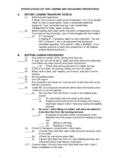
Transcription of DRIVER CHECKLIST FOR LOADING AND …
1 DRIVER CHECKLIST FOR LOADING AND unloading procedures . A. before LOADING transport VEHICLE. _____ (1) Walk Around Inspections: A DRIVER must conduct a walk around inspection. You must visually check for any unusual odors, noise, or physically defective equipment, such as broken springs, over heated tires, misalignment of axles, leaks, smoke, etc. _____ (2) before LOADING each load, verify that every compartment is empty. If you load on top of product, you will be charged with the incident. _____ (a) K-1 Kerosene: If LOADING K-1 Kerosene, step 2 is very important. You are NOT to load K-1 into a compartment that previously contained gasoline.
2 Only load K-1 after a distillate. It is a required practice to drain the compartment of all residual product before LOADING K-1. B. BOTTOM LOADING procedures . _____ (1) Stop delivery vehicle at the LOADING rack stop line. _____ (2) At stop line, turn off all lights, radio, and other electrical equipment (and follow any other posted local plant procedures ). _____ (a) Check tires and suspension for broken springs. _____ (3) If rack is not clear, set parking brakes and shut off engine. _____ (4) When rack is clear, start engine, pull forward, and spot truck for LOADING . _____ (5) Re-set parking brake. _____ (6) Shut off engine.
3 _____ (7) Eye protection and bump hat must be worn at all times during the transfer of product. _____ (8) Under NO circumstances should the DRIVER leave the LOADING area unless due to an emergency. _____ (a) No one other than the DRIVER is to be in the LOADING area except: _____ (i) An authorized instructor training that DRIVER . _____ (ii) Persons authorized by the Oil Company who have a legitimate reason to be in that area during the LOADING process. _____ (b) No DRIVER , while filling his trailer, will allow his attention to be diverted from the LOADING process. _____(i) Examples of activities which unnecessarily divert attention from the proper focus of the LOADING process are: _____ (a) Eating or drinking _____ (b) Reading or writing _____ (9) If trailer is equipped, check product retain lights.
4 _____ (a) Connect high level fiber optic cable (ground line/scully cord). to the trailer _____ (b) +Check for permissive green light _____ (c) If green light does not come on, stop LOADING process, see instructions/plant attendant/or supervisor. _____ (10) Connect vapor recovery hose and close both cam-lock ( ears ). levers completely on the hose. 1. _____ (11) Open fitting box and open internal valves as required. _____ (12) Connect the appropriate leading arms When connecting a LOADING arm coupler to the trailer pipe, slide the collar on the adapter before actuating the lever, which locks the collar and opens the valve.
5 Do not force the collar on with the lever cam. This damages the lever arm and shear pin. _____ (13) Open internal valves as required. _____ (14) Clear registers and set pre-sets for the proper gallons for each compartment. Know the capacities of all compartments on the trailer. The pre-set counter must never be set to an amount greater that the legal/safe fill capacity of the compartment being filled. _____ (15) Start the appropriate product pumps. _____ (16) At each meter: _____ (a) Verify product, pre-set gallon amount and LOADING arm connection to the correct compartment. _____ (b) Actuate start mechanism.
6 _____ (c) Verify that the pre-set meter countdown is working properly. _____ (d) Verify there are no leaks. _____ (17) Observe slow-flow shutdown of all meters. If slow-flow does not engage at 50-30 gallons, stop flow immediately by pressing stop button on pre-set. Do not bypass slow-flow. Report to management. _____ (18) After each compartment is loaded, close the internal valve for that compartment. When a compartment is filled beyond safe-fill capacity, the LOADING rack high level control monitor will not permit further LOADING . If additional LOADING is necessary, the DRIVER must follow local procedures for draining product (which will include notifying plant management) so that the LOADING rack high-level control monitor returns to a permissive state.
7 On units equipped with an on-board overfill indicator, it may be necessary to press a reset button to get a green light on the rack monitor. _____ (19) After LOADING is completed, disconnect and stow LOADING arms. _____ (20) Make sure drop heads are hooked up and interlock bar is down and locked. _____ (21) Close fitting box doors and secure. _____ (22) Disconnect vapor recovery hose. Secure vapor hose to its holder on the rack and lock cam-lock ( ears ). _____ (23) Disconnect high level fiber optic cable and secure. Remember, this is the first thing connected and the last disconnected. _____ (24) Immediately look down the right side of the trailer to ensure that all LOADING equipment has been disconnected and stowed in its proper position.
8 _____ (25) Move unit from the LOADING rack to designated parking area. _____ (a) Set parking brakes _____ (b) Shut off engine DO NOT LEAVE UNIT UNDER RACK AREA AFTER LOADING . _____ (26) Report any spills or LOADING rack equipment malfunctions to plant management. _____ (27) Collect bill of lading/invoice and all other necessary documents. This procedure may vary for each LOADING terminal. 2. _____ (28) Ensure that the OSHA product identification labels and the emergency response guidebook are available in the truck cab _____ (29) NOTE: These procedures may change a little from one LOADING facility to another.
9 You must become familiar with each LOADING facilities rules and regulations in order to do a good job. C. TROUBLESHOOTING HINTS. LOADING RACK PROBLEMS. _____ (1) NO GREEN LIGHT ON GROUND CIRCUIT/OVERFILL SENSOR. CONTROL. _____ (a) If green light is not illuminated . Bulb could be burned out Advise plant management _____ (b) If red light does not go off .. Plug contact points may be dirty. Spring-loaded contact in rack plug may be stuck in . Trailer wiring or sensor may be defective. _____ (c) If light go to green and red each time connection is made . Sensor is reading possible retain; confirm compartment is empty.
10 _____ (d) If light goes to red intermittently while LOADING . Rack-to-trailer connection is not making good contact. Compartment previously loaded is filled too close to sensor level and product is splashing against sensor. _____ (e) If light goes to steady red while LOADING . Compartment currently filling has reached high level sensor. Red light at trailer control box will show what compartment has scullyed out. Trailer-to-rack connection has lost contact. _____ (f) If light stays at a steady red and you can not get a green light, a sensor in one of the compartments may have gone bad. _____ (2) NO POWER TO TRAILER CONTROL BOX.