Transcription of Drug Therapy Protocols: Glyceryl trinitrate
1 Drug Therapy Protocols: Glyceryl trinitrate While the QAS has attempted to contact all copyright owners, this has not always been possible. The QAS would welcome notification from any copyright holder who has been omitted or incorrectly acknowledged. All feedback and suggestions are welcome. Please forward to: The Digital Clinical Practice Manual is expressly intended for use by appropriately qualified QAS clinicians when performing duties and delivering ambulance services for, and on behalf of, the QAS. The QAS disclaims, to the maximum extent permitted by law, all responsibility and all liability (including without limitation, liability in negligence) for all expenses, losses, damages and costs incurred for any reason associated with the use of this manual, including the materials within or referred to throughout this document being in any way inaccurate, out of context, incomplete or unavailable. State of Queensland (Queensland Ambulance Service) work is licensed under the Creative Commons Attribution-NonCommercial-NoDerivatives International LicenseYou are free to copy and communicate the work in its current form for non-commercial purposes, as long as you attribute the State of Queensland, Queensland Ambulance Service and comply with the licence terms.
2 If you alter the work, you may not share or distribute the modified work. To view a copy of this license, visit copyright permissions beyond the scope of this license please contact: codeDTP_GTN_0221 DateFebruary, 2021 PurposeTo ensure a consistent procedural approach to Glyceryl trinitrate to all Queensland Ambulance Service (QAS) clinical care settingPre-hospital assessment and to all ages unless specifically of fundingInternal 100%AuthorClinical Quality & Patient Safety Unit, QASR eview dateFebruary, 2024 Information securityUNCLASSIFIED Queensland Government Information Security Classification AMBULANCE SERVICE IndicationsDrug classVasodilatorPharmacologyGlyceryl trinitrate (GTN) is a potent vasodilator that decreases preload by increasing venous capacity, pooling venous blood in the peripheral veins, reducing ventricular filling pressure and decreasing arterial blood pressure (after load). Because of this cascade it also causes vasodilation in coronary arteries that are in spasm and may assist the redistribution of blood flow along the collateral channels in the heart.
3 [1-3]MetabolismGTN is readily absorbed and metabolised by the liver.[1] Glyceryl trinitrate Suspected ACS (with pain) Acute cardiogenic pulmonary oedema Autonomic dysreflexia(with a systolic BP 160 mmHg )[4 5] Irukandji syndrome(with a systolic BP 160 mmHg ) Contraindications Precautions Suspected inferior AMI Cerebral vascular disease Risk of hypotension and/or syncope Intoxication (GTN effects are enhanced) Phosphodiesterase 5 inhibitor medication administration( tadalafil, sildenafil, vardenafil) administration in theprevious 4 days.[6]February, 2021 Allergy AND/OR Adverse Drug Reaction Heart rate < 50 OR > 150 beats per minute Systolic BP < 100 mmHg Acute CVA Head trauma Phosphodiesterase 5 inhibitor medication administration:[6] - Sildenafil OR vardenafil in the previous 24 hours- Tadalafil in the previous 48 hoursUNCONTROLLED WHEN PRINTED UNCONTROLLED WHEN PRINTED UNCONTROLLED WHEN PRINTED UNCONTROLLED WHEN PRINTED978 QUEENSLAND AMBULANCE SERVICE PresentationOnset DurationHalf-life Spray (sublingual), 400 microg/dose, 200 doses,nitrolingual pump spray Ampoule, 50 mg/10 mL Glyceryl trinitrateSchedule SUBLING spray S3 (Therapeutic poisons).
4 Ampoule, 50 mg/10 mL S4 (Restricted drugs).< 2 minutes Routes of administrationSublingual (SUBLING)20 30 minutes Special notes [1-4] Ambulance officers must only administer medications for the listedindications and dosing range. Any consideration for treatment outsidethe listed scope of practice requires mandatory approval via the QASC linical Consultation and Advice Line. Sublingual GTN is the first line treatment for ACS, however IV GTNshould be considered as part of the management regime for allpatients unresponsive to sublingual GTN, narcotics and/or blockers. Research has identified that GTN potency may be reduced due to themigration of GTN into certain administration sets. IV INF doses shouldbe titrated according to patient response despite the container andgiving set used. Prepared GTN IV infusion solutions are stable in polypropylenesyringes for 24 hours. Some patients with normal or low left ventricular filling pressuresor pulmonary capillary pressure may be hypersensitive to the effectsof GTN and may respond to IV infusion doses from 5 microg/min.
5 CCP ESoP aeromedical officers must display extreme caution whenceasing GTN infusions due to the potential of rebound symptoms. GTN is the first line treatment for autonomic dysreflexia, howevermorphine should be considered as part of the management regime,if the patient is unresponsive to initial treatment. 50 mg/10 mL GTN ampoules are not currently supplied by theQAS warehouse for procurement information please refer tothe QAS Drug Management Code of Practice. All cannulae and IV lines must be flushed thoroughly with sodiumchloride following each medication infusion (IV INF )ACP1 ACP2 CCPATPG lyceryl trinitrate Side effects Dizziness Hypotension Syncope Reflex tachycardia Vascular headachesUNCONTROLLED WHEN PRINTED UNCONTROLLED WHEN PRINTED UNCONTROLLED WHEN PRINTED UNCONTROLLED WHEN PRINTED979 QUEENSLAND AMBULANCE SERVICEA dult dosagesSUBLINGIVINFSUBLINGS uspected ACS (with pain)400 microgRepeated at 5 minute maximum ESoP aeromedical RSQ Clinical Coordinator consultation and approval required in all situations.
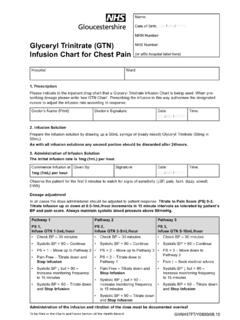
6 Commence infusion at 10 microg/minute (1 mL/hour) and increase by 10 20 microg/minute (1 2 mL/hour) every 3 5 preparation: Mix 30 mg (6 mL) of GTN with 44 mL of glucose 5% in a 50 mL syringe to achieve a final concentration of 600 microg/mL. Ensure all syringes are appropriately labelled. Administer via syringe driver. If at anytime the patient becomes unresponsive or hypotensive, cease infusion may be recommenced at 50% the preceding dose when patient is GCS 15 and systolic BP > 100 dosages (cont.)SUBLING Autonomic dysreflexia (with a systolic BP 160 mmHg) Irukandji syndrome (with a systolic BP 160 mmHg)400 microgRepeated at 5 minute maximum cardiogenic pulmonary oedema400 microgRepeated at 5 minute maximum dosagesSUBLING Autonomic dysreflexia (with a systolic BP 160 mmHg) Irukandji syndrome (with a systolic BP 160 mmHg)QAS Clinical Consultation and Advice Line approval required in all situations. Note: In all other instances, QAS officers are NOT authorised to administer GTN to paediatric trinitrateUNCONTROLLED WHEN PRINTED UNCONTROLLED WHEN PRINTED UNCONTROLLED WHEN PRINTED UNCONTROLLED WHEN PRINTED980 QUEENSLAND AMBULANCE SERVICE1.
7 Position the patient in a sitting or semi-reclined trinitrate instructions for use3. If using a new bottle, prime the pump by holding the bottle upright, facing away from the patient and bystanders & depress the nozzle 5 times (do not shake the bottle). If first use for the day, prime by spraying Remove the plastic cover from the GTN spray bottle, thoroughly wipe the entire container including the nozzle using an alcohol swab and allow to dry. 4. Instruct the patient to open their mouth wide and lift their tongue to the roof of their mouth (some patients may have difficulty and may require a demonstration from the clinician).5. Bring the bottle to within approximately 3 4 cm from the patient (without contact) with the nozzle aimed directly under the patient s tongue and steadily depress the nozzle once. 6. Recap the bottle after each After the last administration, thoroughly wipe the entire bottle including the nozzle and inside of the cap using an alcohol If the nozzle inadvertently comes into direct contact with the patient, the bottle must be discarded after the last administration on the current patient.
8 9. Recap the bottle and store in the drug kit for the next patient. UNCONTROLLED WHEN PRINTED UNCONTROLLED WHEN PRINTED UNCONTROLLED WHEN PRINTED UNCONTROLLED WHEN PRINTED