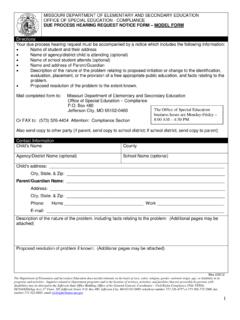
Transcription of Due Process Guide - dmh.mo.gov
1 1 Due Process Guide Appendix C Created 02/08/2013 Revised 08/12/2015 Revised 01/01/2017 Revised 03/06/2018 Notes: This Guide was developed to assist teams when making a referral to the Due Process Review Committee. This is a Guide and is not required to be submitted to the committee; however, the components listed in the Guide are what the Due Process Committees will look for in documentation when doing the review. Due Process is the guaranteed opportunity to protest, to be heard, to be informed, and to give consent. The concept of due Process is intended to protect people from exploitation of undue restrictions or right: (Council on Quality Leadership, 1996 p.)
2 25) 2 DUE Process COMPONENTS Guide The purpose of this Guide is to assist individuals and their planning team to ensure that components of due Process have occurred when developing supports for persons who may require a limitation of their rights. Justification - purpose & rationale Describe the restriction Document less intrusive methods of meeting the need that have been tried but did not work. Identify a specific and individualized assessed need. Explain the reason the limitation or restriction is being put in place. Explain if the restrictions or limitations are necessary to keep the person safe or others safe.
3 Describe any historical pattern or significant situation which has occurred that would justify a limitation or restriction. If the plan is being referred for annual review, there must be documentation noting the progress or lack of progress from the past year of implementation ( summary of monthly reviews, quarterly reviews, behavioral data results, evaluations about the effectiveness of medications/interventions) Conditions - under which the restriction is applied Explain where the restriction or limitation will be imposed ( only at home, in the community, day program, in kitchen, etc).
4 Include a clear description of the condition that is directly proportionate to the specific assessed need. Explain when the restriction will be imposed ( at all times, in morning, after/before a specific event or situation, if family present, only ). Teaching or Support Strategies Outcomes/Strategies that are being taught to help an individual develop skills in order to overcome the need for this restrictive support. Document the positive interventions and supports used prior to any modifications to the person centered service plan. Provide evidence that this type of intervention/teaching has worked in the past and information on why this is the method by which the person learns best.
5 If there are restrictive supports that are required to keep the person or others safe and teaching strategies have not been identified, then the supports need to be identified in the ISP and the efforts that are being explored to support the person in the least restrictive way. For teaching and support strategies, document who is responsible for the training of the strategies. Monitoring methods Include an assurance that interventions and supports will cause no harm to the individual. Include a regular collection and review of data to measure the ongoing effectiveness of the modification.
6 Information on data collection methods should Who is documenting? Where is data kept ( , daily progress notes, outcome data sheets, MAR, etc)? What is the frequency of documentation ( daily, weekly, monthly, etc)? How often is the data reviewed by team? 3 Criteria for restoration Describe what it will take for the restriction to be lifted / how the individual and team will know when the restrictive support is no longer needed or could be reduced in intensity/frequency. The criterion needs to be in specific observable and measurable terms ( if individual has three consecutive months of no attempts to elope, chimes will be removed from the exterior door) Review schedule Include established time limits for periodic reviews to determine if the modification is still necessary or can be terminated.
7 State how often team will submit plan to Due Process Committee for review (minimum is annually) Notice of right to due Process Include informed consent of the individual. Document that the individual and the guardian are aware of the restrictions, were part of the planning Process to develop interventions, know they have a right to due Process , and have information on what to do if they do not agree with the restrictions or interventions. Signed authorization page (can either be signed by guardian only or can be signed by guardian and individual) Authority and Other References 42 CFR (c)(2)(xiii) Subpart G Home and Community-Based Services.
8 Waiver Requirements # Missouri Revised Statutes Section Patient s rights with limitations Section Guaranteed Rights to all DMH consumers Section Explanation of rights and entitlements Section No presumptions regarding consumer rights, responsibilities, or competency Missouri Code of State Regulations 9 CSR Individual Rights 9 CSR Certification of Medicaid Agencies Serving Persons with Developmental Disabilities Contract For Services Contract # ER019914XX Purchase of Services Program for the Division of DD Consumer Rights 4 Due Process Rights Limitation Worksheet This is an optional tool that can be used to help record and track information when there are proposed limitations of rights that are developed to support an individual.
9 Refer to Appendix B to get information on Individual Rights Rights Limitation Rights Limitation Rights Limitation Page # JUSTIFICATION: What is the reason for the limitation or restriction? CONDITIONS OF THE RESTRICTION: Implemented under what conditions when, where, how often, etc. TEACHING/SUPPORT STRATEGIES: Include documentation for who is responsible for training. MONITORING METHODS: How will progress be documented and how frequently? Where is data kept? CRITERIA FOR RESTORATION: What has to occur for the right to be restored, in specific measurable terms?
10 REVIEW SCHEDULE: Frequency of review by planning team and DPRC (minimum of annually by DPR committee). NOTIFICATION: Person & guardian informed of restrictions and right to due Process /right to appeal. Meets criteria for abuse/neglect?