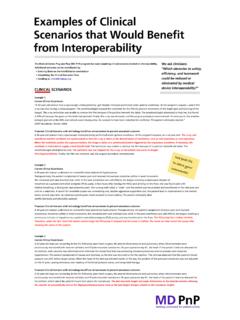
Transcription of Dysrhythmia Assessment and Management …
1 1 DysrhythmiaAssessment andManagement ScenariosAuthors:John Guerriero, EMT-P,Gene Iannuzzi, RN, CCRN, EMT-P,Arther Romano, EMT-P,Kevin Brown, MD, EMT-P2An Important Word About the Therapies Discussed HereThe authors have done everything possible to ensure that the recommendations are upto date and in accord with generally accepted standards. However, as new scientificinformation becomes available through basic and clinical research, recommendedtreatments and drug therapies undergo constant change. The American HeartAssociation s Advanced Cardiac Life Support (ACLS) treatment guidelines--the basis formost of the recommendations contained here--undergo revisions every few years.
2 Themost current ACLS treatment algorithms should be consulted. Recommendedtreatments herein are based on the 2000 guidelines for emergency cardiac described should be applied by the reader in accordance with professionalstandards of care used in regard to the unique circumstances in each reader s scope of practice should conform to national, state, and regional treatmentguidelines along with local practice standards. The reader is advised to always checkproduct inserts and consult with the Physicians Desk Reference (PDR) and theAmerican Hospital Formulary Service books for changes and new information regardingdose and contraindications before administering any drug.
3 Caution is especially urgedwhen using new or infrequently ordered purpose of this material is to illustrate how the skills of dysrhythmiainterpretation relate to clinical Assessment to affect the selection of appropriatedysrhythmia treatment algorithms. The goal is not to stress a specific therapy,but to demonstrate how ECG interpretation, patient Assessment findings, andtreatment options are evaluated and selected. In other words, the question Howis a wide-complex tachycardia treated? cannot be answered without consideringseveral related factors, such as how the patient is tolerating the Dysrhythmia andhow urgently therapy is Dysrhythmia recognition is taught as one distinct phase of cardiac care,clinical Dysrhythmia interpretation must be done in conjunction with patientassessment.
4 Only by considering the effect that a particular Dysrhythmia ishaving upon a patient s well-being can the significance of the abnormal rhythmdisturbance be determined and a decision made as to which therapy, if any, isindicated. For instance, synchronized electrical cardioversion is indicated to treata rapid supraventricular rhythm that is associated with shock, but an electricshock is often not needed if the patient is tolerating the fast ScenariosCase #1: The case of the weak and dizzy elderly woman. Case Presentation: An Emergency Medical Services ALS ambulance receives acall for a sick, elderly female. Upon arrival, they are greeted by a man who4called 9-1-1 because his 84-year-old wife has been complaining of dizziness andgeneralized weakness for the last two hours.
5 The patient, awake and appearingweak, describes briefly passing out while getting up from the couch to go to thebathroom. She was feeling fine until about two hours ago, when she suddenlybecame dizzy and had to be helped to lie patient denies chest pain, shortness of breath, diarrhea, palpitations,nausea or vomiting, blood in her bowel movements, abnormally dark stools, orprior episodes similar to today s events. Her past medical history is significant forhypertension for which she is taking a diuretic and an ACE-inhibitor. Hermedication has not been changed recently, and she takes her medication Examination: Her mental status is alert and oriented; blood pressure:84/60 mmHg; pulse 36/min.
6 ; and respirations: 26/min. Pulse oximetry shows98% saturation. Her skin is pale and sweaty, and her neck veins are notdistended. Her breath sounds are clear and the heart sounds are regular withouta murmur. Her abdominal and neurologic examinations are normal. Oxygen isadministered and cardiac monitoring is started along with insertion of anintravenous intermittent infusion device. The ECG monitor recorded the tracingshown in Figure 1.[INSERT FIGURE 1 HERE]5 Interpretation: Third-degree A-V heart block with a bradycardic ventricularescape rhythm at a rate of 25/minuteReasoning: This is complete A-V heart block because the tracing shows thetypical findings of independent atrial and ventricular activity along with a veryslow regular ventricular rhythm (25/minute).
7 The QRS complexes are wide anddistorted, indicating the presence of a low ventricular escape pacemaker. Atrialactivity consists of P waves at a rate of 60/minute. When the P-R intervals aremeasured, a constant value cannot be found because the distance between theP waves and the QRS complexes is constantly changing. The P waves and QRScomplexes are unrelated to each other since the upper and lower heartchambers are being paced by different Considerations: The primary survey reveals that the patient is alert,and her airway and breathing are adequate. The patient s circulation isinadequate because of the slow heart rate, but she is not in need of cardiaccompressions.
8 High-concentration oxygen via a non-rebreather mask or a nasalcannula should be administered. The D of the ABCDs pertains to disability(neurologic Assessment ) and differential diagnosis involving a consideration ofwhat is causing the patient s condition. Her neurologic examination is intravenous lifeline is established should emergent medication becomenecessary before arriving at the emergency department. Continuous cardiacmonitoring is being done. The patient s symptoms appear to be directly related to6her slow heart rate. The patient is hypotensive and showing signs of adrenergicdischarge: pallor and diaphoresis. Although she seems to be compensatingreasonably well for the abrupt slowing of her heart rate, a blood pressure of 80mmHg is very low for a patient who is normally hypertensive.
9 She is dizzy andinitially lost consciousness. It is clear that this patient s symptoms are related tothe bradycardic rate and that the slow rate needs to be treated. What treatmentis needed at this point?Although third-degree heart block in elderly patients is usually due to gradualfibrosis of the A-V conduction system, the patient needs to be assessed andtreated expectantly as if she were experiencing an acute coronary event. MIsoccurring in the elderly often present atypically; a significant percentage of suchpatients do not experience the traditional complaint of chest pain. In suchatypical cases, elderly MI patients describe only a vague abdominal or chestdiscomfort, nausea, pronounced sweating, sudden weakness, or plan: The Emergency Cardiac Care Treatment Algorithm for AdultBradycardia is found in Figure 2.
10 If the patient s condition is critical or unstable,several of these measures may need to be implemented in rapid instance, artificial pacing and atropine administration may be donesimultaneously for an unstable patient. For a patient who is relatively stable, asthis patient is, treatment may start with either atropine or artificial therapeutic options include:7 Atropine ( to 1 mg) should be given in repeated doses every threeto five minutes up to a total of to mg/kg (approximately 3 mgfor a 70 kg patient). External (transcutaneous) artificial pacing for severely symptomaticpatients is the treatment of choice and should not be delayed whileestablishing intravenous access for atropine administration.