Transcription of Economic outlook
1 SPRING 2018 For more on our current view and outlook , consult The Global Investment outlook . Economic outlookMarket turbulence, macro calmThe recent flare of financial-market turbulence is a useful reminder not to become too complacent after a long period of uninterrupted growth and market gains. While the stock market s decline has since been partially unwound, other potentially challenging developments have stuck, including the aging business cycle, rising yields and inflation as well as protectionist threats. Nevertheless, the global economy continues to grow at its fastest rate in years on the back of strong and, we think, sustainable momentum and fiscal support.
2 Strong macro conditionsThe global Economic environment remains positive, with exuberant macro indicators providing their best readings in almost a decade. We continue to flag many reasons for this growth: A strong Economic handoff from 2017, Decent financial conditions, Classically fast late-cycle growth, A burst of fiscal stimulus and Retreating secular some tailwinds are less encouraging ( , less positive Economic surprises and tightening financial conditions, mainly caused by rising interest rates), others have strengthened. Global growth is currently supported by increasing European and fiscal stimulus as well as reviving risk appetite and productivity growth as the grit that constrained the post-crisis economy starts to wash away.
3 For all the talk about faster growth, several structural constraints remain, namely worsening demographics, maturing emerging-market economies, populist inclinations and high debt loads. Future growth appears set to be better than the post-crisis norm, but still less than the pre-crisis standard. New inflation regimeFor a significant part of the post-crisis era, markets have been on deflation watch concerned about falling rather than rising prices. Even as economies began to recover, inflation remained stubbornly low. However, we were always dubious of the deflation narrative. It is indeed harder for inflation to rise now than in the past because of structural depressants related to demographics, globalization, technological change and sector-level shifts.
4 But focusing only on depressants could neglect equally relevant stimulative factors: less Economic slack in developed-world economies, higher inflation expectations, rising commodity prices and an inherently inflationary wave of have finally abandoned their deflationary mindsight, recognizing that an inflation regime shift is underway. But, in contrast to the idea that a deflationary environment is abruptly transitioning to a high-inflation one, we view the ongoing transformation as a rather gentler shift from a low-inflation regime to a normal one. As such, we anticipate an orderly increase in developed-world inflation measures as well as continued low levels of inflation in emerging markets.
5 The year of protectionismProtectionism has been a risk for some time, but particularly so in 2018 . Brexit s contours must be hashed out this year in advance of an early 2019 deadline and, with tax cuts now delivered, the White House appears to be turning toward trade issues. As such, protectionism is not merely a risk, but also an Economic hopes that the protectionist bark will be worse than its bite, but the has already imposed tariffs on softwood lumber, aerospace products, solar panels, washing machines and steel and aluminum. Furthermore, the United States is not alone in evincing protectionist tendencies the United Kingdom is heading down a very similar path in its plan to Economic outlook Spring 20182 | secede from the EU, Canada is experiencing interprovincial trade wars and non-tariff trade barriers are subtly rising in many countries.
6 Some are fighting against this protectionist wave and globalization is not in complete retreat. In fact, world trade increased nicely over the past year, though entirely because of stronger global demand rather than fewer trade frictions. Although all is not lost on the trade front, some big chips are on the table in dose of fiscal stimulusFiscal stimulus is not usually sought or delivered when economies are already strong enough to require central-bank rate hikes, but political considerations have nevertheless unleashed fiscal stimulus in several jurisdictions today. The budget has become more expansive due to concerns about Brexit damage; the new German grand coalition has been struck largely on the promise of government largesse; and President Trump was elected in significant part on his promise of major tax main fiscal thrust comes from the United States.
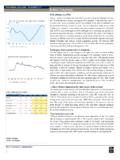
7 We budget for notably more growth in 2018 thanks to this, and for some extra growth in 2019 (Exhibit 1). Underlying this assessment are a confidence boost following the last election; dividends of a deregulatory push; prominent tax cuts delivered several months ago; and further fiscal spending from a recent budget economy soarsSeveral negative forces are buffeting the economy, including higher interest rates (raised by the Federal Reserve most recently on March 21, 2018 , by 25 basis points) and creeping protectionism, but the positives related to the weaker dollar, a high level of Economic optimism and fiscal stimulus appear to be winning out.
8 Consumer spending is strong and housing still has room to improve. Business investment is impressive thanks to tax cuts and a resurgent energy industry. Government spending is now on the ascent and the weak currency brightens the trade picture, though protectionism casts a shadow. We therefore look for a muscular advance in real GDP in 2018 , followed by a increase in 2019. The slight Economic deceleration in 2019 is due to our belief that the dollar could temporarily reclaim some of its lost ground, monetary tightening should continue, fiscal stimulus will become less powerful as time goes on and protectionist actions will mount. For business-cycle reasons, recession risk also arguably rises over stares Brexit in the faceThe British economy continues to grow, but has failed to partake in the synchronized global acceleration.
9 This appears to relate to the uncertainty and potentially negative outcomes from the Brexit negotiations. Business investment is palpably weaker and we figure the economy has already underperformed its erstwhile trajectory by at least one percentage point of GDP. The pound has also weakened since the Brexit vote, though the currency has stabilized recently. The resultant import inflation has British inflation running considerably higher than in other most likely scenario for Brexit is a middling Brexit that permits the free flow of goods, but not of services or people. This outcome would reduce GDP further and we anticipate underwhelming growth to the tune of a gain in both 2018 and growth persists for nowThe Eurozone economy continues to cruise along, accelerating as notably as the United States.
10 Europe could extend this performance longer than the United States as the European Central Bank is still actively delivering monetary stimulus and the region s economy is not as tight as the economy. Credit growth is accelerating as Germany prepares to deliver additional fiscal stimulus while others, like France, are amid important structural reforms that should unleash additional growth. This adds up to a strong GDP gain in 1 Effect of Trump policies on GDP+ + + + pointsCumulative effect on GDP levelEffect on annual GDP growthPositiv e effe ct on GDP growth in short run(confidence, dereg., tax cuts, spending bill)Negative Economic effect on GDP growth later (protectionism, less immig.)