Transcription of Education Analytics
1 Education Analytics White paper March 2017 Education Analytics white paper | March 2017 2 Table of Contents 1 Executive summary .. 3 2 IT trends .. 3 Cloud based services .. 5 Drivers for cloud based services .. 5 Cloud service models .. 6 Data Analytics in cloud .. 7 Microsoft Services Advanced Analytics offering .. 9 3 Analytics overview .. 10 4 Analytics in 14 Opportunities for Analytics in Education .. 15 Student success .. 16 5 Case: Improving graduation in vocational Education in Finland .. 19 User scenarios .. 20 Solution elements .. 21 Technology stack .. 22 6 Getting there .. 23 7 References .. 26 8 Acknowledgements .. 27 Education Analytics white paper | March 2017 3 1 Executive summary The purpose of this document is to describe how schools and school systems can utilize advanced data Analytics to better achieve the goals in Education and how modern technologies offer new opportunities for Education system effectiveness, better learning outcomes, and personalization of learning.
2 The document first describes major IT trends and then continues to explain Analytics in general. Chapter four deep dives in Education Analytics and also presents some case studies in which advanced Analytics are applied. Chapter five describes the ongoing pilot project to improve the graduation rate of Finnish vocational schools. Finally, chapter six presents a framework for Analytics projects. Technology discussed in this document is based on Microsoft Azure and Microsoft Power BI. 2 IT trends IT trends show where technology is moving. Education and IT leaders are using technologies driven by today s IT trends to outpace change and the competition. Organizations need to understand today s IT trends and the industry changes that are happening along with them, and begin to use these emerging technologies to their advantage.
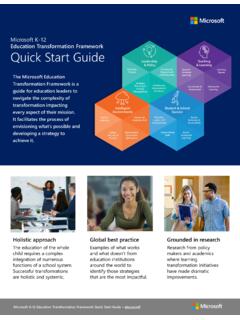
3 A massive transformation in the Education landscape has begun, driven by consumers adopting new trends, or megatrends, that are based around new social and application patterns, huge data consumption, cloud computing and mobility. Picture 1 - IT Trends Education Analytics white paper | March 2017 4 Mobility. As smartphones and tablets become more capable and user interfaces become more natural, old methods of computing seem place-bound and much less intuitive. People increasingly expect to be connected to the Internet wherever they go, and the majority of them use a mobile device to do so. The unprecedented evolution of these devices and the apps that run on them has opened the door to a myriad of uses for Education .
4 Schools all over the world are adopting apps into their curricula and modifying websites and educational materials so they are optimized for these devices. The significance for teaching and learning is that the apps have the potential to facilitate almost any educational experience, allowing learners to organize virtual video meetings with peers all over the world, use specialized software and tools, and collaborate on shared documents or projects. Social refers to a growing trend towards social networking online as an evolution of e-learning rather than a major paradigm shift. Social tools can help organizations excel by allowing people to connect in ways that are familiar to them in their personal lives and by spurring creativity and innovation.
5 Microsoft can help organizations take advantage of social media and integrate it with new and existing communication tools. Business opportunities for social enterprise can include communicating with students, faculty, and staff in new ways and improving internal collaboration. Social tools that meet the expectations of multiple generations of workers can reduce costs and allow organizations to respond faster to new opportunities. Using tools to share ideas and collaborate in a way that provides a more direct link to customers can help educational organizations improve the value of customer relationships and respond to opportunity with speed and intelligence. Data refers to data sets that are large and complex that need to be processed, stored, shared, analysed, and used to help make smarter decisions in both the learning process and the management of the institution.
6 The combination of social networking as a way of life, and the ever-growing number of devices on which people stay connected, continues to generate untapped sources of data that could help organizations to be more proactive. But the unprecedented volume, velocity, and variety of the data available make it more challenging to properly analyse and mine for potential organizational value. As organizations begin to deeply explore what big data can do for them, it s important that the chosen enterprise solution is able to address both business intelligence and big data. Microsoft thinks of this approach as business Analytics . At Microsoft, our ambition is to democratize the fourth industrial revolution by providing the building blocks to empower organizations large and small enabling them to build, innovate and transform, and allowing them to get started quickly and see real business impact and results fast.
7 We believe an organization s data is a key strategic asset which, when combined with the cloud and the potential of intelligence capabilities, provides the opportunity to automate, innovate, and increase the speed of improvement. Education Analytics white paper | March 2017 5 Cloud computing refers to expandable, on-demand services and tools that are served to the user via the Internet from specialized data centres and consume almost no local processing or storage resources. Cloud computing resources support collaboration, file storage, virtualization, and access to computing cycles, and the number of available applications that rely on cloud technologies has grown to the point that few Education institutions do not make some use of the cloud, whether as a matter of policy or not.
8 Over the past few years, cloud computing has been firmly established as an efficient way for businesses to protect data and deliver software and online platforms. Schools are deploying similar strategies to boost collaboration, productivity, and mobility in teaching and learning. Cloud based services Most people now agree that cloud based services have become a core element of any enterprise s technology strategy. Indeed, in the past few years we have seen the conversation around cloud adoption move from if to when and how. Cloud based services are one of the most disruptive changes in computing in years. Their value proposition is many-faceted, ranging from significant cost savings over a traditional datacenter approach to the ability to quickly build robust, resilient applications that can scale up as traffic spikes, and scale down as it recedes.
9 Cloud solutions overall will decrease implementation and innovation costs, and with unlimited resources scalability is not an issue anymore. Users can access applications and services from anywhere, anytime, and with any device. Drivers for cloud based services Speed - With minutes required to procure and provision servers, the pace of innovation has dramatically increased. Reduced time-to-develop and time-to-market means IT can be much more agile in servicing needs of the business or developers. In fact, it is the speed and agility that IT hasn t been able to provide that has resulted in what many call Shadow IT where divisions within an organization are resorting to using credit cards to procure computing resources outside of the purview of IT.
10 Scale The cloud gives organizations an almost infinite set of computing resources. Applications will enjoy massive global scale and can easily scale up or down depending on the demand. That means you never have to worry about running out of capacity or worry about overprovisioning. You use just enough resources for your needs - nothing more, nothing less. Education Analytics white paper | March 2017 6 Economics Customers are paying only for what they use in the cloud. This saves money for any application that has variable computing needs. For some organizations, there is also an additional benefit of changing capital expenses to operating expenses, which frees up capital from infrastructure investments so it can be put to other uses.