Transcription of Effective citing and referencing - International …
1 Effective citing and referencing Effective citing and referencing The IB programme continuum of International education Effective citing and referencing Published August 2014. Published on behalf of the International Baccalaureate Organization, a not-for-profit educational foundation of 15 Route des Morillons, 1218 Le Grand-Saconnex, Geneva, Switzerland by the International Baccalaureate Organization (UK) Ltd Peterson House, Malthouse Avenue, Cardiff Gate Cardiff, Wales CF23 8GL. United Kingdom Website: International Baccalaureate Organization 2014. The International Baccalaureate Organization (known as the IB) offers four high-quality and challenging educational programmes for a worldwide community of schools, aiming to create a better, more peaceful world.
2 This publication is one of a range of materials produced to support these programmes. The IB may use a variety of sources in its work and checks information to verify accuracy and authenticity, particularly when using community-based knowledge sources such as Wikipedia. The IB respects the principles of intellectual property and makes strenuous efforts to identify and obtain permission before publication from rights holders of all copyright material used. The IB is grateful for permissions received for material used in this publication and will be pleased to correct any errors or omissions at the earliest opportunity.
3 All rights reserved. No part of this publication may be reproduced, stored in a retrieval system, or transmitted, in any form or by any means, without the prior written permission of the IB, or as expressly permitted by law or by the IB's own rules and policy. See IB merchandise and publications can be purchased through the IB store at Email: International Baccalaureate, Baccalaur at International and Bachillerato Internacional are registered trademarks of the International Baccalaureate Organization. IB mission statement The International Baccalaureate aims to develop inquiring, knowledgeable and caring young people who help to create a better and more peaceful world through intercultural understanding and respect.
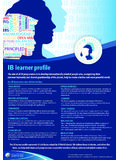
4 To this end the organization works with schools, governments and International organizations to develop challenging programmes of International education and rigorous assessment. These programmes encourage students across the world to become active, compassionate and lifelong learners who understand that other people, with their differences, can also be right. ib learner profile The aim of all IB programmes is to develop internationally minded people who, recognizing their common humanity and shared guardianship of the planet, help to create a better and more peaceful world. IB learners strive to be: Inquirers They develop their natural curiosity.
5 They acquire the skills necessary to conduct inquiry and research and show independence in learning. They actively enjoy learning and this love of learning will be sustained throughout their lives. Knowledgeable They explore concepts, ideas and issues that have local and global significance. In so doing, they acquire in-depth knowledge and develop understanding across a broad and balanced range of disciplines. Thinkers They exercise initiative in applying thinking skills critically and creatively to recognize and approach complex problems, and make reasoned, ethical decisions. Communicators They understand and express ideas and information confidently and creatively in more than one language and in a variety of modes of communication.
6 They work effectively and willingly in collaboration with others. Principled They act with integrity and honesty, with a strong sense of fairness, justice and respect for the dignity of the individual, groups and communities. They take responsibility for their own actions and the consequences that accompany them. Open-minded They understand and appreciate their own cultures and personal histories, and are open to the perspectives, values and traditions of other individuals and communities. They are accustomed to seeking and evaluating a range of points of view, and are willing to grow from the experience.
7 Caring They show empathy, compassion and respect towards the needs and feelings of others. They have a personal commitment to service, and act to make a positive difference to the lives of others and to the environment. Risk-takers They approach unfamiliar situations and uncertainty with courage and forethought, and have the independence of spirit to explore new roles, ideas and strategies. They are brave and articulate in defending their beliefs. Balanced They understand the importance of intellectual, physical and emotional balance to achieve personal well-being for themselves and others. Reflective They give thoughtful consideration to their own learning and experience.
8 They are able to assess and understand their strengths and limitations in order to support their learning and personal development. Contents Introduction 1. Why cite 2. What to cite 3. When to cite 4. How to cite 5. Definitions 11. Documentation checklist 14. Elements to be included in the reference 16. Effective citing and referencing Introduction In the International Baccalaureate (IB) community we produce different types of documents and other forms of work, some of which rely on resources by other people. Following good academic practice, it is expected that we appropriately acknowledge any ideas, words, or work of other people.
9 This means that, when creating an authentic piece of work, we are expected to: undertake research on what is already known analyse the research in the context of the work to be produced compare and/or contrast existing knowledge against our own findings/thoughts/opinions synthesize and present the document in an appropriate way for the expected audience acknowledge all contributing sources appropriately. The ways in which we can acknowledge contributing sources appropriately may vary according to the type of work we produce. Sources are acknowledged differently in a press release or magazine article, in a piece of fiction, in artwork or a musical performance, a slide presentation, film clip or radio broadcast.
10 The important, honest thing for us to do in these and other types of work is to acknowledge our sources and influences in some way. In academic writing, and in any work presented for assessment, not only is it necessary to acknowledge our sources appropriately, but it is regarded as important that the acknowledgments be made using a consistent style. The use of a style guide helps us to ensure this consistency. When we use other people's words, work and ideas to support our own ideas, or to demonstrate divergent opinion, it is essential that we indicate whose words and work we are using. Any reader would benefit from seeing just how the other person's work contributes to ours.