Transcription of Effective December 2017 4424 XV Supercapacitor
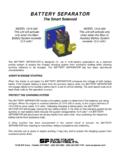
1 Technical Data 4424 Effective December 2017 Supersedes October 2014XV SupercapacitorCylindrical snap-inDescriptionEaton supercapacitors are unique, ultra-high capacitance devices utilizing electrochemical double layer capacitor (EDLC) construction combined with new, high performance materials. This combination of advanced technologies allows Eaton to offer a wide variety of capacitor solutions tailored to specific applications that range from a few microamps for several days to several amps for and benefits Over 10-year operating life at room temperature Ultra low ESR for high power density Large capacitance for high energy density Long cycle life UL RecognizedApplications Hybrid battery or fuel cell systems High pulse current applications UPS / hold up powerPbHALOGENHFFREE2 Technical Data 4424 Effective December 2017XV SupercapacitorCylindrical snap-in F to 600 FWorking VSurge VCapacitance tolerance-5% to +10%Operating temperature range-40 C to +65
2 CExtended operating temperature range-40 C to +85 C (with voltage derating to V @ +85 C)Standard Product1 Capacitance (F)Part NumberMax. initial DC ESR (m ) (Equivalent Series Resistance)Max continuous current2 (A)Peak current3 (A)Max leakage current4 (mA)Max power5 (W)Stored energy6 (Wh)Typical mass (g) 1. Capacitance, ESR and Leakage current are all measured according to IEC 62391-1 at +20 C2. 15 C Temperature Rise3. Peak Current is for 1 second = 1 2 Working Voltage x Capacitance / (1 + DC ESR x Capacitance) 4. Leakage current measured after 72 hours, +20 C5. Max. Power = Working Voltage2 / 4 / DC ESR6. Stored energy = 1 2 Capacitance x Working Voltage2 / 3600 PerformanceParameterCapacitance Change (% of initial value)ESR (% of max.)
3 Initial value)Life@ Max. operating voltage and temp)1500 hours 20% 200%Charge/discharge cycling1500,000 20% 200%Storage Life- uncharged-40 C to +65 C1500 hours 20% 200% 30 C3 years 5% 10%1. Cycling between max operating and 50% of max operating voltage at room temperature3 Technical Data 4424 Effective December 2017rXV SupercapacitorCylindrical snap-in (mm)Part NumberL Part Numbering SystemXV3560-2R740 7-RFamily CodeSize reference- mmDiameter LengthVoltage (V) R = DecimalCapacitance ( F)Standard productValue MultiplierXV = Family Code35602R7= VExample: 407= 40 x 107 F or 400 FPackaging Information Standard packaging: 20 pieces per boxPart Marking Manufacturer Capacitance (F) Max operating voltage (V) Series code (or part number) 0 TerminalPositive TerminalBlank TerminalFor Mechanical L patterns.
4 4- dia Division1000 Eaton BoulevardCleveland, OH 44122 United 2017 EatonAll Rights ReservedPrinted in USAP ublication No. 4424 BU-SB15053 December 2017 Eaton is a registered other trademarks are property of their respective supercapacitorCylindrical snap-in Technical Data 4424 Effective December 2017 Life Support Policy: Eaton does not authorize the use of any of its products for use in life support devices or systems without the express written approval of an officer of the Company. Life support systems are devices which support or sustain life, and whose failure to perform, when properly used in accordance with instructions for use provided in the labeling, can be reasonably expected to result in significant injury to the solder profileProfile FeatureStandard SnPb SolderLead (Pb) Free SolderPreheat and soak Temperature max.
5 (Tsmax)100 C100 C Time seconds60 secondsD preheat to max Temperature160 C C temperature (TP)*220 C 260 C250 C 260 CTime at peak temperature (tp)10 seconds max 5 seconds max each wave10 seconds max 5 seconds max each waveRamp-down rate~ 2 K/s min ~ K/s typ ~5 K/s max~ 2 K/s min ~ K/s typ ~5 K/s maxTime 25 C to 25 C4 minutes4 minutesManual solder+350 C, 4-5 seconds. (by soldering iron), generally manual, hand soldering is not cleaning of circuit boards, however if the circuit board must be cleaned use static or ultrasonic immersion in a standard circuit board cleaning fluid for no more than 5 minutes and a maximum temperature of +60 C. Afterwards thoroughly rinse and dry the circuit boards.
6 In general, treat supercapacitors in the same manner you would an aluminum electrolytic Time TsminTsmax Tstyp Tp tp First Wave Second Wave Preheat area Cool down area