Transcription of Electret microphone replacement for a carbon insert
1 The VMARS Newsletter Issue 2914 June 2003 Electret microphone replacement for a carbon insertColin Guy G4 DDIWhen I found that I had a dud carbon insert in an H33F/PT handset, and I couldn t find another insert that fitted (theoriginal is about 1 diameter) I looked around for an alternative. Trevor Sanderson s excellent article The RAFM icrophone (Radio Bygones issue 79/80) makes reference to the use of Electret inserts with an IC preamplifier intelephones and aircraft headsets, but the information given was too scant to make construction of one of these possiblewithout reference to the IC data sheet, and the IC s are expensive and difficult to obtain.
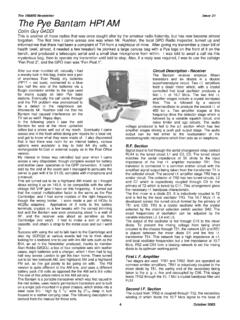
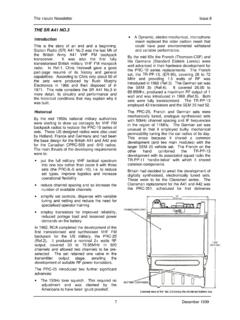
2 I had a GPO type 21A insert , butthe innards of this when dismantled were still too large to fit into the available space. The H33 handset is very slim, andalso virtually solid, so there is very little room in which to place a preamplifier. A dig around on the internet turned up thefollowing article written by F. Hueber, originally published in Elektor Electronics December 1994, and is published herewith permission fromElektor Electronics magazine, December 1994, copyright Segment ,Beek (Lb.), TheNetherlands, The original article included a pcb layout, but I built mine on a strip of veroboard fourtracks wide by about 2 (see photo) and mounted it on the back of the ptt switch. The Electret insert was acquired from ascrap telephone and all the rest of the components from TV panels.
3 To save space the rectifier and R12 weren t included,care being taken to ensure that the polarity was correct. Although many older telephone sets are electrically andmechanically perfectly sound units, their speech quality ispoor compared with that of modern, all-electronic, sets(except the cheap types used in domestic intercoms). Thereason for this deficiency is the carbon microphone in themouthpiece. Here, an up-to-date replacement is discussedfor the carbon microphone . It takes the form of an electretmicrophone and an amplifier with a special circuit diagram shows a conventional three-stagedirect-coupled transistor amplifier whose output signal issuperimposed on the supply voltage.
4 In this way, theamplifier is fully compatible (electrically, that is) with acarbon microphone . Only the sound is much an Electret microphone has a virtually straightfrequency response, the function of pass-band shaping istransferred to the amplifier. Here, thecircuit is laid out to give a frequencyresponse suitable for telephony, ,about 500 Hz to kHz. Themicrophone signal is first sent througha high-pass filter, CI-R2 The high-frequency roll-off is achieved with theaid of capacitor C3 and resistor R2 inthe feedback circuit between T2 andT1. Capacitors C2 and C5 serve tosuppress signals which may bepicked up by the telephone line, thereceiver cord, or the electretmicrophone.
5 R6 and C4 improve theamplifier's stability. The behaviourof the amplifier is such that it behaveslike a carbon microphone , , as anon-linear resistance. Diodes D1 - D4at the amplifier output form a full-waverectifier which provides an amplifiersupply voltage which is sufficientlyindependent from the telephone line current (which canvary between 15 mA and 150 mA depending on thetelephone system, line length. and other factors). Also, therectifier ensures the correct supply polarity in all cases. Forthe audio signal, the rectifier is simply not there since thediodes conduct as a result of the line current which flowswhen the receiver is lifted. The two zener diodes, D1 andD2, are included as protective devices -- they behave likeordinary diodes as long as the voltage on the line terminalsremains below the zener voltage.
6 If a higher voltage occurson the line, the zeners still conduct, keeping the amplifiersupply voltage within safe limits with the aid of amplifier is built on the board shown, so that it canactually replace the carbon microphone , which is carefullyremoved from the mouthpiece. Since many different typesof telephone exist, the best way of doing this will have to befigured out carefully. In most cases, it will be necessary tosolder wires to the spring terminals provided for the originalcarbon transmitter. The Electret microphone is secured atthe solder side of the board, and connected with shortwires to the copper tracks that form the amplifier trimming it to size, the completed board is mountedupside down into the mouthpiece, and glued into solder side of the board should be sprayed withprotective lacquer, or covered with a potting compound toprotect it against the heavily corrosive effect of breath.
7 Insome cases, you may also use the thin disc originally usedto cover the carbon microphone . Every care should betaken to ensure that the amplifier and the electretmicrophone are securely mounted in the mouthpiece. Ifthey are not, lifting the receiver and moving it about willcause noise, which defeats the use of the circuit becausemechanical noise is an inherent disadvantage of the oldcarbon microphone ![Components list is on page 16.]