Transcription of Electronics and Communication Engineering EC 2351 ...
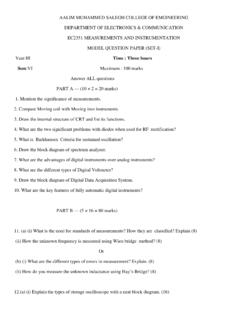
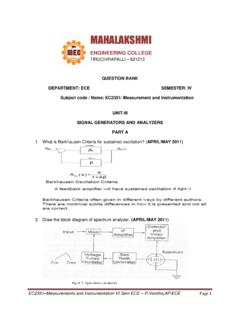
1 Anna University sample Question Paper DEGREE EXAMINATION, APRIL/MAY 2011 Sixth Semester Electronics and Communication Engineering EC 2351 MEASUREMENTS AND instrumentation (Regulation 2008) Time : Three hours Maximum : 100 marks Answer ALL questions PART A (10 2 = 20 marks) 1. Mention the significance of measurements. 2. Compare Moving coil with Moving iron instruments. 3. Draw the internal structure of CRT and list its functions. 4. What are the two significant problems with diodes when used for RF rectification? 5. What is Barkhausen Criteria for sustained oscillation? 6. Draw the block diagram of spectrum analyzer. 7. What are the advantages of digital instruments over analog instruments? 8. What are the different types of Digital Voltmeter? 9. Draw the block diagram of Digital Data Acquisition System. 10. What are the key features of fully automatic digital instruments? PART B (5 16 = 80 marks) 11. (a) (i) What is the need for standards of measurements?
2 How they are classified? Explain (8) (ii) How the unknown frequency is measured using Wein bridge method? (8) Or (b) (i) What are the different types of errors in measurement ? Explain. (8) (ii) How do you measure the unknown inductance using Hay Bridge? (8) 12. (a) (i) Draw the block diagram of sampling oscilloscope and explain the principle. (8) (ii) Explain the measurement of quality factor of a coil. (8) Or (b) (i) Discuss the measurement of DC and AC voltages and currentsusing an electronic Multimeter. (8) (ii) Draw the block diagram of True RMS reading voltmeter and explain its operation. (8) 13. (a) (i) Explain how function generator generates sine wave, triangular wave and square wave. (8) (ii) Draw the block diagram of sweep-frequency generator and explain.
3 (8) Or (b) (i) What is wave analyzer? How it analyzes the harmonics? Explain. (8) (ii) Explain the vector network analyzer and list its application. (8) 14. (a) (i) How computer controlled measurement system is used for testing radio receiver? (8) (ii) What is virtual instrument? List the advantages of virtual instrument over conventional instrument (8) Or (b) (i) With necessary diagrams explain Ramp type digital voltmeter. (8) (ii) Draw the block diagram of digital frequency meter and explain. (8) 15. (a) (i) What are the factors to be considered while interfacing transducers to electronic control and measuring systems? (8) (ii) Draw the block schematic representation of the IEEE 488 instrumentation bus and explain. (8) Or (b) (i) Explain the optical time domain reflectometer with a neat diagram.
4 (8) (ii) Write a detailed note on data loggers. (8) DEGREE EXAMINATION NOVEMBER/DECEMBER 2007 Sixth Semester Electrical and Electronics Engineering EI 1361 --MEASUREMENTS AND instrumentation (Regulation 2004) Time:Three hours Maximum marks:100 Answer ALL questions PART A (10 x 2=20 marks) 1. Distinguish between the direct and indirect methods of measurements. 2. With one example explain "Instrumental Errors" 3. Explain the principle of analog type electrical instruments. 4. How a PMMC meter can be used as voltmeter and ammeter? 5. Draw Maxwell s AC Bridge and give the balance equation interms of resistance. 6. Explain any two technical parameters to be consider in grounding. 7. Explain the characteristics of Time domain output device using in measurements. 8. Explain the following term as applied to digital displays. 3 digit and 4 digit displays. 9. Define inverse transducer with example.
5 10. Explain the principle of piezoelectric transducers and name any two piezoelectric materials. PART B (5 x 16 =80) 11 (i) What are the basic blocks of a generalized instrumentation system. Draw the various blocks and explain their functions. (10) (ii) Explain in detail calibration technique and draw the calibration curve in general. (6) (or) (b) (i) Discuss in detail various types errors associated in measurement and how these errors can be minimized? (10) (ii)Define the following terms in the context of normal frequency distribution of data (6) (1)Mean value (2)Standard Deviation (3)Average(4) Variance 12. (a) Describe the construction, principle of working and applications of synchro transformers. (or) (b) Discuss why is it necessary to carry out frequency domain analysis of measurement systems? What are the two plots obtained when the frequency response of a system is carried out? (16) 13 (a) Explain voltage sensitive self balancing bridge, and derive the bridge sensitivity of voltage sensitive bridge with fundamentals.
6 (16) (or) (b) (i) With fundamentals distinguish between DC and AC potentiometers, and give any two specific applications for each.(8) (ii) Discuss the advantages and limitations of electromagnetic interference in measurements. (8) 14. (a) Describe the construction and working of LCDs, mention the difference between light scattering and field effect types of LCDs, also explain the advantages of LCDs. (16) (or) (b) (i) What is an XY recorders? How do you distinguish is from X - t and Y - t recorders? (8) (ii) Describe the pulse duration modulation (PDM) as used in magnetic tape recording and explain its merits and demerits. (8) 15. (a) (i) Describe the different criteria for selection transducers for a particular application. (8) (ii) Explain the different principles of working of capacitive transducers. (8) Or (b) (i) How is a differential output taken from an inductive transducer?
7 Explain the advantages when inductive transducers are used in push - pull configuration. (8) (ii) Describe in detail the successive approximation method of analog to digital conversion. (8) DEGREE EXAMINATION, MAY/JUNE 2010. Sixth Semester Electronics and Communication Engineering EC1255-MEASUREMENTS ANDINSTRUMENTAION (Regulation 2004) Time:3hrs Maximum:100marks Answer ALL questions. PART A - (10X2=20 marks) 1. What are the different types of standard of measurement ? 2. What is a transfer instrument? 3. How is the electron beam focused to a fine spot on the face of the cathode ray tube? 4. List the disadvantages of storage cathode ray tube. 5. Give the functions of an attenuator in a signal generator. 6. What are the draw backs of tuned circuit analyzers? 7. What is the importance of gate time in frequency counter? 8. How is trigger time error reduced? 9. Distinguish between analog and digital data acquisition systems.
8 10. How much elapsed time would occur to a reflection from a break in an optical fibre of if the index of refraction of the core was PART B - (16X5=80 marks) 11.(a)(i)With a neat diagram explain in detail the construction of PMMC instrument.(8 ) (ii)How do you measure large currents in PMMC instruments?(4) (iii)What is Ayrton shunt?(4) Or (b)(i)Discuss in detail about Kelvin double bridge.(8 ) (ii)With a neat diagram explain in detail about Hay bridge.(8 ) 12.(a)With a neat diagram explain in detail about (i)Ramp type DVM(8 ) (ii)Successive approximation DVM.(8 ) Or (b)With a neat block diagram explain in detail about vector impedance meter.(16) 13.(a)With a neat block diagram explain in detail about the frequency divider typer of signal generator with frequency modulation.(16) Or (b)Explain: (i)General purpose spectrum analyzer.(8 ) (ii)Phase locked circuit for the first local oscillator of spectrum analyzer.(8 ) 14.
9 (a)(i)What method can be used to increase the frequency range of frequency counter.(8 ) (ii)How can this be achieved without degrading the accuracy of the counter.(8 ) Or (b)Discuss in detail about (i)Gating error (ii)Time-base error and trigger level error. (iii)Maximum accuracy achieved for frequency measurements. 15.(a)(i)What are the requirements of an automatic test system? (ii)Explain in detail about IEEE 488 system. Or (b)With a neat block diagram explain (i)Optical power meter (ii) Auto ranging power meter (iii) Optical time-domain reflectometer. DEGREE EXAMINATION, NOVEMBER/DECEMBER 2010 Third emester Electrical and Electronics Engineering EE 2201 MEASUREMENTS AND instrumentation (Regulation 2008) Time : Three hours Maximum : 100 Marks Answer ALL questions PART A (10 2 = 20 Marks) 1. Define static characteristics of an instrument. 2. What is meant by absolute error of measurement ? 3. Why are the ordinary watt-meters not suitable for low power factor circuits?
10 4. What is a phase sequence indicator? 5. List the application of potentiometers. 6. What are parasitic voltages and how are they eliminated? 7. What is the purpose of a Post Deflection Acceleration (PDA) in a CRT? 8. Differentiate between LED and LCD. 9. What are the classifications of encoder? 10. What is the need of sample and hold circuit in A/D converter? PART B (5 16 = 80 Marks) 11. (a) (i) Draw the block diagram of functional elements of measuring system and explain the function of each block. (Marks 8) (ii) Explain the different types of errors in measurements. (8) Or (b) (i) The probable values of two resistors and their are specified as R1 , = , R2 = , = . Find the probable value and for the two resistors when they are connected in (1) Series and (2) Parallel. (Marks 8) (ii) Discuss the different types of standards of measurements. (Marks 8) 12. (a) (i) What are the various types of digital voltmeters?