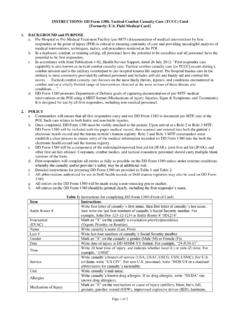
Transcription of EM#Basic–#Tactical#Combat#Casualty#Care(TCCC)# AKA ...
1 EM Basic tactical combat casualty care (TCCC) AKA care Under Fire AKA care in the immediately unsafe scene (This document doesn t reflect the views or opinions of the Department of Defense, the US Army, the US Air Frorce, the SAUSHEC EM residency program, the Wright- Pratt Department of EM 2015 EM Basic, Steve Carroll DO. May freely distribute with proper attribution) Author: Andrew Bohn, MD. Military Emergency Physician/Flight Surgeon Disclaimers: No financial conflict of interest Concepts: tactical scenes (overall command) is police or combatant chain of command Good medicine may be bad tactics, bad tactics cause more casualties.
2 Right intervention at the right time Relative scene safety phases of care Resource constrained environment most good for the most people Military vs civilian battlefield vs. active shooter vs standoff, SABC vs no medical training at all What causes death? 66% of preventable deaths were extremity hemorrhage 30 % Tension pneumothorax ~3% airway Selective immobilization blunt(incl blast) vs penetrating care of the enemy combatant Same standard of care Disarmed, swept, with a guard Definitions: TCCC (TC3, T- Triple- C) joint military/civilian curriculum, NAEMT/PHTLS Combine good tactics with best possible medicine Phases of care .
3 care under fire (misnomer) tactical Field care TACEVAC care care Under Fire care in the imminently unsafe scene : Step 1: Fire superiority on the objective NO medical care can be rendered when receiving effective enemy fire. Don t get dead. Step 2: Clear the battlefield a) casualty collection point (CCP)- defined by tactical COMMAND a. Don t open your aid bag anywhere else b) Voice triage- call out to injured a.
4 Walking wounded triaged to SABC in military, once over by secondary medic in civilian b. Those who can wave but not walk will probably survive at least another 60 seconds, but likely require intervention of some sort. c) Physical triage a. START protocol, consider deviation only if very limited number of patients Step 3: Immediate life saving interventions a) Tourniquet, high/hasty over clothes b) Defer any other management Step 4: Move to CCP (COVER, not merely concealment) tactical Field care care in the potentially unsafe scene what was a safe place may become unsafe.
5 MARCH algorithm vs ABCs- MARCH is the better approach, especially with blast or penetrating injuries Massive hemorrhage, Airway, Respirations, Cardiac, Head injury/Hypothermia Primary survey, immediate intervention, reassess then delayed intervention 1) Massive hemorrhage a. Reassess tourniquets b. Blood sweep (cut clothes, remove armor) i. DOWNSIDE INJURY ii. Strap cutter vs. scissors iii. Disarm c. Pack junctional regions PRN i. Specific techniques beyond scope 2) Airway a.
6 Patent, not patent, THREATENED i. No intervention, immediate intervention, potential delayed intervention b. Biggest bang for least time i. Nasal trumpet ii. Supraglottic iii. ET tube iv. Cric 3) Respirations a. Open PTx i. Chest seal, ideally vented b. Evidence of TPTx i. Classic signs are late ii. Long needles c. Flail segments 4) Cardiac (pulses) a. Pulse correlation to BP has been debunked, but radial pulse generally = brain perfusion b. Not everyone needs fluids.
7 5) Head injury/Hypothermia a. DISARM any confused/altered/unresponsive patient i. GENTLY the weapon is their friend. Enlist another trusted friend b. Avoid further injury i. Head up if possible ii. No tight C- collar iii. Ensure open airway/respirations c. C- spine immobilization PRN (large blast/ blunt injury, NOT penetrating and/or GLF) d. Avoid hypothermia i. HPMK ii. Blankets iii. Warm vehicle 6) Fine tune interventions a. Deliberate tourniquet (taped, timed) b.
8 Analgesics c. Antibiotics d. Delayed airway intervention 7) REASSESS TACEVAC care ( care while leaving the scene) 1) Generally more equipment available a. Monitors b. Oxygen c. Drugs 2) Reassess all interventions (tourniquets, chest movement, pulse) a. Apply monitors b. Fine tune interventions c. Enroute critical care Review: 1) Right intervention at the right tactical time 2) Death from bleeding, PTx, Airway 3) Fire superiority first 4) MARCH 5) Selective immobilization 6) Be prepared for phase changes Contact Steve Carroll Twitter- @embasic