Transcription of EMERGENCY OPERATIONS ENTRE
1 EMERGENCY OPERATIONS CENTRE Operational Guidelines 2nd Edition Table of Contents EMERGENCY OPERATIONS CENTRE - Operational Guidelines i. TTaabbllee ooff CCoonntteennttss 1 1-1 Purpose and 1-1 EMERGENCY Response Organization .. 1-1 Incident Command Post .. 1-2 Department OPERATIONS Centres .. 1-2 EMERGENCY OPERATIONS 1-2 Provincial Regional EMERGENCY OPERATIONS 1-3 Provincial EMERGENCY Coordination Centre .. 1-3 EOC Management Considerations .. 1-4 Direction, Control and Reporting Relationships in 1-7 EOC Site Support Organization Chart .. 1-8 EOC 2 EOC Activation and 2-1 EOC Activation Levels .. 2-2 EOC Activation Flowchart .. 2-4 Notification Procedures .. 2-5 EOC Staffing.
2 2-5 Personnel and Facility 2-7 EOC Facility & 2-7 Telecommunications .. 2-9 Response Management by 2-14 Operational Periods .. 2-15 Action Plans .. 2-15 Information Flow / 2-17 Documentation ..2-19 Resource Management .. 2-20 2-23 Relief and Recovery .. 2-24 Risk Management .. 2-25 Declaring State of Local and / or Provincial 2-27 EMERGENCY Declaration Process - EMERGENCY Program Act .. 2-29 Cancelling a Declaration of State of Local 2-30 Evacuation Orders .. 2-31 Evacuation EOC Team Building .. 2-34 Managing Conflict in the 2-35 POSITION CHECKLIST AND 3 Generic EOC Checklist For All Positions .. 3-3 Policy 3-5 Table of Contents ii. EMERGENCY OPERATIONS CENTRE - Operational Guidelines TTaabbllee ooff CCoonntteennttss CCoonntt EOC Management: EOC Director.
3 3-9 EOC Deputy Director .. 3-13 Liaison Officer ..3-17 Risk Management 3-21 Information 3-25 OPERATIONS Section: OPERATIONS Section Chief .. 3-31 Air OPERATIONS Branch Coordinator .. 3-35 Special OPERATIONS Branch 3-39 Fire Branch Coordinator .. 3-43 Police Branch Coordinator .. 3-47 Ambulance Branch Coordinator .. 3-51 Health Branch 3-55 Environmental Branch Coordinator .. 3-59 EMERGENCY Social Services Branch Coordinator .. 3-63 Engineering Branch 3-67 Utilities Branch Coordinator .. 3-71 Planning Section: Planning Section 3-75 Situation Unit Coordinator .. 3-79 Resource Unit 3-83 Demobilization Unit Coordinator .. 3-87 Advance Planning Unit Coordinator .. 3-89 Recovery Unit Coordinator .. 3-93 Documentation Unit 3-97 Technical Specialists Unit Coordinator.
4 3-100 Logistics Section: Logistics Section Chief .. 3-105 Information Technology Branch Coordinator .. 3-109 Transportation Unit 3-113 Personnel Unit 3-117 Supply Unit Coordinator .. 3-121 EOC Support Branch 3-125 Finance / Administration Section: Finance / Administration Section Chief .. 3-129 Time Unit Coordinator .. 3-133 Procurement Unit 3-137 Compensation and Claims Unit 3-141 Cost Accounting Unit 3-145 FORMS AND 4-1 5-1 Table of Contents EMERGENCY OPERATIONS CENTRE - Operational Guidelines iii. TTaabbllee ooff CCoonntteennttss CCoonntt List of Figures Figure 0-1 Roles in EOC Functions .. 1-4 Figure 1-1 Direction, Control and Reporting Relationships in BCERMS .. 1-7 Figure 1-2 EOC Site Support Organization 1-8 Figure 2-1 Resource Management.
5 2-21 Acronyms: AES Atmospheric Environment Service BCAS BC Ambulance Service BCERMS British Columbia EMERGENCY Response Management System DFA Disaster Financial Assistance DOC Department OPERATIONS Centre EOC EMERGENCY OPERATIONS Centre ESS EMERGENCY Social Services GIS Geographical Information System HUSAR Heavy Urban Search and Rescue IC Incident Commander ICP Incident Command Post ICS Incident Command System JEPP Joint EMERGENCY Preparedness Program JIBC Justice Institute of BC MAF Ministry of Agriculture & Food MOF Ministry of Forests
6 MOT Ministry of Transportation PECC Provincial EMERGENCY Coordination Centre PEP Provincial EMERGENCY Program PREOC Provincial Regional EMERGENCY OPERATIONS Centre PS Public Safety Canada RECC Regional EMERGENCY Coordination Centre SAR Search and Rescue Table of Contents iv. EMERGENCY OPERATIONS CENTRE - Operational Guidelines 1 Overview EMERGENCY OPERATIONS CENTRE - Operational Guidelines 1-1 11 -- OOvveerrvviieeww Introduction These Guidelines are intended for use by all members of an EMERGENCY OPERATIONS Centre (EOC) in the event of a major EMERGENCY . They follow the requirements of the British Columbia EMERGENCY Response Management System (BCERMS), Site Support Coordination level standard, and are also intended to provide guidance during the recovery phase.
7 These Operational Guidelines are a component in the series of BCERMS publications and materials. Reference should be made to the BCERMS Standard and Overview documents as well as any appropriate hazard plans. Purpose and Scope This document guides the management, organization, responsibilities, and coordination necessary to provide for effective response and recovery from major emergencies or disasters at the Site Support (EOC) Level. This document does not address emergencies that are normally handled at the scene by the appropriate first responding agencies. The Guidelines address incidents or events that may cause damage of sufficient severity and magnitude to warrant activation of a Department OPERATIONS Centre (DOC) and / or an EMERGENCY OPERATIONS Centre (EOC).
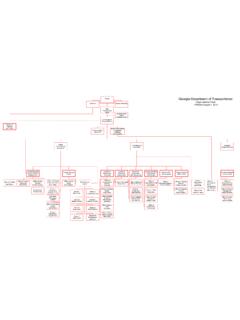
8 EMERGENCY Response Organization These Operational Guidelines utilize the BCERMS Site Support Level Standard as its organizational structure (Figures 1-2 and 1-3). An Incident Commander is always present to oversee site activities, and an EMERGENCY OPERATIONS Centre (if required) is activated to oversee and coordinate all non-site activities. If the EMERGENCY is very large, two or more EOCs are established, or an EMERGENCY occurs in an unorganized area, then a Provincial Regional EMERGENCY OPERATIONS Centre (PREOC) may be established to provide support and coordination. If a PREOC is established, then the Provincial EMERGENCY Coordination Centre (PECC) in Victoria is also established. 1 Overview 1-2 EMERGENCY OPERATIONS CENTRE - Operational Guidelines Incident Command Post The Incident Command Post (ICP) is the location from which the Incident Commander directs the site response to the EMERGENCY .
9 Incident objectives, strategies and tactics for the site are formulated and directed from the ICP. Department OPERATIONS Centres In some emergencies, agencies that require unique local support for their OPERATIONS may establish a Department OPERATIONS Centre (DOC). A DOC is primarily concerned with supporting the OPERATIONS of the agency and ensuring regular activities continue. The DOC will focus on such issues as staff scheduling, obtaining, coordinating and directing highly specialized resources for the agency to fulfill its mission. The Agency Executive may be located at the DOC. The EOC s relationship to a DOC is usually one of policy direction and support or assistance in facilitating resources or actions at the request of the DOC Director.
10 A DOC, if established by a provincial agency, must utilize the BCERMS standards; however, it is recognized that many of the functional positions outlined in these guidelines will not be applicable. DOCs established by provincial agencies may call for support from a PREOC or their Ministry s Regional EMERGENCY OPERATIONS Centre, if activated. EMERGENCY OPERATIONS Centres EMERGENCY OPERATIONS Centres (EOC) are normally activated at the request of the Incident Commander or senior municipal officials to provide overall jurisdictional direction and control, coordination and resource support. It is recommended that an EOC utilize the BCERMS principles for organizing and managing EOC OPERATIONS and activities. By using BCERMS five functional elements an EOC will operate more effectively and consistently with its regional and provincial counterparts.