Transcription of en - Ilex Medical Ltd.
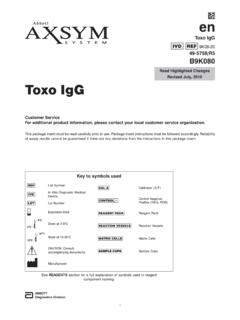
1 1systemenSyphilis TP 8D06F5-Y203-2/R1 syphilis TPCustomer Service: Contact your local representative or find country specific contact information on insert instructions must be carefully followed. Reliability of assay results cannot be guaranteed if there are any deviations from the instructions in this package to symbols usedList NumberIn Vitro Diagnostic Medical DeviceLot NumberExpiration DateStore at 2-8 CConsult instructions for useManufacturerReagent LotSerial NumberReaction VesselsSample CupsSeptumReplacement CapsAssay CD-ROMC ontrol NumberSee REAGENTS section for a full explanation of symbols used in reagentcomponent syphilis TPINTENDED USEThe ARCHITECT syphilis TP assay is a chemiluminescent microparticle immunoassay (CMIA) for the qualitative detection of antibody to Treponema pallidum (TP)
2 In human serum and plasma on the ARCHITECT i System as an aid to diagnosis of AND EXPLANATION OF TEST syphilis is caused by infection with the bacterium TP1 which can be transmitted congenitally or by sexual contact. The disease can evolve into a latent phase in which syphilis is clinically inapparent. Serological tests (nontreponemal and treponemal specific), in addition to patients clinical history, are currently the primary methods for the diagnosis and management of PRINCIPLES OF THE PROCEDUREThe ARCHITECT syphilis TP assay is a two-step immunoassay for the qualitative detection of antibody to TP in human serum or plasma using CMIA technology with flexible assay protocols, referred to as Chemiflex. In the first step, sample, microparticles coated with recombinant TP antigens (TpN15, TpN17 and TpN47) and Assay Diluent are combined.
3 Anti-TP antibodies present in the sample bind to the TP coated microparticles. After washing, the acridinium-labeled anti-human IgG and IgM conjugate is added in the second step. Following another wash cycle, Pre-Trigger and Trigger Solutions are added to the reaction mixture. The resulting chemiluminescent reaction is measured as relative light units (RLUs). A direct relationship exists between the amount of anti-TP antibodies in the sample and the RLUs detected by the ARCHITECT i* optical presence or absence of anti-TP antibodies in the specimen is determined by comparing the chemiluminescent signal in the reaction to the cutoff signal determined from a previous ARCHITECT syphilis TP calibration. If the chemiluminescent signal in the specimen is greater than or equal to the cutoff signal, the specimen is considered reactive for additional information on system and assay technology, refer to the ARCHITECT System Operations Manual, Section * = immunoassayREAGENTSR eagent Kit, 100 Tests/500 TestsNOTE: Some kit sizes are not available in all countries or for use on all ARCHITECT i Systems.
4 Please contact your local syphilis TP Reagent Kit (8D06) 1 Bottle ( mL per 100 test mL per 500 test bottle) Microparticles: TP ( , recombinant) antigen coated microparticles in MES buffer. Minimum concentration: solids. Preservatives: sodium azide and other antimicrobial agents. 1 Bottle ( mL per 100 test mL per 500 test bottle) Conjugate: Murine anti-IgG/anti-IgM acridinium-labeled conjugate in MES buffer with protein (bovine) stabilizer. Minimum concentration: (anti-IgG) ng/mL / (anti-IgM) ng/mL. Preservatives: sodium azide and other antimicrobial agents. 1 Bottle ( mL per 100 test mL per 500 test bottle) syphilis TP Assay Diluent containing MES buffer. Preservatives: sodium azide and other antimicrobial ReagentsARCHITECT i Pre-Trigger Solution Pre-Trigger Solution containing (w/v) hydrogen peroxide.
5 ARCHITECT i Trigger Solution Trigger Solution containing N sodium hydroxide. ARCHITECT i Wash Buffer Wash Buffer containing phosphate buffered saline solution. Preservatives: antimicrobial AND PRECAUTIONS For In Vitro Diagnostic UsePackage insert instructions must be carefully followed. Reliability of assay results cannot be guaranteed if there are any deviations from the instructions in this package PrecautionsCAUTION: This product requires the handling of human specimens. It is recommended that all human sourced materials be considered potentially infectious and handled in accordance with the OSHA Standard on Bloodborne Biosafety Level 23 or other appropriate biosafety practices4,5 should be used for materials that contain or are suspected of containing infectious product contains sodium azide; for a specific listing, refer to the REAGENTS section.
6 Contact with acids liberates very toxic gas. This material and its container must be disposed of in a safe product not classified as dangerous per European Directive 1999/45/EC as amended - Safety data sheet available for professional user on information on the safe disposal of sodium azide and a detailed discussion of safety precautions during system operation, refer to the ARCHITECT System Operations Manual, Section PrecautionsDo not use reagent kits beyond the expiration date. Do not pool reagents within a kit or between reagent kits. Before loading the ARCHITECT syphilis TP Reagent Kit on the system for the first time, the microparticle bottle requires mixing to resuspend microparticles that have settled during shipment. For microparticle mixing instructions, refer to the PROCEDURE, Assay Procedure section of this package MUST be used to prevent reagent evaporation and contamination and to ensure reagent integrity.
7 Reliability of assay results cannot be guaranteed if septums are not used according to the instructions in this package avoid contamination, wear clean gloves when placing a septum on an uncapped reagent handling conjugate vials, change gloves that have contacted human serum or plasma, since introduction of human IgG/IgM will result in a neutralized a septum has been placed on an open reagent bottle, do not invert the bottle as this will result in reagent leakage and may compromise assay time, residual liquids may dry on the septum surface. These are typically dried salts which have no effect on assay a detailed discussion of handling precautions during system operation, refer to the ARCHITECT System Operations Manual, Section Instructions The ARCHITECT syphilis TP Reagent Kit must be stored at 2-8 C in an upright position and may be used immediately after removal from 2-8 C stored and handled as directed, reagents are stable until the expiration ARCHITECT syphilis TP Reagent Kit may be stored on board the ARCHITECT i System for a maximum of 30 days.
8 After 30 days, the reagent kit must be discarded. For information on tracking onboard time, refer to the ARCHITECT System Operations Manual, Section may be stored on or off the ARCHITECT i System. If reagents are removed from the system, store them at 2-8 C (with septums and replacement caps) in an upright position. For reagents stored off the system, it is recommended that they be stored in their original trays and boxes to ensure they remain upright. If the microparticle bottle does not remain upright (with a septum installed) while in refrigerated storage off the system, the reagent kit must be discarded. For information on unloading reagents, refer to the ARCHITECT System Operations Manual, Section of Reagent DeteriorationWhen a control value is out of the specified range, it may indicate deterioration of the reagents or errors in technique.
9 Associated test results are invalid and samples must be retested. Assay recalibration may be necessary. For troubleshooting information, refer to the ARCHITECT System Operations Manual, Section PROCEDUREThe ARCHITECT syphilis TP assay file must be installed on the ARCHITECT i System from the ARCHITECT i Assay CD-ROM (Addition C) prior to performing the assay. For detailed information on assay file installation and on viewing and editing assay parameters, refer to the ARCHITECT System Operations Manual, Section information on printing assay parameters, refer to the ARCHITECT System Operations Manual, Section a detailed description of system procedures, refer to the ARCHITECT System Operations COLLECTION AND PREPARATION FOR ANALYSISS pecimen Types The specimen collection tubes listed below were verified to be used with the ARCHITECT syphilis TP assay.
10 Other specimen collection tubes have not been tested with this serum (including serum collected in serum separator tubes) Human plasma collected in: Potassium EDTA Sodium citrate Lithium heparin CPD Sodium heparin Liquid anticoagulants may have a dilution effect resulting in lower concentrations for individual patient ARCHITECT i System does not provide the capability to verify specimen type. It is the responsibility of the operator to verify that the correct specimen types are used in the ARCHITECT syphilis TP ConditionsDo not use specimens with the following conditions: heat-inactivated grossly hemolyzed (> 500 mg/dL) obvious microbial contamination cadaver specimens or any other body fluids For accurate results, serum and plasma specimens should be free of fibrin, red blood cells, and other particulate matter.