Transcription of ENCE717 – Bridge Engineering Concrete Bridges …
1 1 ENCE717 Bridge EngineeringReinforced and Prestressed Concrete BridgesChung C. Fu, , (http: ) Concrete Bridges1. Reinforced Concrete (RC) Bridges ( )2. Prestressed Concrete (PC) Bridges ( )i. Precast Pre-tensioned Concrete Bridgesii. Precast/Cast-in-place post-tensioned Concrete Bridgeiii. PC Bridge Modelingiv. PC Bridge Load Rating3. Curved Concrete Bridges ( )Portland Cement Types in BridgesThe AASHTO Specification M85 lists ten types of portland cement I IA Normal, II Moderate sulfate IIA Moderate sulfate resistance, II(MH) Moderate heat of hydration, moderate sulfate II(MH)
2 A Moderate heat of hydration, moderate sulfate resistance, III High early IIIA High early strength, IV Low heat of V High sulfate resistanceHigh-Performance Concrete in Bridges High-Strength Concrete in excess of ksi specified at 56 days to achieve longer span lengths, wider beam spacing, or the use of shallower sections. Low-Permeability Concrete -beneficial in reducing the rate of penetration of chlorides into the Concrete ; most high-strength concretes have a low permeability but not all low permeability concretes have high strength. Self-Consolidating Concrete (SCC) -a highly flowable, nonsegragating Concrete that can spread into place, fill the formwork, and encapsulate the reinforcement without any mechanical consolidation; using a high-rangewater-reducing admixture, and, in some cases, including a viscosity-modifying admixture; more expensive due to more stringent quality control Ultra-High-Performance Concrete (UHPC) -compressive strength greater than ksi.
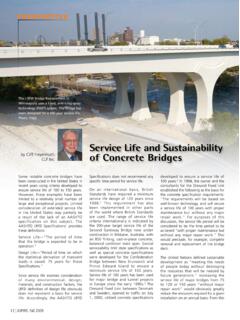
3 A cementitious composite material that contains cement, fine sand, silica fume, ground quartz, superplasticizer, steel or plastic fibers, and waterUHPC applications to footbridges and roadbridges110 32 -52 -30 400 UHPC ApplicationThe first UHPC Bridge constructed in the United States. The Bridge includes three UHPC prestressed I-girders spanning a creek in rural at ambient temperatures, or steam curing up to 115 F (46 C), until the compressive strength of match-cured cylinders attained 14,500 psi (100 MPa).thermal treatment of approximately 190 F (88 C) along with relative humidity of at least 95% for at least 48 hours [5400 psi (37 MPa) at 28 hours, 14,900 psi (103 MPa) at 50 hours, and 32,400 psi (223 MPa) after the second stage Concrete and Steel Material Properties Stress-strain relation for monotonic loading of confined and unconfined Concrete based on Mander, et al.]
4 Model True and Idealized steel stress-strain relationships Stress-strain response of SFRC FRP uniaxial stress-strain curve for carbon and glass FRP composites in the fiber directionBehavior of Non-skewed/Skewed Concrete Beam-Slab BridgesSkew Bridge Behavior Possible alternate load paths Load can travel to obtuse corners of abutment instead of traveling along longitudinal girders Can cause uplifting of acute corners Can cause torsional loads and displacements Act like a Z-shape continuous beamSupport lineSupport line Skew Bridge Shear Behavior Loads are transferred through the shortest distance to the supportsAASHTO Shear Correction on the obtuse corner0 60 , 3 -5 S 16 -0 , 20 L 240 , Nb 4 gskLtgSkew Bridge Moment Behavior Longitudinal moments are reduced due to skew anglesAASHTO Moment Reduction on skew = 1 c1(tan )
5 < 30othen c1= > 60ouse = 60o30 60 , S , 20 L 240 , Nb 4 Interior mid-spanFree edge LSLtkcsgSkew Bridge ReinforcementNarrow Skew BridgeWide Skew BridgeSupportSupportRecommendations Use transverse ties oriented parallel to the Bridge skew Do not build Bridges with a skew greater than 30 Span (ft.)Skew (deg.)Number of Transverse TiesOrientation of Transverse TiesLocation of Transverse Ties20 - 30 302 Parallel to SkewThird Points (L/3)35 - 45 303 Parallel to Skew5 ft. from supports and mid-span (L/2)50 - 55 304 Parallel to Skew5 ft.
6 From supports and 20 ft. from supportsPrinciple and Modeling of Concrete Beam-Slab Bridges Linear elastic modeling production purposes It can be simplified as a beam or a grid The equivalent stiffness can be calculated from equation for rectangular void block or equation for circular block. The most common types of finite element used are flat shell elements A beam-and-slab or cellular Bridge deck may require a three-dimensional (3D) finite element analysis. Nonlinear modeling research/study purposes as an equivalent uniaxial material which is distributing throughout the finite element.
7 It is often referred as smeared steel (smeared model); as discrete bars connected to the nodes in the finite element model (discrete model); as a uniaxial element which is embedded in a larger finite element (embedded model). FRC/FRP modeling research/study purposes The FE model uses a smeared cracking approach for the Concrete and three-dimensional layered elements to model FRP compositesPrestressing steel, Strand Anchors and Couplers Ref: PCI Bridge Design Manual Pretensioning Method Prestress loading stagesTensile Stress Release of Precast Prestressed Concrete GirdersPrestressing strand profiles (a) harped strands (b) debonded strands (the dashed lines indicate debonding material around prestressing strand)(a) harped strands Precast Prestressed Concrete Girders(a) Mid section(b) End sectionFigure - Section of the AASHTO beams with strands(a) harped strands Precast Prestressed Concrete Girders(a)
8 Harped strands Nonprestressed Reinforcement Configurations for Precast Prestressed Concrete GirdersBox BeamI- & Bulb-Tee BeamDeck Bulb-TeeRef: PCI Bridge Design Manual US Practice - Tensile Stress Release of Precast Prestressed Concrete GirdersPrestressing strand profiles (b) debonded strands (the dashed lines indicate debonding material around prestressing strand)Rigid tubing instead of sheathingBulb-tee beam types w/debondUS Practice - Tensile Stress Release of Precast Prestressed Concrete GirdersPrestressing strand profiles (b) debonded strands (Transfer length vs Development length)Mn=Nominal flexure resistance (flexural resistance Mr= Mn)
9 Mu=Factored momentMcr=cracking moment where Mr=min( ,Mcr)Mr MuPrecast Prestressed Concrete GirdersIntermediate Diaphragm AASHTO Standard recommends one intermediate diaphragm at the point of maximum positive moments for spans exceeding 12m (40 ft). ( MD practice) Such diaphragms are used to resist lateral forces and to maintain section geometry, allowing the Bridge to behave as one entity. Also, their presence can help in the construction phase of the Bridge . AASHTO LRFD Specifications allows diaphragms be omitted where tests or structural analysis show them to be unnecessary.
10 Three types of intermediate diaphragms: Steel, In-situ Concrete , and Precast concretePrecast Prestressed Concrete GirdersIntermediate DiaphragmPrecast Prestressed Concrete GirdersFigure - Section of the AASHTO beams with strandsBridge Analysis Approximate MethodSection of the AASHTO beams with strands (simple span for dead load and continuous for live load) Bridge Analysis - Loss of Prestress Estimate(AASHTO LRFD Art. ) Pretensioned members: fpt = fpES+ fpSR+ fpCR+ fpR2 Posttenssioned members: fpt = fpF+ fpA+ fpES+ fpSR+ fpCR+ fpR2where fpt= total loss; fpF= loss due to friction; fpA= loss due to anchorage set; fpES= loss due to elastic shortening; fpSR= loss due to shrinkage; fpCR= loss due to creepof Concrete .