Transcription of ENDOTOXIN (E. coli O113:H10) Control Standard …
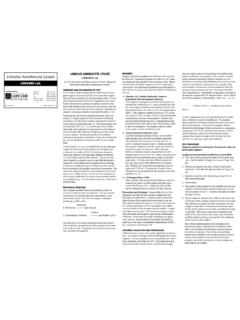
1 ENDOTOXIN (E. coli o113 :H10). Control Standard ENDOTOXIN (CSE). Control Standard ENDOTOXIN (CSE) may be used to prepare controls for the Limulus Amebocyte Lysate (LAL) test or for oven depyro- genation studies. Store at 2-8oC before reconstitution. Directions for use in oven depyrogenation studies are given below. Materials: 1) Control Standard ENDOTOXIN (CSE), 125 g/vial, (catalog #E0125). 2) LAL Reagent Water (LRW). Use sterile water for injection or irrigation (no bacteriostat) or another water certified as an LRW. (see lysate package insert). 3) 5 mL sterile disposable pipets. 4) Parafilm M (American National Can). 5) Dilution tubes (depyrogenated glass tubes or sterile, polystyrene disposables).
2 *. *Disposables should be tested for ENDOTOXIN contamination and interference (adsorption and/or extractable) with the LAL test. Procedure: 1) Remove the metal seal from the vial and aseptically remove the stopper. 2) Add LRW to the vial. Recommended reconstitution volume is 5 mL, however, alternate volumes may be used to achieve desired concentration of stock solution. a. To reconstitute with a pipet, break the vacuum by lifting the stopper just enough to allow air to enter, remove the stopper and add LRW. Seal the vial with Parafilm. 3) Vortex vigorously for one minute, at 5-10 minute intervals over a 30-60 minute period at room temperature. 4) Store reconstituted CSE at 2-8oC for not more than three months.
3 Do not freeze CSE. 5) Vortex the CSE for at least 30 seconds immediately before making the first dilution and then make appropriate dilutions to achieve desired concentrations. The dilutions may be initiated with a hundredfold dilution of the stock concentration (25,000. ng/mL when reconstituted with 5 mL) followed by serial hun- dred or tenfold dilutions. Serial two-fold dilutions may then be made from the 1 or EU/mL concentration to bracket the sensitivity of the LAL gel-clot method or make dilutions appro- priate for the turbidimetric or chromogenic method. Vortex between dilutions; time of mixing may be as little as 4 seconds depending on the volume of the solution.
4 Potency The potency of a given lot of CSE is determined with a specific lot of LAL reagent relative to the current FDA or USP lot of reference Standard ENDOTOXIN (RSE). The potency (EU/ng) is used to convert units of reconstituted CSE from ng/ml to EU/ml. Certificates of analysis stating potency are available from Associates of Cape Cod, Inc. They can be obtained from Customer Service or our website at You must provide the lot number of both the CSE and LAL reagent when making a request. Instructions for Use in the Validation of Depyrogenation Two methods are recommended for using Control Standard ENDOTOXIN (CSE), catalog numbers E0005 and E0125, for monitoring depyrogenation procedures.
5 These are A) Direct (dry) method, or B). Indirect (reconstituted and dispensed). Method A. 1) Remove the label, metal seal and stopper from each vial and cover the vials with a double layer of aluminum foil. 2) Retain a minimum of two vials for use as positive controls. 3) Place the challenge vials in the oven load to be used for the validation. 4) At the end of the depyrogenation process, collect the vials for testing. 5) Reconstitute processed and Control vials of CSE according to the procedure on the reverse side of this sheet. 6) Test all vials as unknowns according to the package insert included with the lysate. 7) Calculate the reduction in ENDOTOXIN between the Control vials and the processed vials (mean measured concentration in Control vials divided by the mean measured concentration in process vials).
6 If the value is 1000 or greater, then the oven has achieved a 3-log or greater reduction**. Method B. 1) Reconstitute a vial according to the procedure on the reverse side of this sheet. 2) Add small aliquots or dilutions of the CSE to material to be depyrogenated. Add an amount sufficient to determine at least three log removal. Take into account any dilution involved to recover added ENDOTOXIN and any loss due to non-recoverable adsorption to the vessel. Include at least two vessels as recov- ery controls. 3) Run material through the depyrogenation procedure. 4) Recover CSE from materials using a minimum amount of LAL. reagent water (LRW). 5) Test with LAL as above.
7 6) Calculate the reduction in ENDOTOXIN as indicated in step 7. above. **Note: Several articles have been published describing depyro- genation procedures and validation. Some are listed below: Bibliography 1. Tsuji, K., and Lewis. 1978. Dry-heat destruction of lipopolysaccharide: Mathematical approach to process validation. Appl. Environ. Microbiol. 36:715-719. 2. Tsuji, K., and Harrison. 1978. Dry-heat destruction of lipopolysaccharide: dry- heat destruction kinetics. Appl. Environ. Microbiol. 36:710-714. 3. Validation of dry heat processes used for sterilization and depyrogenation, Tech. Rpt. No. 3, Parenteral Drug Association, Inc. (1981).
8 4. Akers, , Ketron, and Thompson. 1982. F value requirements for the destruction of ENDOTOXIN in the validation of dry heat sterilization/depyrogenation cycles. J. Parenter. Sci. Technol. 36:23-27. 5. Depyrogenation, Tech. Rpt. No. 7, Parenteral Drug Association, Inc. (1985). 6. LAL UPDATE , Vol. 4, No. 1, 1986. 7. Novitsky, , J. Schmidt-Gengenbach, and Remillard. 1986. Factors affecting the recovery of ENDOTOXIN adsorbed to container surfaces. J. Parenter. Sci. Technol. 40:284-286. 8. Avis, , Jewell, and Ludwig. 1987. Studies on the thermal destruction of Escherichia coli ENDOTOXIN . J. Parenter. Sci. Technol. 41:49-56. 9. LAL UPDATE , Vol. 6, No.
9 2, 1988. 10. Ludwig, , and Avis. 1988. Validation of a heating cell for precisely controlled studies on the thermal destruction of ENDOTOXIN in glass. J. Parenter. Sci. Technol. 43:9-14. 11. Baird, R. 1988. Validation of dry heat tunnels and ovens. Pharm. Engineer. 8:31-33. 12. Ludwig, , and Avis. 1989. Recovery of ENDOTOXIN preparations from the sur- face of glass capillary tubes. J. Parenter. Sci. Technol. 43:276-278. 13. LAL UPDATE , Vol. 8, No. 1, 1990. 14. Ludwig, , and Avis. 1990. Dry heat inactivation of ENDOTOXIN on the surface of glass. J. Parenter. Sci. Technol. 44:412. 15. LAL UPDATE , Vol. 11, No. 5, 1993. ENDOTOXIN (E. coli o113 :H10).
10 Control Standard ENDOTOXIN (CSE). 125 g/vial Manufactured by: Telephone: (508) 540-3444. Toll-Free: (888) 395-2221. Fax: (508) 540-8680. Technical Support: (800) 848-3248. Customer Service: (800) 525-8378. PN000403 Rev 003.