Transcription of ENTHONE M-Series
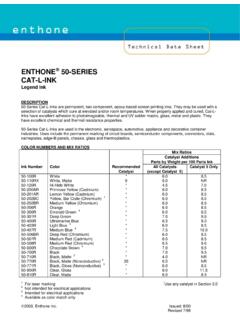
1 Issued: 8/00 2000, ENTHONE : 7/98 ENTHONE M-SeriesPermanent Epoxy Marking InkDESCRIPTIONM-Series inks are permanent, two component, epoxy-based marking inks. They may be used with a selection ofcatalysts which cure at elevated and/or room temperatures. When properly applied and cured, M-Series inks haveexcellent adhesion to glass, metal and thermosetting plastics. They have excellent chemical and thermalresistance marking inks are used in the electronic, aerospace, automotive, appliance and decorative packagingindustries. Uses include the permanent marking of semiconductor components, printed circuit boards, connectors,dials, nameplates, panels, chassis, glass and NUMBERS AND MIX RATIOSMix RatiosCatalyst AdditionsParts by Weight per 100 Parts InkInkNumberColorRecommendedCatalystAll Catalysts(except Catalyst 5)
2 Catalyst 5 OnlyM-1-NM-2-NM-3-NM-4-NM-5-NM-6-NM-7-NM -8-NM-9-NM-0-NM-0-NCBrownRedOrangeYellow GreenBlueVioletGrayWhiteBlackInorganic Black**B-13 NR* Use any catalyst in Section M-SERIEST echnical data SheetPage 2 of 7 CATALYST DESCRIPTIONC atalyst DescriptionCureAveragePot Life*(hours)20/ABasic air cure catalyst. Cures at room temperature in 5-7 days. Tack freeafter 1-2 hours. May also be heat orHeat2B-3 Basic heat cure only catalyst.
3 Higher cure temperatures decrease cure pot life. Excellent adhesion properties. Special mix ratios are requiredfor this heat cure only catalyst (refer to Section ).Heat24 +B-13/28 Accelerated air cure catalyst. Cures at room temperature in 3 days. Shorterpot orHeat145 Long pot life. This heat cure only catalyst contains adhesion excellent adhesion to glass and metals with good water decreases solvent promoting catalyst. Cures at room temperature in 5-7 similar characteristics as Catalyst 45. Maximum adhesion isachieved by heat cure @ oC (150-200oF).
4 OrHeat1* @ 21 C (70 F)MIXING INSTRUCTIONSM easure ink and catalyst at the proper mix ratio (refer to Section ). Both the inkand catalyst should be weighed accurately. Excessive and insufficient amounts ofcatalyst are detrimental to cured ink film thoroughly without introducing excessive amounts of air. Avoid the use of paperor wax coated cups. Stir from bottom of the INDUCTION PERIODAll catalysts:30 minutesCatalysts 45 and 5:60 minutesAllow ink/catalyst mixture to stand for at least 30 minutes prior to application. Thisprovides an induction period ensuring a homogenous mix of resin and catalyst andallows any entrapped air to escape from the mixture.
5 The average pot life begins afterthe induction inks may be applied by hand stamping, machine marking, screen printing, spraying, and roller ensure optimum adhesion, it is imperative that the surface to be printed is clean and free of any residues ADDITIONSA dditions of thinner or flow agents should always follow the induction period. If the induction period is notobserved, the thinner or flow agent may interfere with the catalyzation process and could effect the final LIFEPot life will vary with the catalyst used (refer to Section ). To avoid waste, mix only an amount which can beconsumed before the end of the pot life.
6 High ambient temperatures will shorten the pot life. Solvent additionswill increase the pot life. If an exceptionally long pot life is required (24+ hours), heat cure only Catalyst 5 isavailable through special M-SERIEST echnical data SheetPage 3 of 7 SHELF LIFEM-Series Inks:3 years from date of manufactureAll Catalysts:2 years from date of manufactureNOTE: Catalysts are hygroscopic. Containers should be kept tightly closed after each use to preventmoisture OF APPLICATIONMACHINE MARKINGM inimum pressure is recommended for transfer-pad or flat-bed printers.
7 Adjust rollersto mils ( ) clearance prior to the addition of ink. Increase the depth ofthe ink on the roll feeds until ink is transferred. Additions of AD2003 retarder may be used during the print STAMPINGUse a brayer to roll out a thin film of ink onto a glass or metal plate. Transfer the ink from plate to the part witha rubber, neoprene, or urethane stamp. Minimum pressure provides a sharp image definition. Disposable stamppads made of finely textured polyurethane foam or foam rubber may also be used. Because the ink beginsto solidify at the end of its pot life, stamp pads cannot be PRINTINGM onofilament polyester fabrics with a mesh count of 180-330 may be used.
8 Mesh tension should be to the fabricmanufacturer s recommendations. Stencils may be applied by direct, indirect, or direct/indirect material should be 70-80 durometer, sharp and free of nicks. Squeegee durometer, pressure, angleand print speed should be adjusted according to overall printing parameters to ensure high quality print thinning is required, add small amounts of AD2001 thinner . Additions should be made after the induction additions extend the pot amounts of AD2003 or carbitol acetate are recommended. Additions should only be made after theinduction period has been the induction period, thin with AD2002 or a blend of 80% PM glycol ether and 20% methyl isobutylketone at 25-40% by volume, depending on air pressure and orifice of spray unit.
9 thinner additions will extend the pot life SC1710 screen cleaner, AD2003 or any lacquer wash will effectively clean stamps, screens, andequipment before the ink M-SERIEST echnical data SheetPage 4 of 7 Recommended CureCURE SCHEDULE2 1 0 -2 0 0 1 9 0 1 8 0 1 7 0 1 6 0 1 5 0 1 4 0 1 3 0 1 2 0 1 1 0 1 0 0 9 0 8 0 7 0 C U R E T E M P E R A T U R E , CC U R E T I M E , M I N U T E S5 1 5 3 0 6 0 7 5 9 0c a t a l y s t # 5a l l s t a n d a r d c a t a l y s t s e x c e p t c a t a l y s t # 51 5 m i n.
10 @ 1 5 0 C ( 3 0 0 F )5 m i n . @ 2 0 5 C ( 4 0 0 F )1 0 m i n . @ 1 7 7 C ( 3 5 0 F )3 0 m i n . @ 1 2 1 C ( 2 5 0 F )6 0 m i n . @ 9 3 C ( 2 0 0 F )9 0 m i n . @ 7 9 C ( 1 7 5 F ) ADDITIONAL CURE INFORMATIONCure schedules denote times/temperatures for curing ink film only.