Transcription of Equipment List - AHA Instructor Network Home
1 The following table lists the Equipment needed for this course. Use the lesson map or cue sheet to make sure you have all the Equipment you need for each station. The equip-ment used for this course includes a code cart for in-hospital providers and a code kit for out-of-hospital providers. The code cart/kit should contain the appropriate Equipment and supplies from the list NeededLessons NeededPaperworkPrecourse letter1/studentPrecoursePALS Provider Manual1/studentCourse roster1/courseAllName tags 1/student & instructorCourse agenda1/student & instructorCourse completion card1/studentPALS Course Guide1/student & instructorPALS Instructor Manual with lesson maps1/instructorInstructor cue sheets1/instructorCase discussionsCase simulationsLearning station competency checklists1/student & instructorCase simulationsTeam role labels1 set per station to identify team role for each studentCase simulationsPutting it all togetherCore case tests(continued)
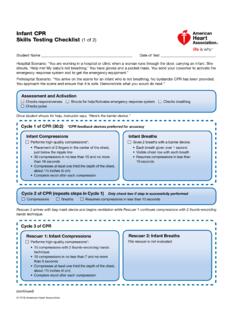
2 Equipment List 2006 American Heart AssociationEquipmentQuantity NeededLessons NeededSkills station competency checklists1/student & instructorSkills stationsPALS course progress checklist1/instructorAll Core case testing checklists1/studentCore case test 1 Core case test 2 CPR testing checklist1/every studentCPR/AEDECC Handbook (optional)1/student & instructorAll except written testPALS algorithms/flowcharts1 set for every stationPALS Provider Course written test1/studentWritten testBlank test answer sheet1/student Written test answer key1/courseAV EquipmentTV with DVD player or VCR or Computer with projector and screen 2/course1 DVD player/VCR and 1 DVD/video tape is needed per station for the management of respiratory emer-gencies skills station and the CPR/AED testing station because these occur at the same timeCourse DVD(s) or videotape(s)2/courseCPR/AED EquipmentChild CPR manikin1/every 3 students Skills stations Case simulations Core case testsInfant CPR manikin1/every 3 studentsAirway manikin1/every 12 studentsAirway manikin1/every 12 studentsManagement of respiratory emer-genciesStopwatch1/instructorAllCoun tdown timer1/instructorAED trainer with adult/child AED training pads1/every 3 studentsCPR/AEDS tools to stand on for CPR1/every 3 students CPR/AED Case simulations 2006 American Heart Association(continued)EquipmentQuantity NeededLessons NeededAirway and VentilationChild pocket mask and infant pocket mask 1/every 3 students or 1/studentCPR/AED1-Way valve 1/studentBag-mask for infant and child manikins, reservoir, and tubing1/every 3 students (CPR/AED)
3 1/station CPR/AED Management of respiratory emergencies Case simulations Core case testsOropharyngeal and nasopharyngeal airways1 set each stationManagement of respiratory emer-genciesWater-soluble lubricant1/stationNonrebreathing mask/simple face mask1/station Management of respiratory emergencies Case simulations Core case testsNasal cannula1/stationSuction catheters (various sizes)1/stationNebulizer Equipment (optional)1/stationPulse oximeter probe (optional)1/stationAdvanced Airway Endotracheal tube kit1/station Management of respiratory emergencies Case simulations Core case testsExhaled CO2 detector 1/stationEsophageal detector device (EDD) (optional)1/stationVascular AccessPoultry thighs/IO manikin1/stationVascular accessGloves1/studentIO needles2-3/station Vascular access Case simulations Core case testsIV Equipment (catheters, fluid bags, tubing, 3-way stopcocks, T-connectors, pole)1/stationSyringes1/station(continue d) 2006 American Heart AssociationEquipmentQuantity NeededLessons NeededRhythm Recognition and Electrical TherapyECG cards or rhythm generator (If a rhythm generator is used, it should ideally be able to display both narrow- and wide-complex tachycardias (SVT).)
4 For a realistic depiction of narrow-complex tachy-cardias (SVT) in infants and children, the generator should be able to achieve rates >220/min for infants (rates >260/min are best) and >180/min for children, with no beat-to-beat variability.)1/station Electrical therapy Case simulations Core case testsMonitor capable of defibrillator/syn-chronized cardioversion with small (pediatric) and large (adult) paddles1/stationElectrodes, electrode pads (pediatric and adult), electrode cream or paste (if self-adhesive monitor/electrode pads are not used)1/stationSpare batteries or power cord1/stationSpare ECG paper1/stationElectrical therapyAED with training module1/stationCPR/AEDS uggested Drugs or Drug PackageAdenosine1/station Case simulations Core case testsAlbuterol1/stationAmiodarone 1/stationAtropine sulfate 1/stationEpinephrine 1:10 000, 1:1000, race-mic ( )1/stationGlucose1/stationLidocaine 1/stationMagnesium sulfate 1/stationProcainamide1/stationSafetyShar ps container (if using real needles)1/courseVariable(continued)Equip mentQuantity NeededLessons NeededOtherLength-based/color-coded resusci-tation tape1/station Skills stations Case simulations Core case testsTowel1/stationBlood pressure cuff1/stationStethoscope 1/stationWhiteboard or flip chart with easel and markers1/stationCore case testsCleaning Supplies for Use Between Student Practice and After CourseManikin cleaning supplies VariesAllNote: The AHA does not require or endorse the use of live animals in PALS courses.
5 If a training site decides to use live animals to supplement the required instruction in a PALS course, it must be identified as not being a part of the course, it must not be a requirement for successful course completion, and it must be identified to the students that it is not a requirement of the AHA to participate in or to complete the PALS course. Depending upon country and locale, various live animal policies, regulations, and laws apply. Training sites need to be aware of and ensure compliance with all institutional and governmental policies, regulations, and laws on the use of live animals. In the United States live animals must be obtained through an institutional animal care facility that is accredited by and complies with the regulations of the American Association for the Accreditation of Laboratory Animal Care (AAALAC) or the US Public Health Service, Division of Animal Welfare Assurance.
6 In addition, approval must be obtained from the Institutional Animal Care and Use Committee, and the protocol must follow guidelines outlined in the NIH document Guide to the Care and Use of Laboratory Animals. A skilled animal handler should be present at the skills station to care for the animals and give addi-tional sedation if necessary. 2006 American Heart Associatio