Transcription of Essay Introduction Outline | Sample PDF
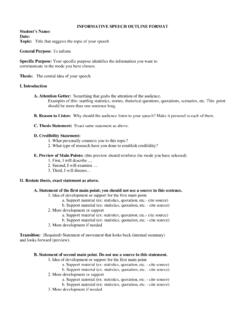
1 Writing introductions An Introduction should tell your reader exactly what your paper is about and how it is structured. Introductions are usually 5-10% of the length of an a typical Essay . Readers gain their first impressions of a paper from this section, so an effective Introduction is vital. Generally, introductions begin with some brief background or contextual information that provides a focus for your paper. This should be followed by a clear articulation of your controlling argument or point of view - a sentence that is sometimes called a thesis statement. The thesis statement must directly and clearly respond to the set question or topic and can sometimes be indicated by phrases such as; This paper will argue that.
2 Or This Essay will advance the idea that .. Next, an overview of how you will support your argument should be presented, with a clear preview of the order in which you will proceed; this process can be indicated by such phrases as In order to explore these issues, this paper will ; This will be followed by .. ; The paper will conclude etc. The Introduction should also clarify how you intend to interpret or limit the question. You may also need to define key terms, or theoretical approaches. Do not pad your Introduction with too much detail or references from other sources, rather, relate this section directly to the set question or topic. It can be useful to incorporate some of the actual words of the question into your Introduction .
3 The Introduction should tell your reader: How you understand the topic ( context, background, key terms) What your controlling argument is What issues you will cover (and in which order) Highlight ideas as major or minor (for longer essays ) What conclusion you will reach Writing an Essay is not like writing a mystery novel with an unfolding plot. Aim to be transparent and direct. Your reader should not have to read several pages before finding out what your argument or thesis is; it needs to be in the Introduction . Following is an example of an Introduction with its key aspects identified in the text boxes. Question (from Arts): To what extent can the American Revolution be understood as a revolution from below ?
4 Why did working people become involved and with what aims in mind? Historians generally concentrate on the twenty year period between 1763 and 1783 as the period which constitutes the American Revolution. However, when considering the involvement of working people, or people from below, in the revolution it is important to make a distinction between the pre revolutionary period 1763 1774 and the revolution of 1774 1788 , marked by the establishment of the continental Congress (1). This paper will argue that the nature and aims of the actions of working people are difficult to assess as it changed according to each phase. The pre revolutionary period was characterised by opposition to Britain s authority.
5 During this period the aims and actions of the working people were more conservative as they responded to grievances related to taxes and scarce land, issues which directly affected them. However, examination of activities such as the organisation of crowd action and town meetings, pamphlet writing, formal communications to Britain of American grievances and physical action in the streets, demonstrates that their aims and actions became more revolutionary after 1775. Sets general context of the period How the key term from below is interpreted Thesis statement or statement of argument Indication of conclusion Elaboration on content of Essay