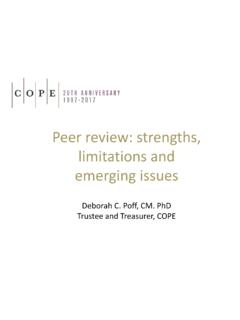
Transcription of Ethical guidelines for peer reviewers - COPE
1 guidelines : Ethical GUIDELINESFOR peer provides leadership in thinking on publication ethics and practical resources to educate and support members, and offers a professional voice in current debatesCommittee on Publication Ethics (COPE)Registered charity No 1123023 Registered in England and Wales, Company No 6389120 Registered office: COPE, New Kings Court, Tollgate, Chandler s Ford, Eastleigh, Hampshire, SO53 3LG, United this as: COPE Council. COPE Ethical guidelines for peer reviewers English. Version 2: September 2017. 2017 Committee on Publication Ethics (CC BY-NC-ND ) 2: September 2017 Cite this as: COPE Council. COPE Ethical guidelines for peer reviewers English. Version 2: September 2017. 2017 Committee on Publication Ethics (CC BY-NC-ND ) Ethical guidelines FOR peer REVIEWERSS ummaryPeer reviewers play a role in ensuring the integrity of the scholarly record.
2 The peer review process depends to a large extent on the trust and willing participation of the scholarly community and requires that everyone involved behaves responsibly and ethically. peer reviewers play a central and critical part in the peer review process, but may come to the role without any guidance and be unaware of their Ethical obligations. Journals have an obligation to provide transparent policies for peer review , and reviewers have an obligation to conduct reviews in an Ethical and accountable manner. Clear communication between the journal and the reviewers is essential to facilitate consistent, fair and timely review . COPE has heard cases from its members related to peer review issues and bases these guidelines , in part, on the collective experience and wisdom of the COPE Forum participants. It is hoped they will provide helpful guidance to researchers, be a reference for editors and publishers in guiding their reviewers , and act as an educational resource for institutions in training their students and review , for the purposes of these guidelines , refers to reviews provided on manuscript submissions to journals, but can also include reviews for other platforms and apply to public commenting that can occur pre- or post-publication.
3 Reviews of other materials such as preprints, grants, books, conference proceeding submissions, registered reports (pre-registered protocols), or data will have a similar underlying Ethical framework, but the process will vary depending on the source material and the type of review requested. The model of peer review will also influence elements of the OF peer REVIEWT here are different types or models of peer review , all of which have various advantages and disadvantages. See the COPE document Who owns peer reviews?1 (section titled models of peer review ) ( ) for an explanation of various peer review models. It is important to be aware of the model of peer review that the journal or platform uses before agreeing to undertake the peer review . The chart below, reproduced with permission from QUT, Australia, identifies key elements of the various models related to processes in peer review .
4 reviewers should understand their responsibilities related to confidentiality of the process and ownership of the review product based on the model of peer review being are many different models of peer review . A peer review process may operate to almost any combination in the following table by selecting one option from each row:Using the chart above, a standard, blinded, peer review process for a journal could be: peer reviews are not publishedReview is facilitated by a journalReviews owned by the authors of the reviewsSingle blindPre-publicationEditors mediate all interactions between reviewers and authorsTimingPreprintsPre-publicationPos t-publicationIdentifiabilityDouble blindSingle blindOpenMediationEditors mediate all interactions between reviewers and authorsReviewers interact with one another openlyReviewers and authors all interact with one another openlyPublicationPeer reviews are not publishedPeer reviews are published but not signedPeer reviews are published and signedFacilitationReview facilitated by a journalReview facilitated by a third partyReview facilitated by authorsOwnershipReview owned by a journal or third partyReview owned by the authors of the reviewsShared or mixed ownership of reviews5 BEING A REVIEWERP
5 Rofessional responsibilityAuthors who have benefited from the peer review process should consider becoming peer reviewers as a part of their professional responsibilities. Some journals require a formal process of appointment to the review panel, and some require specific expertise; anyone interested in becoming a reviewer should look for the journal guidelines on peer review and follow any requirements posted. In order to assign appropriate reviewers , editors must match reviewers with the scope of the content in a manuscript to get the best reviews possible. Potential reviewers should provide journals with personal and professional information that is accurate and a fair representation of their expertise, including verifiable and accurate contact information. It is important to recognise that impersonation of another individual during the review process is considered serious misconduct (eg, see COPE Case 12-12: Compromised peer review system in published papers) ( ).
6 When approached to review , agree to review only if you have the necessary expertise to assess the manuscript and can be unbiased in your assessment. It is better to identify clearly any gaps in your expertise when asked to interestsEnsure you declare all potential competing, or conflicting, interests. If you are unsure about a potential competing interest that may prevent you from reviewing, do raise this. Competing interests may be personal, financial, intellectual, professional, political or religious in nature. If you are currently employed at the same institution as any of the authors or have been recent (eg, within the past 3 years) mentors, mentees, close collaborators or joint grant holders, you should not agree to review . In addition, you should not agree to review a manuscript just to gain sight of it with no intention of submitting a review , or agree to review a manuscript that is very similar to one you have in preparation or under consideration at another is courteous to respond to an invitation to peer review within a reasonable time frame, even if you cannot undertake the review .
7 If you feel qualified to judge a particular manuscript, you should agree to review only if you are able to return a review within the proposed or mutually agreed time frame. Always inform the journal promptly if your circumstances change and you cannot fulfil your original agreement or if you require an extension. If you cannot review , it is helpful to make suggestions for alternative reviewers if relevant, based on their expertise and without any influence of personal considerations or any intention of the manuscript receiving a specific outcome (either positive or negative).GUIDELINESCOPE GUIDELINESCite this as: COPE Council. COPE Ethical guidelines for peer reviewers English. Version 2: September 2017. 2017 Committee on Publication Ethics (CC BY-NC-ND ) A REVIEWI nitial stepsRead the manuscript, supplementary data files and ancillary material thoroughly (eg, reviewer instructions, required ethics and policy statements), getting back to the journal if anything is not clear and requesting any missing or incomplete items you need.
8 Do not contact the authors directly without the permission of the journal. It is important to understand the scope of the review before commencing (ie, is a review of raw data expected?).ConfidentialityRespect the confidentiality of the peer review process and refrain from using information obtained during the peer review process for your own or another s advantage, or to disadvantage or discredit others (eg, see COPE Case 14-06: Possible breach of reviewer confidentiality) ( ). Do not involve anyone else in the review of a manuscript (including early career researchers you are mentoring), without first obtaining permission from the journal (eg, see COPE Case 11-29: reviewer asks trainee to review manuscript) ( ). The names of any individuals who have helped with the review should be included so that they are associated with the manuscript in the journal s records and can also receive due recognition for their and competing interestsIt is important to remain unbiased by considerations related to the nationality, religious or political beliefs, gender or other characteristics of the authors, origins of a manuscript or by commercial considerations.
9 If you discover a competing interest that might prevent you from providing a fair and unbiased review , notify the journal and seek advice (eg, see COPE Case 15-05: reviewer requests to be added as an author after publication) ( ). While waiting for a response, refrain from looking at the manuscript and associated material in case the request to review is rescinded. Similarly, notify the journal as soon as possible if you find you do not have the necessary expertise to assess the relevant aspects of a manuscript so as not to unduly delay the review process. In the case of double blind review , if you suspect the identity of the author(s) notify the journal if this knowledge raises any potential competing or conflict of of ethics violationsIf you come across any irregularities with respect to research and publication ethics do let the journal know (eg, see COPE Case 02-11: Contacting research ethics committees with concerns over studies) ( ).
10 For example, you may have concerns that misconduct occurred during either the research or the writing and submission of the manuscript, or you may notice substantial similarity between the manuscript and a concurrent submission to another journal or a published article. In the case of these or any other Ethical concerns, contact the editor directly and do not attempt to investigate on your own. It is appropriate to cooperate, in confidence, with the journal, but not to personally investigate further unless the journal asks for additional information or advice. 7 CONDUCTING A review (CONT.)Transferability of peer reviewPublishers may have policies related to transferring peer reviews to other journals in the publisher s portfolio (sometimes referred to as portable or cascading peer review ). reviewers may be asked to give permission for the transfer of their reviews if that is journal policy .