Transcription of EV PRIMER BASIC INFORMATION (Range, Speeds, Terrain)
1 EV PRIMER . BASIC INFORMATION . (Range, Speeds, terrain ). With gasoline approaching $3/gal, we have been swamped with Catalog requests, calculations, and more. So we want to provide BASIC INFORMATION to help you determine if an EV can meet your requirements. BASIC rules of thumb for conversions are: Horsepower 1. Electric motors are rated at their point of maximum efficiency; they may be capable of 2-4 times their continuous rating but only for a few minutes (acceleration or hill climbing). Internal combustion engines are rated at the peak hp.
2 For example, the FB1-4001A motor is rated as 30 hp continuous at 144V and 100 hp peak. The 5. minute rating of the FB1-4001A motor is 48 hp at 144V. 2. 6-8 hp is required for each 1000 lbs of vehicle weight after conversion. This is the continuous rating of the motor. So a 3000 lb conversion requires a motor that is rated at approximately 20 hp. More hp is required for higher speeds, heavier vehicles, and steeper terrains. 3. The available horsepower of a motor increases with voltage; for example, the FB1- 4001A motor is rated at 18 hp continuous at 72V but is rated at 30 hp continuous at 144V.
3 As the voltage is increased the rpm increases. Hp is a function of rpm x torque. 4. Although electric motors are rated as continuous , the motor can run at less hp. If only 10 hp is required for the speed then the motor runs at that reduced load. This is the function of the motor controller. 5. Operating continuously above the rated hp will eventually overheat and damage the motor. A motor that is rated at 150 amps can run at 300 amps for a short time (minutes), but longer periods can easily damage the motor. Do not buy an undersize motor for your vehicle for your application it will not last long.
4 Current is what overheats components. 6. Highway speeds require greater hp. The hp required at 70 mph is 4 times the hp required at 35 mph. That means the current required is 4 times also; which means less range. Batteries (lead Acid). 1. It takes 15-20 lbs of lead to get 1 mile in range. So if you want to do 40 miles, it will probably require 800 lbs of batteries. 2. Approximately 1/3 of the converted weight should be batteries. 3. Batteries weigh approximately 60- 75 lbs each. You can have a 12V, 8V, or 6V. battery pack. It is all about space.
5 You may only have space for 15 batteries. 4. Batteries are approximately 7 inches wide x 11 inches long x 12 inches high. See for actual dimensions. 5. Most on-road EVs use battery packs equal to or greater than 96V to get reasonable performance. 6. Increasing the voltage decreases the current (amperage) for the same hp. In addition, batteries have more capacity at lower amperages. 7. Cranking amps is a meaningless number for EVs. EVs use deep cycle batteries; the most important number is the number of minutes the battery can discharge 75 amps continuously.
6 The 30 XHS (12V) is rated at 57 minutes at 75 amps output; the T-145. (6V) is rated at 145 minutes at 75 amps output. Almost three times as much energy when you have the same pack voltage. 8. There is much press about Lithium Ion and Nickel Metal Hydride batteries. These batteries cost 10-20 times the cost of lead acid batteries. This high cost makes them unaffordable for most individuals; consequently, we do not sell them. If you want INFORMATION on them, please contact the manufacturers. Batteries (Lithium Ion & NiMH). 1. These batteries are not in production yet; therefore, the cost is high.
7 A. typical lithium battery pack is approximately $20,000+. A NiMH pack is higher. This changes the economic advantages of EVs significantly. Controllers 1. The most popular Curtis controllers are the 1221C-7401 (72-120V 400A) and the 1231C-8601 (96-144V 500A). The 1231 can provide 50% more peak hp. 2. Basically, there are no DC regen controllers. Transmissions 1. Automatic transmissions are not typically used in EVs. The problem is that they shift to the next gear at approximately 2000 -2500 rpm. The electric motor is typically most efficient at 4000 - 5500 rpm.
8 If the motor operates at 2000 rpm, it is very inefficient (60%). So it generates a lot of heat (40%). At lower rpm, the internal fan of the motor is not capable of removing the excess heat than that is generated. Cost 1. Higher voltages (more hp) cost more money. A 96V system is approximately $4000- $4500. A 144V system is approximately $5500- $6000. Neither price includes batteries. Batteries are typically $100- $200 each. 2. AC systems operate at higher voltages (180-300V) and typically cost 2-3 times the cost of a DC system. Very little difference (~10%) in efficiency.
9 The major benefit is regen - if you have hills. EV conversion of cars is acceptable for commutes of less than 40 miles because they require 800 lbs of batteries. The question then is Does your vehicle have the space and payload capacity to locate those batteries?" Basically you want a car that weighs less than 2600 lbs before conversion. So mid-size and large vehicles will yield less than acceptable performance. Light-weight trucks (S-10, Ranger, etc) have a greater payload capacity and more space, so they can accommodate 1200-1400 lbs of batteries.
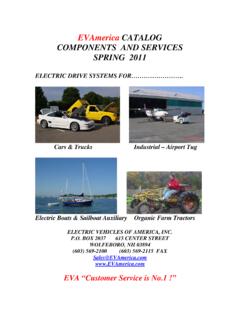
10 Therefore, they have a greater range. Large trucks, SUVs, and 4 WDs are not good candidates for EVs because 30 hp continuous 100 hp peak cannot match the 300 hp engines typically required. For specific INFORMATION on doing a conversion, you can buy----- 114 Pages with 24 Pictures Only $10 with Free Shipping in - Just call Available only thru EVA ! We design systems to meet your specific requirements (vehicle, range, speed , terrain , etc.) Why buy more than you need? Why buy a system that won't meet your requirements? We design systems for different applications (industrial vehicles, stage productions, parade vehicles, electric boats, tuk-tuks in Thailand, electric cars, electric trucks, and more).