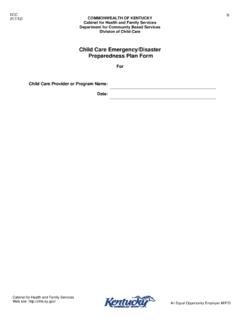
Transcription of Evacuation Planning Form for Child Care …
1 DCC N. ( ) COMMONWEALTH OF KENTUCKY. Cabinet for Health and Family Services Department for Community Based Services Division of Child Care Evacuation Planning Form for Child Care Emergency/Disaster Preparedness For Child Care Provider or Program Name: Date: Cabinet DCC for Health and Family Services Web site: ( ) An Equal OpportunityPage 1 of 12. Employer M/F/D. Evacuation Planning Form for Child Care Emergency/Disaster Preparedness Table of Contents Page Child Care Sample Forms for Emergency Disaster Preparedness Planning 2. Child Care Regulatory References for Emergency/Disaster Preparedness 3. Emergency/Disaster Preparedness Planning 4. Emergency/Disaster Procedures and Evacuation Plan Form 5. Child Care Roles and Responsibilities 9. Disclaimer and Signature of the Responsible Child Care Provider 11. _____. Helpful Information Child Care Sample Forms for Emergency Disaster Preparedness Planning In addition to this basic Planning form, the following information and supportive sample forms are available at to assist Child Care providers in Emergency Disaster Preparedness Planning : 1.
2 Division of Child Care Things to Know When Preparing for an Emergency and/or Disaster in Child Care 2. Sample Child Care Child Information Form 3. Sample Child Care Daily Attendance Record Form 4. Sample Child Care Emergency Disaster Preparedness Parent Information Form for Reunification 5. Sample Child Care Evacuation Response Checklist Form 6. Sample Child Care Emergency Disaster Roster Sign Out Form 7. Sample Child Care Fire Drill Form 8. Sample Child Care Earthquake and Tornado Drill Form 9. Sample Child Care Bomb Threat Information Form 10. Sample Child Care Emergency Disaster Preparedness Provider Statement 11. Child Care Emergency Disaster Preparedness Planning Checklist DCC. ( ) Page 2 of 12. Child Care Regulatory References for Emergency/Disaster Preparedness Evacuation plan required for Child -care centers and family Child -care homes -- Annual updating of plan -- Provision of plan to local emergency management officials and parents.
3 (Effective July 12, 2012) (1) A Child -care center licensed under KRS and a family Child -care home certified under KRS shall have a written plan for Evacuation in the event of fire, natural disaster, or other threatening situation that may pose a health or safety hazard to the children in the center or home. The plan shall include but not be limited to: A designated relocation site and Evacuation route;. Procedures for notifying parents of the relocation and ensuring family reunification;. Procedures to address the needs of individual children including children with special needs;. Instructions relating to the training of staff or the reassignment of staff duties, as appropriate;. Coordination with local emergency management officials; and A program to ensure that appropriate staff is familiar with the plan's components. (2) A Child -care center and a family Child -care home shall update the Evacuation plan by December 31 each year.
4 (3) A Child -care center and a family Child -care home shall retain an updated copy of the plan for Evacuation , provide an updated copy to appropriate local emergency management officials, and provide a copy to each parent, custodian, or guardian of the Child at the time of the Child 's enrollment in the program and whenever the plan is updated. 922 KAR 2:120. Child - Child care center health and safety standards. "Adequate supervision" means that qualified staff devotes full-time attention to a Child in care and ensures the Child is within scope of vision and range of voice. 922 KAR 2:110. Child -care center provider requirements. The following records shall be maintained at the Child -care center for five (5) years: o A written record of quarterly, practiced earthquake and tornado drills detailing the date, time, and children who participated;. o A written record of practiced fire drills conducted monthly detailing the date, time, and children who participated.
5 O A written plan and diagram outlining the course of action in the event of natural or manmade disaster, posted in a prominent place. Certification of Family Child Care Homes/Registered Provider 922 KAR 2:100 Section 10: General Requirements, 922 KAR 2:180 Section 3: Additional Requirements Each floor level used for Child care shall have at least one (1): unblocked exit to the outside; smoke detector, fire extinguisher; and carbon monoxide detector if the home uses fuel burning appliances; or has an attached garage. At least one (1) working land-line, unless the cabinet has been notified that the telephone is temporarily out of service) telephone on each level used for Child care with a residential or commercial line and a list of emergency numbers posted by each telephone, including numbers for the police, fire station, emergency medical care and rescue squad and poison control. A fire and tornado drill shall be conducted during hours of operation at least monthly and documented.
6 An earthquake drill shall be conducted during hours of operation; at least quarterly and documented. DCC. ( ) Page 3 of 12. Emergency/Disaster Preparedness Planning A Child Care Provider/ Facility should prepare plans that allow for partial or full Evacuation in a quick and efficient manner. Causes for Evacuation may include fire, bomb threat, explosion, flood, severe thunderstorm, severe winter storm, hurricane, tornado, toxic spill, electrical failure or structural damage. In the event of an emergency/disaster, Evacuation should be done as quickly and safely as possible. When Planning it is important to keep in mind there are three types of evacuations to consider. Sheltering in place: Children and staff remain at the facility/home but seek shelter for the emergency/disaster at hand. This would include tornado and chemical releases. On-site Evacuation : Children and staff move out of the facilities affected areas and relocate to another area on the property.
7 Off-site Evacuation : Children and staff/provider are relocated to designated location not on the property A) A completed Emergency/Disaster Plan should be reviewed and updated annually. A copy of the plan should be shared with local authorities that may be responding to your emergencies. B) All Child care providers should be trained in plan procedures and provided clear guidelines to their responsibilities during times of emergency/disaster. New Child care provider orientation should include training and review of emergency/disaster procedures. C) All children should be involved in practicing emergency/disaster procedures as outlined by licensing regulations. D) Floor plans of the Child care location should be posted in each classroom and in public spaces showing exits and directional Evacuation routes. Copies of floor plans should be shared with local authorities that may be responding to your emergencies.
8 E) Fire drills are to be held monthly and documentation should include date, time, and names of children who participated in the drill. Individual classroom attendance forms with first and last names of staff/children present during the drill should be attached to the drill form. F) Tornado and earthquake drills are to be held quarterly. Other types of drills should be held at least twice a year and attendance forms with first and last names of staff/children present during the drill should be attached to the drill form. G) Power generators (if available) and other emergency/disaster equipment should be tested on a regular schedule. H) Grab-n-go-kits are a gallon size zip and seal bag to create individual activity bags for each Child in the program. Each bag could include items like a recent photo of the Child , laminated emergency card, 4-6. crayons, a small notebook for doodling or a board book.
9 I) A best practice recommended Emergency/Disaster Supply kit should include the following: Class roster with emergency contact Formula information Phone card\ Cell phone Battery or solar operated radio Plastic trash bags Blankets/bucket Sanitation supplies (diapers, wipes, toilet paper, Crescent wrench to shut off gas line if needed soap, and toweling). (professional will need to restore) Water (1-3 gallons per person per day, 3 day Extra batteries (replaced twice a year) minimum) & disposable cups First aid kit (see state Child care regulations for Wet wipes/tissues required items) Whistles Flashlight(s) Work gloves Permanent marker(s) Map of area for Evacuation or for locating Hand sanitizer shelters Non-perishable food items and manual can Other items as your program requires opener (minimum supply for 3 days) (Children's Records). DCC. ( ) Page 4 of 12. Emergency/Disaster Procedures and Evacuation Planning Form General Information and Instructions A.
10 The first priority of a Child care provider is the safety of the children and staff. Emergency/disaster plans are to provide the providers with procedures to be followed to help ensure everyone's wellbeing. B. When an emergency/disaster occurs, it is necessary to maintain adequate supervision of the children. In the state of Kentucky, adequate supervision is defined as qualified staff devoting full-time attention to a Child in care and ensures the Child is within scope of vision and range of voice. C. Please complete the following form and respond to each question. If the question is not applicable to your Child care setting please state so and a reason. All information with a is required by a Child care regulation. Evacuation Planning Form for Child Care Emergency/Disaster Preparedness Insert Provider/Program Name and Information Name of Child Care Provider/ . Program Street Address.