Transcription of Evaluating Transportation Land Use Impacts
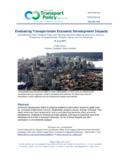
1 250-508-5150 Todd Alexander Litman 1995-2019 You are welcome and encouraged to copy, distribute, share and excerpt this document and its ideas, provided the author is given attribution. Please send your corrections, comments and suggestions for improvement. Evaluating Transportation land Use Impacts Considering the Impacts , Benefits and Costs of Different land Use Development Patterns 17 December 2021 Todd Litman Victoria Transport Policy Institute Suburban Residential urban Commercial Center Abstract This report examines ways that Transportation decisions affect land use patterns, and the resulting economic, social and environmental Impacts .
2 These include direct Impacts on land used for Transportation facilities, and indirect Impacts caused by changes to land use development patterns. In particular, certain Transportation planning decisions tend to increase sprawl (dispersed, urban -fringe, automobile-dependent development), while others support smart growth (more compact, infill, multi-modal development). These development patterns have various economic, social and environmental Impacts . This report describes specific methods for Evaluating these Impacts in transport planning. Originally published as land Use Impact Costs of Transportation , World Transport Policy & Practice, Vol.
3 1, No. 4, 1995, pp. 9-16. Evaluating Transportation land Use Impacts Victoria Transport Policy Institute 1 Contents Introduction .. 2 Evaluation Framework .. 5 land Use Categories .. 7 How Transportation Planning Decisions Affect land Use .. 11 Direct Impacts land Devoted To Transportation Facilities .. 13 Roads .. 13 Parking .. 14 Total Amount Of land Devoted to 15 Indirect Impacts How Transport Affects land Use Development .. 16 Costs and Benefits Of Different land Use Patterns .. 20 Accessibility and Transportation Costs .. 20 Household Affordability .. 22 Infrastructure and Public Service Costs.
4 23 Safety and Health .. 28 Economic Productivity and Development .. 30 Social Inclusion .. 32 Community Cohesion .. 33 Environmental Impacts .. 34 Energy Consumption and Pollution Emissions .. 38 Aesthetic Impacts .. 39 Cultural Preservation .. 39 Consumer and Economic Impacts .. 40 Optimal Level of Sprawl .. 41 Evaluation Techniques .. 43 Comprehensive Project Analysis .. 44 Monetized Impact Evaluation .. 45 Planning Objectives .. 46 Examples and Case Studies .. 47 ASSET .. 49 Vision California - Charting Our Future .. 50 Conclusions .. 51 References and Resources for More Information.
5 51 Evaluating Transportation land Use Impacts Victoria Transport Policy Institute 2 Introduction land use development patterns (also called urban form, built environment, community design, spatial development, and urban geography) refer to human use of the earth s surface, including the location, type and design of infrastructure such as roads and buildings. land use patterns can have diverse economic, social and environmental Impacts : some some require less impervious surface (buildings and pavement, also called sealed soil) per capita and so preserve more openspace (gardens, farmland and natural habitat), and some are more accessible and so reduce Transportation costs to businesses and consumers.
6 Transportation planning decisions influence land use directly, by affecting the amount of land used for transport facilities, and indirectly, by affecting the location and design of development. For example, expanding urban highways increases pavement area, and encourages more dispersed, automobile-oriented development (sprawl), while walking, cycling and public transit improvements encourage compact, infill development (smart growth). Planning Decision (development practices, infrastructure investment, zoning, development fees, etc.) urban Forum Patterns (density, mix, connectivity, parking supply, etc.)
7 Travel Behavior land Use (amount and type of walking, cycling, (Impervious surface coverage, public transit and automobile travel) greenspace, public service costs) Economic, Social and Environmental Impacts (consumer costs, public service costs, physical fitness, crashes, pollution emissions, etc.) There may be several steps between a transport planning decision, its Impacts on urban form and travel behavior, and its ultimate economic, social and environmental Impacts .
8 These relationships are complex. There may be several steps between a transport planning decision and its ultimate effects, and a particular planning deicison can have a variety of Impacts and costs, as illustrated above. Table 1 summarizes these Impacts . Table 1 Transport Planning land Use Impacts and Costs Increased Pavement Area More Dispersed Development Reduced openspace (gardens, parks, farmlands and wildlife habitat). Increased flooding and stormwater management costs. Reduced groundwater recharge. Aesthetic degradation. Reduced openspace (farmlands and wildlife habitat).
9 Longer travel distances, more total vehicle travel. Reduced accessibility for non-drivers, which is inequitable (harms disadvantaged people). Increased vehicle traffic and resulting external costs (congestion, accident risk, energy consumption, pollution emissions). This table summarizes various land use Impacts and costs from transport planning decisions. Evaluating Transportation land Use Impacts Victoria Transport Policy Institute 3 Historical Context During the last century, many Transportation and land use planning practices reinforced a cycle of increased automobile dependency and sprawl, as illustrated in Figure 1.
10 This was generally unintended, reflecting a lack of consideration of the full Impacts of these decisions. For example, when deciding how much parking to require for a particular type of land use, traffic engineers were probably not thinking about the additional sprawl that would result from a more generous standard, they simply wanted to ensure motorist convenience. Similarly, planning decisions that affect roadway supply, transit service quality or roadway user fees often overlooked various land use Impacts . Figure 1 Cycle of Automobile Dependency and Sprawl This figure illustrates the self-reinforcing cycle of increased automobile dependency and sprawl.