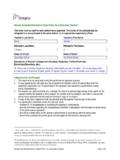
Transcription of Evaluation Rubrics for Teachers
1 Evaluation Rubrics for TeachersOffice of School ImprovementWEST VIRGINIADEPARTMENT OF EDUCATIONSTATE OF WEST VIRGINIAMONTANI SEMPER Levels of Performance Four distinct levels of performance are used to describe the quality of teaching within West Virginia classrooms. Rubrics guide the determination of specific performance levels. Distinguished Accomplished Emerging Unsatisfactory Distinguished performance describes professional teaching that engages students to be highly responsible for their own learning .
2 Performing at this level involves contributing to the professional learning of others through teacher leadership. Accomplished performance describes professional teaching that exhibits mastery of the work of teaching while improving practice and serving the professional community. Emerging performance represents teaching that demonstrates knowledge and skills to implement essential elements albeit not always successfully at times. Unsatisfactory performance describes teaching that does not convey sufficient understanding of concepts or the successful implementation of essential elements.
3 Performance-level ratings may fluctuate from year-to-year due to a variety of circumstances, such as changes in content or grade level. Evaluators select a performance level from the rubric that best describes current, actual educator practice not a future expectation for a particular element. Connecting the performance level to actual practice is especially important when choosing between two adjoining performance levels. For example, emerging performance is clearly different from unsatisfactory performance.
4 Educators, likewise, select from the rubric a performance level that best describes current practice when completing the self-reflection. West Virginia Professional Teaching Standards may offer additional insight into selecting an appropriate performance level for self-reflection or Evaluation . Professional Teaching Standards The five Professional Teaching Standards used in the Evaluation system are derived from the West Virginia Professional Teaching Standards. The Professional Teaching Standards recognize performance at the Accomplished level to be meritorious as well as rigorous and of high quality.
5 Accomplished performance is expected to be the most frequently recognized level of performance; performance at the Distinguished will likely occur on occasion. Preponderance of the evidence provides the basis for evaluators to determine performance-level ratings. Professional Teaching Standards STANDARD 1: CURRICULUM AND PLANNING Element : The teacher demonstrates a deep and extensive knowledge of the subject matter. Distinguished Accomplished Emerging Unsatisfactory The teacher demonstrates expert.
6 Specialized content knowledge collaborates with Teachers from other grades and subjects to extend and connect student learning to other content areas The teacher demonstrates extensive content knowledge connects student learning to other content areas The teacher demonstrates content knowledge attempts to connect student learning to other content areas The teacher does not demonstrate sufficient content knowledge does not attempt to connect student learning to other content areas Element : The teacher designs standards-driven instruction using state-approved curricula.
7 Distinguished Accomplished Emerging Unsatisfactory The teacher collaborates with others, including students , to design instruction and assessment aligned to the state-approved curricula collaborates with students to design sequential learning activities that provide for varied student abilities and interests collaborates with others, including students , to design learning activities that promote student collaboration, critical thinking, and problem solving The teacher designs written instructional plans that align instruction and assessment to the state- approved curricula designs sequential learning activities that provide for varied student abilities and interests designs activities that promote student collaboration, critical thinking.
8 And problem solving The teacher designs written instructional plans aligned to the state- approved curricula designs sequential learning activities at appropriate developmental levels designs activities that promote student collaboration The teacher does not design written instructional plans does not design instructional plans and/or units that are driven by state-approved curricula does not design sequential learning activities at appropriate developmental levels does not design activities that promote student collaboration Element : The teacher uses a balanced assessment approach to guide student learning .
9 Distinguished Accomplished Emerging Unsatisfactory The teacher collaborates with students to design and use a variety of assessments, including peer and student self- reflections, to monitor student progress and set learning goals collaborates with students and others to clearly define and communicate assessment criteria shares assessment data and provides timely feedback to students and other stakeholders The teacher designs and uses formative and summative assessments to monitor student progress and set learning goals clearly defines and communicates assessment criteria shares assessment data and provides timely feedback to students The teacher designs and uses
10 Formative and summative assessments communicates assessment criteria shares assessment data with students The teacher does not use formative and summative assessments does not communicate assessment criteria does not share assessment data or provide feedback to students STANDARD 2: THE LEARNER AND THE learning ENVIRONMENT Element : The teacher understands and responds to the unique characteristics of learners. Distinguished Accomplished Emerging Unsatisfactory The teacher demonstrates extensive knowledge of students social, emotional, and academic needs, interests, learning styles, cultural heritage, and gender plans and implements differentiated learning activities with students helps colleagues understand the unique characteristics of all learners The teacher demonstrates thorough knowledge of students social, emotional, and academic needs, interests, learning styles, cultural heritage.