Transcription of EVOLVING TERMS OF HUMAN RESOURCE …
1 Uluslararas Sosyal Ara t rmalar Dergisi The Journal of International Social Research Volume 2 / 9 Fall 2009 EVOLVING TERMS OF HUMAN RESOURCE management AND development Haslinda Abstract The term HRM and HRD has been used by scholars, academics and practitioners. However, confusion arises on the TERMS or labels for HRM and HRD and its position in management function. The purpose of this paper is to examine the EVOLVING TERMS in HUMAN RESOURCE management (HRM) and HUMAN RESOURCE development (HRD).
2 Based on a review of the literature, this paper draws the concepts surrounding the TERMS in HUMAN RESOURCE management and development . The findings highlight that the TERMS HRM and HRD have evolved along with globalization and rapid technological advances. Due to these changes in the environment, new TERMS are seen to be necessary to describe new ideas, concepts and philosophies of HRM and HRD. Currently, and in the near future, new TERMS will emerged to describe the philosophy of HRM and HRD.
3 This paper suggests a need for practitioners to understand the various TERMS describing HRM and HRD before it is used in organizations rather than to use new TERMS to describe old ideas or functions of HRM and HRD. Key Words: HUMAN capital, training, management , development INTRODUCTION HUMAN resources are an organization's greatest assets because without them, everyday business functions such as managing cash flow, making business transactions, communicating through all forms of media, and dealing with customers could not be completed.
4 HUMAN resources and the potential they possess are key drivers for an organization s success. With globalization and technological advances, today's organizations are continuously changing. Thus, organizational change impacts not only the business but also its employees. In order to maximize organizational effectiveness, HUMAN potentials, individuals' capabilities, time, and talents must be managed and developed. Hence, the practice of HUMAN RESOURCE management (HRM) and HUMAN RESOURCE development (HRD) works to ensure that employees are able to meet the organization's goals.
5 Globally, the term HRM and HRD has been used by scholars, academics and practitioners. However, confusion arises on the TERMS or labels for HRM and HRD and its position in management function. The term for HRM has been understood as the only word to represent and explain the management and development of HUMAN resources from the point of recruitment to compensation and rewards through to career management and development to the point of retirement. Hence, it is pertinent to examine the TERMS that evolved around the management and development of HUMAN resources in organizations.
6 In order to achieve this objective, it is important to examine the difference in TERMS for HRM and HRD, the history or starting point for HRM and HRD, their relationships and the up-coming TERMS used to refer HUMAN RESOURCE management and development . WHAT IS HRM AND HRD? In order to examine the TERMS differentials for HRM and HRD, first, it is pertinent to examine and understand the definitions for HRM and HRD. Many definitions for HRM have been proposed by scholars from a short and simple definition to a lengthy and comprehensive description.
7 In short, HRM is best understood as the process of managing HUMAN talents to achieve organization s objective . The process of managing HUMAN talents is said to include the process of recruitment and selection, compensation and benefits, labor and industrial relations and also the management of employees safety and health in organizations. On the other end, numerous definitions for HRD have been proposed by researchers and writers. These definitions varied from the perspectives of an individual researcher or theorists to definitions of HRD by country.
8 In addition, theorists have even tried to define HRD from a global and international perspective. Indeed, many definitions have been suggested; even before the emergence of 1 Associate Professor, Faculty of Economics and management , Universiti Putra Malaysia Uluslararas Sosyal Ara t rmalar Dergisi The Journal of International Social Research Volume 2 / 9 Fall 2009 - 181 - HRD in 1970s through today. A definition by Nadler and Nadler in 1970s described HRD as a series of organized activities conducted within a specified time and designed to produce behavioral change through training activities.
9 The latest definition by Desimone, Werner & Harris (2002) for HRD was defined as a set of systematic and planned activities designed by an organization to provide its members with the opportunities to learn necessary skills to meet current and future job demands . These systematic and planned activities are said to include training and development , career planning and development , performance appraisals and management and change management for organizational development .
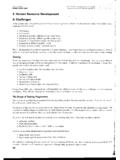
10 In the context of professionals, this activity is termed as continuing professional education and development . To all intents and purposes, the continuing professional education and development activities are the same as in training and development but it is labeled differently directed to professionals education and development . Table 1: Comparison of HRM and HRD HRM HRD Definition: HRM is a process of managing HUMAN talents to achieve organisation s objective Definition: HRD is a series of organized activities conducted within a specified time and designed to produce behavioural change Process: 1.