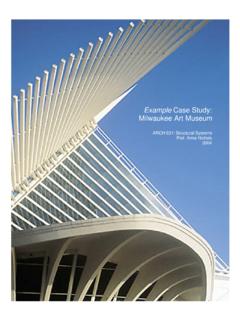
Transcription of Example Case Study: Milwaukee Art Museum
1 1 Example case study : Milwaukee Art Museum ARCH 631: Structural Systems Prof. Anne Nichols 2004 i Contents Overview (Introduction) 1 The Milwaukee Art Museum (Background) 1 The Architect (Background) 2 The Quadracci Pavilion (Body) 4 Design Concept 4 Building Layout 4 Structural Features 8 Building Components and System 9 Burke Brise-Soleil 13 Pedestrian Bridge 14 Loading Summary 15 Gravity Loads 16 Lateral Load Resistance 20 Foundation and Soil 22 Summary Bibliography (References)
2 1 Overview On May 4, 2001, a much-anticipated addition to the Milwaukee Art Museum first opened its doors to the public. The $125-million-dollar project, designed by architect Santiago Calatrava, became an icon for the Museum and the city of Milwaukee , Wisconsin even before its completion. This report presents a case study of the project. Background information regarding the architectural context for the addition will be provided, as well as a synopsis of the architect s mastery of structural design.
3 A number of unique elements of the building will be discussed in detail. In addition, the building s complex structural design will be reviewed through component and system evaluation, diagrams, and simplified computer-based structural analysis. The Milwaukee Art Museum The Milwaukee Art Museum (MAM) traces its beginnings to two institutions, the Layton Art Gallery, established in 1888, and the Milwaukee Art Institute, which was established in 1918. In 1957 the groups joined together, forming the private, nonprofit Milwaukee Art Center, now known as the Milwaukee Art Museum .
4 At this time, the Center moved to its present location on the Milwaukee waterfront Finnish architect Eero Saarinen, known for his St. Louis Arch, designed the Center s new home. Saarinen designed a unique structure incorporating floating cruciform sections with cantilevered portions; the building is now considered a classic in the development of modern architecture. The building opened in 1957, at which time the Milwaukee Art Institute and Layton Art Gallery merged their collections and projects to form the Milwaukee Art Center.
5 An addition was added to the Milwaukee Art Center in 1975, after the Center had received a number of donations and contributions to its collection. In addition to exhibit space, the Center added amenities such as a theater, educational center and a small restaurant. In 1980, the Center changed its name to the Milwaukee Art Museum . The Museum s collection continued to grow during the 80s and 90s, leading to consideration of another major addition. Attendance and membership had increased dramatically, with nearly 200,000 annual visitors.
6 2 With higher attendance, record numbers of art acquisitions, and new programs continually being added, the facilities of the MAM were becoming inadequate. Museum officials looking for a style which would complement the existing Saarinen structure turned to architect Santiago Calatrava in 1994 to design the new addition. Calatrava was asked to provide a strong architectural statement in an exciting yet functional building to set an architectural standard for the next millennium [1].
7 Calatrava's dynamic expansion design was unveiled in March 1996. The Milwaukee community was elated with the result. Groundbreaking took place on December 10, 1997, and the entire expansion project was complete by October 2001 (after opening in May of that year). The Quadracci Pavilion (Figure 1) was the first building designed by Calatrava to be constructed in the United States. Since its completion, record numbers of visitors have enjoyed the new exhibition galleries, larger Museum store, auditorium in the Quadracci Pavilion, and the completely renovated and reinstalled permanent collection galleries.
8 Despite cost overruns and financing setbacks resulting from the expansion project, the Museum foresees a prosperous future, and the city of Milwaukee has a new waterfront icon. Figure 1: Quadracci Pavilion 3 The Architect Internationally-acclaimed architect Santiago Calatrava was born on July 28, 1951, in Valencia, Spain and earned a degree in architecture from the Escuela Tecnica Superior de Arquitectura. Following his training in architecture, Calatrava pursued post-graduate studies in civil engineering at the ETH (Federal Institute of Technology) in Zurich and received his in 1979.
9 After completing his studies, Calatrava began his career by accepting small engineering commissions. He also entered design competitions, believing this was his most likely way to secure commissions. His first winning competition proposal in 1983 was for the design and construction of Stadelhofen Railway Station in Zurich. In 1984 Calatrava designed and built the Bach de Roda Bridge commissioned for the Olympic Games in Barcelona. This was followed by such projects as the Alamillo Bridge and viaduct commissioned for the World s Fair in Seville (1987-92), Campo Volantin Footbridge in Bilbao (1990-97), and Alameda Bridge and underground station in Valencia (1991-95).
10 Calatrava established his firm s second office (Paris) in 1989, and his third (Valencia) in 1991. His major project in Valencia, the City of Arts and Sciences, is an ongoing effort. Other notable projects from this period include the BCE Place mall in Toronto (1987-92), the Oriente railway station in Lisbon (1993-98, commissioned for Expo 98), and the winning proposal in the design competition to complete the Cathedral of St. John the Divine in New York City (1991, unbuilt). More recent major projects include Sondica Airport, Bilbao (2000), the Bridge of Europe, Orl ans, France (2000), the Bodegas Ysios winery in Laguardia, Spain (2001), and the expansion of the Milwaukee Art Museum (2001).