Transcription of Factoring - Factoring Special Products
1 - Factoring Special ProductsObjective: Identify and factor Special Products includinga difference ofsquares, perfect squares, and sum and difference of Factoring there are a few Special Products that, if we can recognize them,can help us factor polynomials. The first is one we have seen before. When multi-plying Special Products we found that a sum and a difference could multiply to adifference of squares. Here we will use this Special product to help us factorDifference of Squares:a2 b2= (a+b)(a b)If we are subtracting two perfect squares then it will alwaysfactor to the sum anddifference of the square 16 Subtracting two perfect squares,the square roots arexand4(x+ 4)(x 4)Our SolutionExample 25b2 Subtracting two perfect squares,the square roots are3aand5b(3a+ 5b)(3a 5b)Our SolutionIt is important to note, that a sum of squares will never factor.
2 It is alwaysprime. This can be seen if we try to use the ac method to factorx2+ +36 Nobxterm,we + 0x+36 Multiply to 36,add to01 36,2 18,3 12,4 9,6 6No combinations that multiply to 36 add to0 Prime,cannot factor Our SolutionIt turns out that a sum of squares is always of Squares:a2+b2=Prime1A great example where we see a sum of squares comes from Factoring a differenceof 4th powers. Because the square root of a fourth power is a square (a4 =a2),we can factor a difference of fourth powers just like we factora difference ofsquares, to a sum and difference of the square roots.
3 This willgive us two factors,one which will be a prime sum of squares, and a second which will be a differenceof squares which we can factor again. This is shown in the following b4 Difference of squares with rootsa2andb2(a2+b2)(a2 b2)The first factor is prime,the second isadifference of squares!(a2+b2)(a+b)(a b)Our SolutionExample 16 Difference of squares with rootsx2and4(x2+ 4)(x2 4)The first factor is prime,the second isadifference of squares!(x2+ 4)(x+ 2)(x 2)Our SolutionAnother Factoring shortcut is the perfect square.
4 We had a shortcut for multi-plying a perfect square which can be reversed to help us factor a perfect squarePerfect Square:a2+ 2ab+b2= (a+b)2A perfect square can be difficult to recognize at first glance, but if we use the acmethod and get two of the same numbers we know we have a we can just factor using the square roots of the first and last terms and thesign from the middle. This is shown in the following 6x+ 9 Multiply to9,add to 6 The numbers are 3and 3,the same!Perfect square(x 3)2 Use square roots from first and last terms and sign from the middleExample +20xy+25y2 Multiply to 100,add to 20 The numbers are 10 and 10,the same!
5 Perfect square(2x+ 5y)2 Usesquarerootsfromfirstandlasttermsandsi gnfromthemiddle2 World View Note:The first known record of work with polynomials comesfrom the Chinese around 200 BC. Problems would be written as three sheafs of agood crop, two sheafs of a mediocre crop, and one sheaf of a badcrop sold for 29dou. This would be the polynomial (trinomial)3x+ 2y+z= Factoring shortcut has cubes. With cubes we can either do a sum or adifference of cubes. Both sum and difference of cubes have verysimilar factoringformulasSum of Cubes:a3+b3= (a+b)(a2 ab+b2)Difference of Cubes:a3 b3= (a b)(a2+ab+b2)Comparing the formulas you may notice that the only difference is the signs inbetween the terms.
6 One way to keep these two formulas straight is to think ofSOAP. S stands for Same sign as the problem. If we have a sum of cubes, we addfirst, a difference of cubes we subtract first. O stands for Opposite sign. If wehave a sum, then subtraction is the second sign, a difference would have additionfor the second sign. Finally, AP stands for Always formulas endwith addition. The following examples show Factoring with 27 We have cube rootsmand3(m3)(m23m9)Use formula,use SOAP to fill in signs(m 3)(m2+ 3m+ 9)Our SolutionExample + 8r3We have cube roots5pand2r(5p2r)(25p210r4r2)Use formula,use SOAP to fill in signs(5p+ 2r)(25p2 10r+ 4r2)Our SolutionThe previous example illustrates an important point.
7 When we fill in the trino-mial s first and last terms we square the cube roots5pand2r. Often studentsforget to square the number in addition to the variable. Notice that when donecorrectly, both get after Factoring a sum or difference of cubes, students want to factor thesecond factor, the trinomial further. As a general rule, this factor will always beprime (unless there is a GCF which should have been factored out before usingcubes rule).3 The following table sumarizes all of the shortcuts that we can use to factor specialproductsFactoring Special ProductsDifference of Squaresa2 b2= (a+b)(a b)Sum of Squaresa2+b2=PrimePerfect Squarea2+ 2ab+b2= (a+b)2 Sum of Cubesa3+b3= (a+b)(a2 ab+b2)Difference of Cubesa3 b3= (a b)(a2+ab+b2)As always, when Factoring Special Products it is important to check for a GCFfirst.
8 Only after checking for a GCF should we be using the Special is shown in the following examplesExample 2 GCF is22(36x2 1)Difference of Squares,square roots are6xand12(6x+ 1)(6x 1)Our SolutionExample 24xy+ 3yGCF is3y3y(16x2 8x+ 1)Multiply to 16 add to8 The numbers are4and4,the same!Perfect Square3y(4x 1)2 Our SolutionExample +54ab5 GCF is2ab22ab2(64a3+27b3)Sum of cubes!Cube roots are4aand3b2ab2(4a+ 3b)(16a2 12ab+ 9b2)Our SolutionBeginning and Intermediate Algebra by Tyler Wallace is licensed under a Creative CommonsAttribution Unported License.
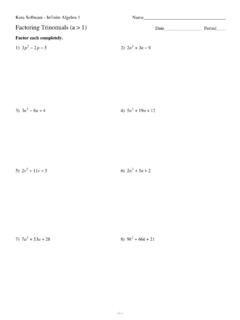
9 ( ) Practice - Factoring Special ProductsFactor each )r2 163)v2 255)p2 47)9k2 49)3x2 2711) 16x2 3613) 18a2 50b215)a2 2a+ 117)x2+ 6x+ 919)x2 6x+ 921) 25p2 10p+ 123) 25a2+30ab+ 9b225)4a2 20ab+25b227)8x2 24xy+18y229)8 m331)x3 6433) 216 u335) 125a3 6437) 64x3+27y339) 54x3+250y341)a4 8143) 16 z445)x4 y447)m4 81b42)x2 94)x2 16)4v2 18)9a2 110)5n2 2012) 125x2+45y214)4m2+64n216)k2+ 4k+ 418)n2 8n+1620)k2 4k+ 422)x2+ 2x+ 124)x2+ 8xy+16y226) 18m2 24mn+ 8n228) 20x2+20xy+ 5y230)x3+6432)x3+ 834) 125x3 21636) 64x3 2738) 32m3 108n340) 375m3+648n342)x4 25644)n4 146) 16a4 b448) 81c4 16d4 Beginning and Intermediate Algebra by Tyler Wallace is licensed under a Creative CommonsAttribution Unported License.
10 ( ) - Factoring Special Products1)(r+ 4)(r 4)2)(x+ 3)(x 3)3)(v+ 5)(v 5)4)(x+ 1)(x 1)5)(p+ 2)(p 2)6)(2v+ 1)(2v 1)7)(3k+ 2)(3k 2)8)(3a+ 1)(3a 1)9)3(x+ 3)(x 3)10)5(n+ 2)(n 2)11)4(2x+ 3)(2x 3)12)5(25x2+ 9y2)13)2(3a+ 5b)(3a 5b)14)4(m2+16n2)15)(a 1)216)(k+ 2)217)(x+ 3)218)(n 4)219)(x 3)220)(k 2)221)(5p 1)222)(x+ 1)223)(5a+ 3b)224)(x+ 4y)225)(2a 5b)226)2(3m 2n)227)2(2x 3y)228)5(2x+y)229)(2 m)(4 + 2m+m2)30)(x+ 4)(x2 4x+16)31)(x 4)(x2+ 4x+16)32)(x+ 2)(x2 2x+ 4)33)(6 u)(36+ 6u+u2)34)(5x 6)(25x2+30x+36)35)(5a 4)(25a2+20a+16)36)(4x 3)(16x2+12x+ 9)37)(4x+ 3y)(16x2 12xy+ 9y2)38)4(2m 3n)(4m2+ 6mn+ 9n2)39)2(3x+ 5y)(9x2 15xy+25y2)40)3(5m+ 6n)(25m2 30mn+36n2)41)(a2+ 9)(a+ 3)(a 3)42)(x2+16)(x+ 4)(x 4)43)(4 +z2)(2 +z)(2 z)44)(n2+ 1)(n+ 1)(n 1)45)(x2+y2)(x+y)(x y)46)(4a2+b2)(2a+b)(2a b)47)(m2+ 9b2)(m+ 3b)(m 3b)48)(9c2+ 4d2)(3c+ 2d)(3c 2d)Beginning and Intermediate Algebra by Tyler Wallace is licensed under a Creative CommonsAttribution Unported License.