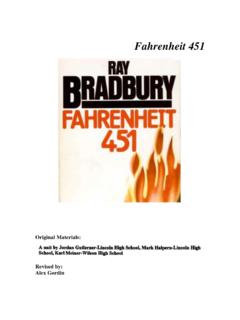
Transcription of Fahrenheit 451 - Ms. Venti's Class
1 Fahrenheit 451 UNIT PACKET We need not to be let alone. We need to be really bothered once in a while. How long is it since you were really bothered? About something important, about something real? -Montag, Fahrenheit 451 English II / April 2009 Name: _____ Period: _____ 2 Table of Contents Student Contract Pg. 3 Class Calendar Pg. 4 Homework Tracker Pg. 5 Benchmark Quiz Tracker Pg. 6 Vocabulary Section Pg. 7 Reading Response Section Pg. 11 Figurative Language Guide Pg. 15 Figurative Language Practice Pg. 16 Figurative Language in Fahrenheit 451 Pg. 17 More Figurative Language: Symbolism Pg. 18 Symbolism in Fahrenheit 451: Activity Pg. 19 The 411 on Fahrenheit 451 Pg. 23 WHY F451 Is Important TODAY Pg. 24 Book Quotes Pg. 26 Notes Pg.
2 27 3 Student Contract Student Statement of Purpose Our final mission this year is to read and analyze the classic novel, Fahrenheit 451. In reading this novel, we will use all of the knowledge that we have gained thus far in the year, as well as learn new skills that will help us in our journey to become excellent readers and thinkers, AND, prepare us to be high achieving ELEVENTH GRADE SCHOLARS. In order to gain the most knowledge from this unit and be successful throughout the remainder of the year, I know that: 1. I must bring my Fahrenheit 451 Unit Packet to EVERY Class . If I do not, I lose points for that day s assignments. 2. I must bring my copy of Fahrenheit 451 to EVERY Class . I am responsible for doing this. 3. If I miss a day of Class , for ANY reason, it is my responsibility to check the Class calendar to see what work I missed. Ms. Paulus will not remind me that I missed work. 4. If I miss a day of Class , for ANY reason, I have ONE extra Class to make the work up.
3 If I do not make the work up within ONE Class , I forfeit the grades and will take a Z in the Gradebook. 5. I must keep up with the reading assignments AND each night s homework. 6. I must come to Class willing and ready to THINK and LEARN and PREPARE myself for my future. 7. I must keep an open mind and remember that the best part of being a student is being able to think and grow my mind. Making mistakes is part of the growing process and is okay, as long as I learn from those mistakes. YES! I am ready for success! I have read the Student Contract. By signing below, I agree to follow the contract to ensure my success: Signature: _____ Date: _____ 4 Class Calendar *Dates may change; pay attention in Class ! Periods 3, 5, 7 Periods 2, 6, 8 Thursday, April 30th Friday, May 1st Monday, May 4th Tuesday, May 5th Wednesday, May 6th Thursday, May 7th Friday, May 8th Monday, May 11th Tuesday, May 12th Wednesday, May 13th Thursday, May 14th Friday, May 15th Monday, May 18th Tuesday, May 19th Wednesday, May 20th Thursday, May 21st 5 Homework Tracker DATE ASSIGNED DUE DATE ASSIGNEMENT DESCRIPTION MATERIALS COMMENTS/NOTES CHECK WHEN COMPLETE 6 Benchmark Quiz Tracker: Fahrenheit 451 Tracking My Progress in box = Correct on Quiz / in box = Incorrect on Quiz Working HARD to achieve BIG GOAL #1 Benchmark: Quiz #1 Quiz #2 Quiz #3 Quiz #4 Quiz #5 Overall Quiz % Mastery (Add # of checks and divide by 5) Author s Purpose/ Point of View: Cause and Effect: Compare and Contrast.
4 Context Clues: Main Idea: Reference and Research: 7 Vocabulary Section Directions: Each of these words appears in Fahrenheit 451. For each vocabulary word, write the definition. Then, find the word in the book and write the sentence where the word appears. Words are in order as they appear in the book. 1. Stolid - _____ Pg. _____ / Sentence from Book: _____ _____. 2. Refracted - _____ Pg. _____ / Sentence from Book: _____ _____. 3. Imperceptibly - _____ Pg. _____ / Sentence from Book: _____ _____. 4. Pulverized - _____ Pg. _____ / Sentence from Book: _____ _____. 5. Melancholy - _____ Pg. _____ / Sentence from Book: _____ _____. 6. Capillary - _____ Pg. _____ / Sentence from Book: _____ _____. 7. Multifaceted - _____ Pg. _____ / Sentence from Book: _____ _____.
5 8. Ballistics - _____ Pg. _____ / Sentence from Book: _____ _____. 8 9. Erected - _____ Pg. _____ / Sentence from Book: _____ _____. 10. Proclivities - _____ Pg. _____ / Sentence from Book: _____ _____. 11. Odious - _____ Pg. _____ / Sentence from Book: _____ _____. 12. Ravenous - _____ Pg. _____ / Sentence from Book: _____ _____. 13. Pratfall - _____ Pg. _____ / Sentence from Book: _____ _____. 14. Dictum - _____ Pg. _____ / Sentence from Book: _____ _____. 15. Noncombustible - _____ Pg. _____ / Sentence from Book: _____ _____. 16. Tactile - _____ Pg. _____ / Sentence from Book: _____ _____. 17. Cadenced - _____ Pg. _____ / Sentence from Book: _____ _____. 18. Retaliation - _____ Pg. _____ / Sentence from Book: _____ _____. 9 19. Receptacle - _____ Pg.
6 _____ / Sentence from Book: _____ _____. 20. Cowardice - _____ Pg. _____ / Sentence from Book: _____ _____. 21. Simultaneously - _____ Pg. _____ / Sentence from Book: _____ _____. 22. Manifested - _____ Pg. _____ / Sentence from Book: _____ _____. 23. Verbiage - _____ Pg. _____ / Sentence from Book: _____ _____. 24. Smouldering - _____ Pg. _____ / Sentence from Book: _____ _____. 25. Indecisive - _____ Pg. _____ / Sentence from Book: _____ _____. 26. Grotesque - _____ Pg. _____ / Sentence from Book: _____ _____. 27. Limned - _____ Pg. _____ / Sentence from Book: _____ _____. 28. Juggernaut - _____ Pg. _____ / Sentence from Book: _____ _____. 10 29. Cardamom - _____ Pg. _____ / Sentence from Book: _____ _____. 30. Pedants - _____ Pg. _____ / Sentence from Book: _____ _____.
7 31. Pyre - _____ Pg. _____ / Sentence from Book: _____ _____. 11 Reading Response Section Directions: Using your knowledge from what you read, answer the following questions. Include the page numbers where you found the answers. These response questions will also serve as your Unit Test Review, so complete the answers thoroughly! *BE SURE TO CHECK THE DUE DATES FOR READING RESPONSE QUESTIONS!* Reading Response Questions: Set One DUE DATE: 1. Who is Guy Montag? Describe his job. 2. Describe Clarisse McClellan. 3. What smelled like perfume to Montag? 4. Clarisse asked Montag if he was happy. Was he? 5. Who is Mildred, and what happened to her? 6. Why did Emergency Hospital send technicians instead of doctors to treat Mildred? 7. What are parlor-walls? 8. Describe the mechanical hound. 9. What did Montag believe had been done to the hound?
8 10. Why was Clarisse considered anti-social? 11. Who gave Clarisse most of her information about the way life used to be? 12 Reading Response Questions: Set Two DUE DATE: 1. Who was Captain Beatty? 2. How did the firemen know which houses had books? 3. What lie did Captain Beatty tell Montag? 4. What did Montag do in the old lady's attic? 5. Why were the alarms to burn always at night? 6. Why did the old woman light the match and commit suicide? 7. What happened to Clarisse? Was it an accident? 8. What was Montag afraid Captain Beatty would discover when he came to visit? 9. Why did Captain Beatty believe books should be destroyed? 10. What did Montag show Mildred after the captain had left the house? 13 Reading Response Questions: Set Three DUE DATE: 1. Who was Faber? 2. Why did Montag go to see Faber? 3. What three elements did Faber feel were missing from life?
9 4. What plan did Montag and Faber devise? 5. What was Montag willing to do to convince Faber to help carry out the plan? 6. What had Faber designed that allowed him to be in constant contact with Montag? 7. Why did Faber decide to go to St. Louis? 8. Why did Montag burn the book of poetry in the wall incinerator in his home? 9. Where did Montag hide his books after the ladies left? 10. What was the destination of the alarm on the night Montag returned to work at the firehouse? 14 Reading Response Questions: Set Four DUE DATE: 1. Who was the informant on Montag's home? 2. Why did Montag kill Captain Beatty? 3. Why didn't Montag run away before he killed Captain Beatty? 4. Where did Montag go after he killed Beatty? 5. When Montag left Faber's house, which direction did he go? 6. Why did Montag take whiskey, a suitcase, and some of Faber's dirty clothes with him?
10 7. What did the railroad tracks mean to Montag? 8. What was different about the fire Montag saw after leaving the river? 9. During the manhunt for Montag by the hound, why did the camera identify an innocent man as Montag? 10. What was different about the hobos Montag Met? Why did each man identify himself as a famous author or piece of literature? 11. What had Montag been able to memorize? 12. What happened to the city during the war? 13. What did Montag and the intellectuals believe their mission was once the war ended? 15 Figurative Language Guide One of the most AWESOME and INTERESTING tools that great writers use is figurative language. Very simply, figurative language is speech that contains images, or in other words, when writers describe something by comparing it to something else that is unusual, shocking, or funny to paint a picture in the reader s mind. FIGURATIVE LANGUAGE is composed of many types of figures of speech, such as similes, metaphors, personification, symbolism, alliteration, hyperbole, onomatopoeias, idioms, and allusions.