Transcription of Falls: Morse Fall Scale - Home - Primaris
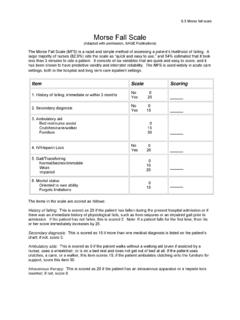
1 Resident name: _____Room #:_____Medical record #: _____Date of assessment: _____Assessment #:_____The Morse fall Scale (MFS) is a rapid and simple method of assessing a resident s likelihood of falling. The MFS is used widely in acute care 1 of 2 See scoring details on page 2 Falls: Morse fall ScaleVariablesScoreHistory of fallingooNo (score as 0) ..Yes (score as 25) .._____Secondary diagnosisooNo (score as 0) ..Yes (score as 15) .._____Ambulatory aidoooBed rest/nurse assist (score as 0) ..Crutches/cane/walker (score as 15) ..Furniture (score as 30) .._____IV or IV accessooNo (score as 0) ..Yes (score as 20) .._____GaitoooNormal/bed rest/immobile (score as 0) ..Weak (score as 10).
2 Impaired (score as 20) .._____Mental statusooKnows own limits (score as 0) ..Overestimates or forgets limits (score as 15) .._____Total ScoreRisk LevelMFS ScoreActionNo risk0 - 24 Good basic nursing careLow to moderate risk25 - 45 Implement standard fall prevention interventions using the Falling Leaf ProgramHigh risk46 +Implement high-risk fall prevention interventions using the Falling Leaf ProgramFalls: Morse fall Scalepage 2 of 2 Document available at April 2006 This material was prepared by Primaris , the Medicare Quality Improvement Organization for Missouri, under contract with the Centers for Medicare & Medicaid Services (CMS), an agency of the Department of Health and Human Services.
3 The contents presented do not necessarily reflect CMS items on the Scale are scored as follows. The score is then tallied and recorded on the resident s assessment/chart. Risk level and recommended actions are identified. History of FallingNote: If a resident falls for the first time, then his/her score immediately increases by 25. 25 Identify all current residents at risk for falls at the beginning of the program using the facility risk assessment form or a chosen form . This could be done by the charge nurse, supervising registered nurse, or interdisciplinary care team . Residents with highest risk or residents having multiple falls may be placed in Falling Leaf precaution . 0 The resident has not fallen, this is scored 0.
4 Secondary Diagnosis 15 More than one medical diagnosis is listed on the resident s chart . 0 No more than one medical diagnosis is listed on the resident s chart . Ambulatory Aids30 The resident ambulates clutching onto the furniture for support .15 The resident uses crutches, a cane, or a walker . 0 The resident walks without a walking aid (even if assisted by a nurse), uses a wheelchair, or is on bed rest and does not get out of bed at all . Intravenous Therapy20 The resident has an intravenous apparatus or heparin lock inserted . 0 The resident does not have an intravenous apparatus or a heparin lock inserted .Gait20 The resident has an impaired gait . With an impaired gait, the resident may have difficulty rising from the chair or attempts to get up by pushing on the arms of the chair or by bouncing.
5 The resident s head is down, and he/she watches the ground . Because the residents balance is poor, the resident grasps onto the furniture, a support person or a walking aid for support and cannot walk without assistance .10 The resident has a weak gait . With a weak gait, he/she is stooped but able to lift the head while walking without losing balance . Steps are short and the resident may shuffle . 0 This resident has a normal gait . A normal gait is characterized by the resident walking with the head erect, arms swinging freely at the side, and striding without hesitation . Mental StatusWhen using this Scale , mental status is measured by checking the residents self-assessment of his/her own ability to ambulate.
6 Ask the resident, Are you able to go to the bathroom alone, or do you need assistance? 15 The resident s response is not consistent with nursing orders . If the resident s response is unrealistic, then he/she is considered to overestimate his/her own abilities and to be forgetful of limitations . 0 The resident s reply judging his/her own ability is consistent with the ambulatory order on the plan of care . The resident is rated as normal.