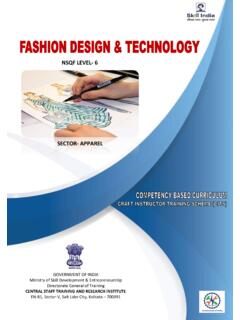
Transcription of FASHION DESIGN&TECHNOLOGY
1 GOVERNMENT OF INDIA MINISTRY OF SKILL DEVELOPMENT & ENTREPRENEURSHIP DIRECTORATE GENERAL OF TRAINING COMPETENCY BASED CURRICULUM FASHION design & technology (Duration: One Year) CRAFTSMEN TRAINING SCHEME (CTS) NSQF LEVEL- 4 SECTOR APPAREL FASHION design & technology (Non-Engineering Trade) (Revised in 2019) Version: CRAFTSMEN TRAINING SCHEME (CTS) NSQF LEVEL - 4 Developed By Ministry of Skill Development and Entrepreneurship Directorate General of Training CENTRAL STAFF TRAINING AND RESEARCH INSTITUTE EN-81, Sector-V, Salt Lake City, Kolkata 700 091 SNo. Topics Page No. 1. Course Information 1 2. Training System 2 3. Job Role 6 4. General Information 7 5.
2 Learning Outcome 9 6. Assessment Criteria 10 7. Trade Syllabus 13 Annexure I(List of Trade Tools & Equipment) 23 Annexure II (List of Trade experts) 27 CONTENTS 1 FASHION design & technology During the one-year duration of FASHION design & technology trade a candidate is trained on Professional Skill, Professional Knowledge and Employability Skill related to job role. In this trade we encourage each and every student to access and nurture their own natural sense of flair and creativity. We also help them to know that how can they create new ideas, thoughts and also to execute them in real form. In addition to this a candidate is entrusted to undertake project work, extracurricular activities and on job training to build up confidence.
3 The broad components covered under Professional Skill subject are as below:- The broad professional skills covered as part of the skill training start with familiarization and identification of tools & sewing machine, sketches of female croquie and design using elements and principle of design in terms of dress. The trainees learn to draw texture and perform fabric rendering. Also develop motifs for various traditional embroideries and perform machine stitches to make different parts as per design . The content also covers different fabrics; designing through Corel draw and working on special effects are also part of the professional components in this part.
4 The professional skill starts sketching different elements of garment. Develop different views of male & female croquie and develop designer wears based on draping techniques. Ensures quality and gets ideas about FASHION merchandising and career prospect in the field. Finally, the trainees imparts skill on designing FASHION accessories as per latest trend. The trainee also undergoes two weeks project work at the mid and end of the year which gives them more practical exposure and helps to build up confidence level. 1. COURSE INFORMATION 2 FASHION design & technology GENERAL The Directorate General of Training (DGT) under Ministry of Skill Development & Entrepreneurship offers a range of vocational training courses catering to the need of different sectors of economy/ Labour market.
5 The vocational training programmes are delivered under the aegis of Directorate General of Training (DGT). Craftsman Training Scheme (CTS) with variants and Apprenticeship Training Scheme (ATS) are two pioneer schemes of DGT for strengthening vocational training. FASHION design & technology trade under CTS is one of the popular coursesdelivered nationwide through a network of ITIs. The course is of one-year duration. It mainly consists of Domain area and Core area. The Domain area (Trade Theory & Practical) imparts professional skills and knowledge, while the core area (Employability Skill) imparts requisite core skills, knowledge, and life skills.
6 After passing out the training program, the trainee is awarded National Trade Certificate (NTC) by DGT which is recognized worldwide. Broadly candidates need to demonstrate that they are able to: Read & interpret parameters/documentation, plan work, identify necessary materials and tools; Perform task with due consideration to safety rules, accident prevention regulations and environmental protection stipulations; Apply professional knowledge, core skills & employability skills while performing the job. Check the task/assembly as per drawing for functioning, identify and rectify errors in task. Document the parameters related to the task undertaken.
7 PROGRESSION PATHWAYS: Can join industry as Craftsman and will progress further as Senior Craftsman, Supervisor and can rise up to the level of Manager. Can become Entrepreneur in the related field. Can join Apprenticeship programme in different types of industries leading to National Apprenticeship certificate (NAC). Can join Crafts Instructor Training Scheme (CITS) in the trade for becoming instructor in ITIs. Can join advanced Diploma (Vocational) courses under DGT as applicable. 2. TRAINING SYSTEM 3 FASHION design & technology COURSE STRUCTURE: Table below depicts the distribution of training hours across various course elements during a period of one-year: - S No.
8 Course Element Notional Training Hours 1. Professional Skill (Trade Practical) 1200 2. Professional Knowledge (Trade Theory) 240 3. Employability Skills 160 Total 1600 ASSESSMENT & CERTIFICATION The trainee will be tested for his skill, knowledge and attitude during the period of course through formative assessment and at the end of the training programme through summative assessment as notified by the DGTfrom time to time. a) The Continuous Assessment (Internal)during the period of training will be done by Formative Assessment Method by testing for assessment criteria listed against learning outcomes. The training institute has to maintain an individual trainee portfolio as detailed in assessment guideline.
9 The marks of internal assessment will be as per the formative assessment template provided on b) The final assessment will be in the form of summative assessment. The All India Trade Test for awarding NTC will be conducted by Controller of examinations, DGT as per the guidelines. The pattern and marking structure is being notified by DGT from time to time. The learning outcome and assessment criteria will be the basis for setting question papers for final assessment. The examiner during final examination will also check the individual trainee s profile as detailed in assessment guideline before giving marks for practical examination.
10 PASS REGULATION For the purposes of determining the overall result, weightage of 100% is applied for six months and one year duration courses and 50% weightage is applied to each examination for two years courses. The minimum pass percent for Trade Practical and Formative assessment is 60% & for all other subjects is 33%. There will be no Grace marks. 4 FASHION design & technology ASSESSMENT GUIDELINE Appropriate arrangements should be made to ensure that there will be no artificial barriers to assessment. The nature of special needs should be taken into account while undertaking the assessment. Due consideration should be given while assessing for teamwork, avoidance/reduction of scrap/wastage and disposal of scrap/waste as per procedure, behavioral attitude, sensitivity to the environment and regularity in training.