Transcription of Federal Enterprise Architecture - NIST
1 Scott A. Bernard, Federal Chief Enterprise Architect Executive Office of the President Office of Management and Budget Federal Enterprise Architecture Using EA to Design Future-Ready Agencies and Implement Shared Services OMB Policy Directives on EA Shared Services Is Action Item #6 M-11-29 CIO Authorities Memo: Commodity IT (Aug 2011) 2 May 2, 2012 May 2, 2012 IT Reform Agenda s 25-Point Plan (Dec 2010) IT Shared Services Strategy (May 2012) Common Approach to Federal EA (May 2012) Security and Privacy ControlsHostingApplicationsData ExchangeWorkflowRequirementsSecurity and Privacy ControlsHostingApplicationsData ExchangeWorkflowRequirementsSecurity and Privacy ControlsHostingApplicationsData ExchangeWorkflowRequirementsSecurity and Privacy ControlsHostingApplicationsData ExchangeWorkflowRequirementsSecurity and Privacy ControlsHostingApplicationsData ExchangeWorkflowRequirementsSecurity and Privacy ControlsHostingApplicationsData ExchangeWorkflowRequirementsSecurity and Privacy ControlsHostingApplicationsData ExchangeWorkflowRequirementsSecurity and PrivacyHostingApplicationsData ExchangeWorkflowRequirementsProvider AgencyConsumer Agency #1 Consumer Agency #2 Consumer Agency #3 Consumer Agency #4 Consumer Agency #5 Consumer Agency #6
2 Consumer Agency #7 SharedServiceSVR Memo The Common Approach to Federal Enterprise Architecture is OMB policy on EA standards. FEAv2 is the implementation of the Common Approach, it provides design and analysis methods to support shared service implementation, DGS, IRM Strategic Plans, and PortfolioStat investment reviews. IRM Strategic Plan The Role of Enterprise Architecture 3 Security and Privacy ControlsHostingApplicationsData ExchangeWorkflowRequirementsSecurity and Privacy ControlsHostingApplicationsData ExchangeWorkflowRequirementsSecurity and Privacy ControlsHostingApplicationsData ExchangeWorkflowRequirementsSecurity and Privacy ControlsHostingApplicationsData ExchangeWorkflowRequirementsSecurity and Privacy ControlsHostingApplicationsData ExchangeWorkflowRequirementsSecurity and Privacy ControlsHostingApplicationsData ExchangeWorkflowRequirementsSecurity and Privacy ControlsHostingApplicationsData ExchangeWorkflowRequirementsSecurity and PrivacyHostingApplicationsData ExchangeWorkflowRequirementsProvider AgencyConsumer Agency #1 Consumer Agency #2 Consumer Agency #3
3 Consumer Agency #4 Consumer Agency #5 Consumer Agency #6 Consumer Agency #7 SharedServiceThe Common Approach to Federal EA 3 Common Approach FEA DoDAF Other The Common Approach to Federal Enterprise Architecture helps to make agencies Future-Ready by accelerating agency business transformation and new technology enablement by providing standardization, design principles, scalability, an Enterprise roadmap, and a repeatable Architecture project method. Common Approach Meta-Model 5 Primary Outcomes Framework Levels of Scope Program Elements Primary Outcomes 6 Service Delivery Functional Integration Resource Optimization Authoritative Reference While there are many positive outcomes that EA contributes to, these four outcomes are primary in that they represent areas of direct, positive impact that architectures can make within and between agencies and with customers and partners external to government EA Project Levels of Scope International National Federal Sector Agency Segment System Application These levels of scope promote consistency in Architecture methods to promote comparability and support varying levels of complexity.
4 Solution Architecture is done in a similar way at all levels of scope, using the Collaborative Planning Method (CPM) 7 EA Program Basic Elements These basic elements ensure that agency EA programs are complete and can be effective in developing solutions that support planning and decision-making. 8 Element 1: Governance 9 Element 2: Principles General EA Principles Future-Ready Investment Support Shared Services Interoperability Standards Information Access Security and Privacy Technology Adoption 10 Design/Analysis Principles Strategic Drivers Business Activities Technology Enablement Element 3: Method for EA Projects 11 The Collaborative Planning Methodology (CPM) is a repeatable process that consists of steps that require integrated multi-disciplinary activities to affect change with the collaboration of leaders, stakeholders, planners, and implementers.
5 It is inclusive of the full planning and implementation lifecycle and is intended for use at all levels of scope. Element 3: Method (continued) 12 Engage Sponsor and Assess Stakeholder Needs Analyze and Validate Needs Formulate Case to Address the Needs Idenfy Organizaons and Service Providers to Engage Analyze Opportunies to Leverage Determine Whether to Leverage Formalize Collaborave Planning Team and Launch Planning Refine the Vision for Performance and Outcomes Analyze the Current State, Determine Adjustments, and Plan the Target State Formulate the Integrated Plan and Roadmap Iniate Execuon Governance Define Funding Strategy and Make Decision Obtain Resources and Validate Plan Execute the Plan Operate with the New Capabilies Measure Performance Against Metrics Analyze and Provide Feedback Idenfy and Engage Governance Element 4.
6 EA Tools Repository website and content to create a visual representation of Architecture in its current and future states Decomposable views of the overall Architecture and specific architectures Over-arching management views of the Architecture Strategic planning products and performance measures Business process documentation to answer questions and solve problems Physical / logical design of data entities, objects, applications, and systems Physical and logical design of networks & cloud computing environments Configuration management and quality standards Security and risk solutions for physical, information, personnel and operational needs 13 Element 5: Standards 14 Design Artifact s List Strategic Plan Workflow Diagram Dataflow Diagram System Interface Network Diagram Security Controls EA standards for doing design projects EA standards for doing analysis projects Analysis Element 6: Use The Common Approach supports: Shared-Services Implementation Cloud-First Implementation Digital Strategy Mobile & Web TechStats / PortfolioStats Security and Privacy Control Design Business Process Improvement Big Data Data Center Consolidation Voice, Data, Video Convergence 15 Element 7: Reporting 16 Annual submission to OMB that tells the story of the agency s use of IT to enable mission, support, and commodity functions.
7 Due April 1st these are public documents, nothing sensitive in it. Format Guidelines: Main Body: a) Synopsis of IRM Strategic Plan and goals b) Enterprise -wide business and technology Architecture c) Transition Plan milestones Appendix 1: IT Asset Inventory Appendix 2: IT Commodity Consolidation Plan (M-11-29) Appendix 3: Agency Shared Services Plan (improve quality & uptake) Appendix 4: EA Program Assessment / Project Value Measurement Element 8: Audit 17 Roadmap (Appendix 4) provides an evaluation of: EA Program maturity The value of EA projects Uses EA Management Maturity Framework v2 (EAMMF), Aug 2010 The Federal Enterprise Architecture Version (FEAv2) Implementing the Common Approach 18 Common Approach & FEAv2 Common Approach FEAv2 DoDAF Other The Common Approach to Federal Enterprise Architecture (Common Approach) accelerates supports the identification of opportunities for shared services and design alternatives.
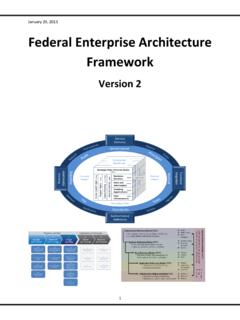
8 The Federal EA version 2 (FEAv2) will be released in January 2013 and aligns with the standards of the Common Approach. 19 FEAv2: Major Components FEAv2 aligns with the Common Approach and has three major components: Standards: Framework Artifacts Methods: Common Approach Collaborative Planning Method (former FSAM) Analytics / Reporting: Consolidated Reference Model Ex 53 & 300 Enterprise Roadmap Common ApproachFEADoDAFO ther20 EA3 Cube Level/Thread Artifact ID # Artifact Name (* Composite Artifact) Zachman Mapping DODAF Mapping Strategic Goals & Initiatives (I) S-1 Strategic Plan* C6/R1 AV-1 S-2 SWOT Analysis C5/R1 S-3 Concept of Operations Scenario AV-1 S-4 Concept of Operations Diagram C2/R1 OV-1 S-5 Balanced Scorecard * C6/R4, C6/R5 Business Products & Services (B)
9 B-1 Business Plan* C2/R2, C5R1 B-2 Node Connectivity Diagram C3/R1 OV-2 B-3 Swim Lane Process Diagram * C4/R2 OV-5 B-4 Business Process/Service Model C2/R2 OV-5 B-5 Business Process/ Product Matrix * C4/R2 B-6 Use Case Narrative & Diagram C6/R3, C6/R4 OV-6a, SV-10a B-7 Investment Business Case* Data & Information (D) D-1 Knowledge Management Plan C1/R1, C1/R2 D-2 Information Exchange Matrix* C3/R2, C4/R2 OV-3 D-3 Object State-Transition Diagram C1/R3 OV-6b, SV-10b D-4 Object Event Sequence Diagram C2/R2, C5/R3 OV-6c, SV-10c D-5 Logical Data Model C1/R3 OV-7, SV-11 D-6 Physical Data Model C1/R4 D-7 Activity/Entity (CRUD) Matrix * C1/R3, C4/R2 SV-9 D-8 Data Dictionary / Object Library C1/R5 AV-2 Systems & Applications (SA) SA-1 System Interface Diagram C3/R4, C3R2 SV-1 SA-2 System Communication Description C2/R4, C3/R2 SV-2 SA-3 System Interface Matrix * C2/R4 SV-3 SA-4 System Data Flow Diagram C2/R3 SV-4 SA-5 System/Operations Matrix * C2/R4 SV-5 SA-6 Systems Data Exchange Matrix * C2/R3 SV-6 SA-7 System Performance Matrix * C2/R3 SV-7 SA-8 System Evolution Diagram C2/R4 SV-8 SA-9 Web Application Diagram C2/R3 Networks & Infrastructure (NI) NI-1 Network Connectivity Diagram C3/R5 NI-2 Network Inventory C3/R5 NI-3 Capital Equipment Inventory C3/R5 NI-4 Building Blueprints * C3/R5 NI-5 Network Center Diagram C3/R5 NI-6 Cable Plant Diagram C3/R5 NI-7 Rack Elevation Diagram C3/R5 Security (SP)
10 SP-1 Security and Privacy Plan* C4/R5 SP-2 Security Solutions Description C4/R5 SP-3 System Accreditation Document* C4/R5 SP-4 Continuity Of Operations Plan* C4/R5 SP-5 Disaster Recovery Procedures * C4/R5 Standards (ST) ST-1 Technical Standards Profile C3/R4 TV-1 ST-2 Technology Forecast C3/R4 TV-2, SV-9 Workforce (W) W-1 Workforce Plan* C4/R1 W-2 Organization Chart C4/R2 OV-4 W-3 Knowledge and Skills Profile C4/R3 OV-4 The standard artifact list consists of the core artifacts that need to be considered and/or tailored to support a robust set of EA artifacts for the organization Core Artifact List Strategic Plan/Priority Goals Workflow Diagram Dataflow Diagram System Interfaces Network Diagram Security Controls FEAv2 Standards: Framework & Artifacts 21 FEAv2: Collaborative Planning Method The Collaborative Planning Methodology is a repeatable process that consists of steps that require integrated multi-disciplinary activities to affect change with the collaboration of leaders, stakeholders, planners, and implementers.