Transcription of FEMALE GENITAL MUTILATION - Wikimedia Commons
1 1 FEMALE GENITAL MUTILATION In many civilizations, certain surgical procedures have profound cultural and social meanings. Male circumcision, for example, has deep importance as a symbol of religious and ethnic identity and has played a major part in the political and social history of many communities (Remondino, 1891). The practice of FEMALE GENITAL MUTILATION (FGM) is regrettably persistent all over the world (Talle, 2007). The practice is more common in developing countries where it is deeply rooted on culture, religion, tradition and continues to ignore decades of legislation and campaign to eradicate it (Onuh et al., 2006; Momoh, 2003). Globally, about 140 million girls have undergone the practice of FEMALE GENITAL MUTILATION and over 3million girls are at risk of undergoing this procedure annually (Adeyinka et al.)
2 , 2012). In some communities, FEMALE GENITAL MUTILATION is viewed as an act of love or rite of passage and is often performed on young girls between infancy and age 15 (Toubia, 1994; Karmarker et al., 2011; WHO, 2012). The procedure in practicing communities remain persistent because they find it difficult to understand why the practice is being condemned and believe they are doing what is best for their daughters (RCN, 2006). Studies have proven that FEMALE GENITAL MUTILATION has no health benefits for girls and women; rather, it is seen as a form of child abuse and violence against women and girls (HM Government, 2010). This practice reflects inequalities between sexes and constitutes a great form of discrimination against women (WHO, 2012).
3 FEMALE GENITAL MUTILATION is beyond a mere health problem but a continued violation of human rights if the practice persists and is not completely eradicated. DEFINITION: The World Health Organisation (WHO) defines FEMALE GENITAL MUTILATION (FGM) as any procedure involving the partial or total removal of the external FEMALE genitalia, or other injury to the FEMALE GENITAL organs for non-medical reasons (WHO, 2012). FEMALE GENITAL 2 MUTILATION is often synonymously used with FEMALE circumcision giving an erroneous idea of it been similar to male circumcision. However, the extent of incision is more extensive, often hindering a woman s sexual and reproductive function and even their ability to pass urine normally (RCN, 2006).
4 FEMALE GENITAL MUTILATION has been practiced worldwide in various forms and with different justifications and indications (Magoha and Magoha, 2000). The practice has generated global debate and has evolved to be a contentious issue that has divided academic and activist opinion (Irvine, 2011). However well-intentioned FEMALE GENITAL MUTILATION is for those who practice it, studies have proven that it is medically unnecessary, very painful and extremely dangerous (Kaplan-Macusan et al., 2010; Dorkenoo, 1995). CLASSIFICATION OF FEMALE GENITAL MUTILATION : Although various types of FEMALE GENITAL MUTILATION has been practiced and observed, people who engage in the act often do not know which one they perform (Black and Debelle, 1995).
5 The World Health Organisation has classified FEMALE GENITAL MUTILATION into four categories namely: Clitoridectomy (Type 1); Excision (Type2); Infibulation (Type 3); and others (Type 4) (WHO, 2012). Clitoridectomy (Type 1) is the total or partial removal of the clitoris or the total or partial removal of the skin surrounding the clitoris also known as the prepuce (WHO, 2012; RCN, 2006). [Figure 1] Excision (Type 2) is the total or partial removal of the clitoris with the total or partial removal of the labia minora (WHO, 2012). It is also known as Sunna circumcision (RCN, 2006). [Figure 2] 3 Infibulation (Type 3) is the partial or total removal of the external genitalia (RCN, 2006). Here, the vaginal opening is narrowed through the creation of a seal developed by cutting and repositioning the inner and outer labia with or without the removal of the clitoris (WHO, 2012).
6 This form is also known as pharaonic circumcision of infibulation (RCN, 2006). [Figure 3] Others (Type 4) are other harmful procedures such as pricking, piercing, scraping, incising, stretching, cauterising, cutting, introduction of corrosive substances to the FEMALE genitalia for non-medical purposes (WHO, 2012). [Figure 4] PREVALENCE OF FEMALE GENITIAL MUTLATION: Recent data shows that FEMALE GENITAL MUTILATION is practiced in twenty eight African countries including Nigeria (Berg and Denison, 2012; Ibekwe et al., 2012) [Figure 5]. The practice is equally prevalent in some countries in the Middle East, among minority communities in Asia, and migrants from practising communities that have settled in America, Australia and Europe (HRP, 2006; Toubia, 1994).
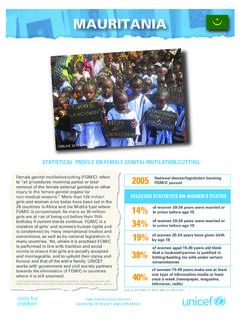
7 Current estimates for FEMALE GENITAL MUTILATION in African countries shows a prevalence rate of over 70% in places like Egypt, Mali, Burkina Faso, Ethiopia, and Somalia (Yoder and Khan, 2008) (Table 1). Due to the variations that exist between and within countries which often is a reflection of tradition and ethnicity, the United Nations Children s Funds (UNICEF) made a proposition that countries be classified into three groups in accordance with the FEMALE GENITAL MUTILATION prevalence rates present in those countries. Countries with a prevalence rate of 80% and above (Somalia, Mali, and Ethiopia) are classified as group 1; countries with prevalence rate between 25 and 79% (Senegal, Kenya) are classed as group 2; while countries with a prevalence rate below 25% (Nigeria) are classed as group 3 (Berg and Denison, 2012; UNICEF, 2005) (Table 2).
8 4 In Nigeria, the prevalence of FEMALE GENITAL MUTILATION ranges from between 0% in the North-Western parts of the country in regions like Kogi State to 100% in Benue and Kebbi States (Onuh et al., 2006). According to the Nigerian Democratic Health Survey (NDHS, 2003), prevalence of FEMALE GENITAL MUTILATION is highest in the South-Western and South-Eastern regions of the country and lowest in the North-Western parts of the country [Figure 6]. On the average, the overall prevalence of FEMALE GENITAL MUTILATION in Nigeria settles at 50%. However, due to her large population size, Nigeria has the highest absolute number of genitally mutilated women globally (Okonofua, 1998). The most common form of FEMALE GENITAL MUTILATION , Type 2, accounts for about 80% of all cases while Type 3, the most severe form, accounts for about 15% of all cases (Onuh et al.)
9 , 2006). Type 1 and Type 4 account for the remaining 5%. The most commonly practiced form of FEMALE GENITAL MUTILATION in Nigeria is the Type 2 (Excision). However, other forms of the practice are prevalent in different parts of the country (Coulibaly et al., 1996). A very common form of the practice in the Northern part of the country is the Type 4 where it is known as GISHRI cuts (NDHS, 2003). [Figure 7]. In Nigeria, the practice is often performed during infancy (42%), mostly by traditional birth attendants (73%) and by circumcision practitioners or traditional healers under unsterile conditions (NDHS, 2000). STATEMENT OF THE PROBLEM - A Nigerian perspective From the public health perspective, FEMALE GENITAL MUTILATION (circumcision) is much more damaging than male circumcision.
10 The mildest form, clitoridectomy, is anatomically equivalent to amputation of the penis. Under the conditions in which most procedures take place, FEMALE circumcision constitutes a health hazard with short and long term physical complications and psychological effects (Denison et al., 2011). It continues to be a fundamentally contentious subject. It remains disturbing why the harmful practice remains widespread despite efforts carried out to encourage its abandonment. Using Nigeria as an 5 example, one of the explanations put forward to justify FEMALE the practice is the belief that it reduces sexual feelings in women and therefore reduces the level of sexual promiscuity among them (Orubuloye and Caldwell, 2000).