Transcription of FIGURE 2: Recommended immunization schedule for …
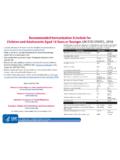
1 FIGURE 2: Recommended immunization schedule for persons aged 7 through 18 years United States, 2012 (for those who fall behind or start late, see the schedule below and the catch-up schedule [ FIGURE 3])This schedule includes recommendations in effect as of December 23, 2011. Any dose not administered at the Recommended age should be administered at a subsequent visit, when indicated and feasible. The use of a combination vaccine generally is preferred over separate injections of its equivalent component vaccines. Vaccination providers should consult the relevant Advisory Committee on immunization Practices (ACIP) statement for detailed recommendations, available online at Clinically significant adverse events that follow vaccination should be reported to the Vaccine Adverse Event Reporting System (VAERS) online ( ) or by telephone (800-822-7967).
2 1. Tetanus and diphtheria toxoids and acellular pertussis (Tdap) vaccine. (Minimum age: 10 years for Boostrix and 11 years for Adacel) persons aged 11 through 18 years who have not received Tdap vaccine should receive a dose followed by tetanus and diphtheria toxoids (Td) booster doses every 10 years thereafter. Tdap vaccine should be substituted for a single dose of Td in the catch-up series for children aged 7 through 10 years. Refer to the catch-up schedule if additional doses of tetanus and diphtheria toxoid containing vaccine are needed. Tdap vaccine can be administered regardless of the interval since the last tetanus and diphtheria toxoid containing vaccine. 2. Human papillomavirus (HPV) vaccines (HPV4 [Gardasil] and HPV2 [Cervarix]). (Minimum age: 9 years) Either HPV4 or HPV2 is Recommended in a 3-dose series for females aged 11 or 12 years.
3 HPV4 is Recommended in a 3-dose series for males aged 11 or 12 years. The vaccine series can be started beginning at age 9 years. Administer the second dose 1 to 2 months after the first dose and the third dose 6 months after the first dose (at least 24 weeks after the first dose). See MMWR 2010;59:626 32, available at 3. Meningococcal conjugate vaccines, quadrivalent (MCV4). Administer MCV4 at age 11 through 12 years with a booster dose at age 16 years. Administer MCV4 at age 13 through 18 years if patient is not previously vaccinated. If the first dose is administered at age 13 through 15 years, a booster dose should be administered at age 16 through 18 years with a minimum interval of at least 8 weeks after the preceding dose. If the first dose is administered at age 16 years or older, a booster dose is not needed. Administer 2 primary doses at least 8 weeks apart to previously unvaccinated persons with persistent complement component deficiency or anatomic/functional asplenia, and 1 dose every 5 years thereafter.
4 Adolescents aged 11 through 18 years with human immunodeficiency virus (HIV) infection should receive a 2-dose primary series of MCV4, at least 8 weeks apart. See MMWR 2011;60:72 76, available at , and Vaccines for Children Program resolution No. 6/11-1, available at , for further guidelines. 4. Influenza vaccines (trivalent inactivated influenza vaccine [TIV] and live, attenuated influenza vaccine [LAIV]). For most healthy, nonpregnant persons , either LAIV or TIV may be used, except LAIV should not be used for some persons , including those with asthma or any other underlying medical conditions that predispose them to influenza complications. For all other contraindications to use of LAIV, see MMWR 2010;59( ), available at Administer 1 dose to persons aged 9 years and older. For children aged 6 months through 8 years: For the 2011 12 season, administer 2 doses (separated by at least 4 weeks) to those who did not receive at least 1 dose of the 2010 11 vaccine.
5 Those who received at least 1 dose of the 2010 11 vaccine require 1 dose for the 2011 12 season. For the 2012 13 season, follow dosing guidelines in the 2012 ACIP influenza vaccine recommendations. 5. Pneumococcal vaccines (pneumococcal conjugate vaccine [PCV] and pneumococcal polysaccharide vaccine [PPSV]). A single dose of PCV may be administered to children aged 6 through 18 years who have anatomic/functional asplenia, HIV infection or other immunocompromising condition, cochlear implant, or cerebral spinal fluid leak. See MMWR 2010:59(No. RR-11), available at Administer PPSV at least 8 weeks after the last dose of PCV to children aged 2 years or older with certain underlying medical conditions, including a cochlear implant. A single revaccination should be administered after 5 years to children with anatomic/functional asplenia or an immunocompromising condition.
6 6. Hepatitis A (HepA) vaccine. HepA vaccine is Recommended for children older than 23 months who live in areas where vaccination programs target older children, who are at increased risk for infection, or for whom immunity against hepatitis A virus infection is desired. See MMWR 2006;55(No. RR-7), available at Administer 2 doses at least 6 months apart to unvaccinated persons . 7. Hepatitis B (HepB) vaccine. Administer the 3-dose series to those not previously vaccinated. For those with incomplete vaccination, follow the catch-up recommendations ( FIGURE 3). A 2-dose series (doses separated by at least 4 months) of adult formulation Recombivax HB is licensed for use in children aged 11 through 15 years. 8. Inactivated poliovirus vaccine (IPV). The final dose in the series should be administered at least 6 months after the previous dose.
7 If both OPV and IPV were administered as part of a series, a total of 4 doses should be administered, regardless of the child s current age. IPV is not routinely Recommended for residents aged18 years or older. 9. Measles, mumps, and rubella (MMR) vaccine. The minimum interval between the 2 doses of MMR vaccine is 4 Varicella (VAR) vaccine. For persons without evidence of immunity (see MMWR 2007;56[No. RR-4], available at ), administer 2 doses if not previously vaccinated or the second dose if only 1 dose has been administered. For persons aged 7 through 12 years, the Recommended minimum interval between doses is 3 months. However, if the second dose was administered at least 4 weeks after the first dose, it can be accepted as valid. For persons aged 13 years and older, the minimum interval between doses is 4 weeks. Vaccine Age 7 10 years11 12 years13 18 yearsTetanus, diphtheria, pertussis1 Human papillomavirus2 Meningococcal3 Influenza4 Pneumococcal5 Hepatitis A6 Hepatitis B7 Inactivated poliovirus8 Measles, mumps, rubella9 Complete 2-Dose SeriesVaricella10 Range of Recommended ages for all childrenRange of Recommended ages for catch-up immunizationRange of Recommended ages for certain high-risk groupsInfluenza (yearly)This schedule is approved by the Advisory Committee on immunization Practices ( ),the American Academy of Pediatrics ( ), and the American Academy of Family Physicians ( ).
8 Department of Health and Human Services Centers for Disease Control and Prevention1 dose (if indicated)1 dose (if indicated)1 dosesee footnote2 See footnote33 dosesDose 1 See footnote 5 Complete 2-dose seriesComplete 3-dose series Complete 3-dose seriesComplete 2-dose seriesComplete 2-dose seriesComplete 3-dose seriesBooster at 16 years ol