Transcription of FINAL YEAR PROJECT (FYP) INFORMATION BOOKLET
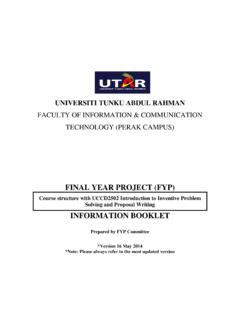
1 UNIVERSITI TUNKU ABDUL RAHMAN FACULTY OF INFORMATION & COMMUNICATION TECHNOLOGY (PERAK CAMPUS) FINAL year PROJECT (FYP) Course structure with UCCD2502 Introduction to Inventive Problem Solving and Proposal Writing INFORMATION BOOKLET Prepared by FYP Committee *Version 16 May 2014 *Note: Please always refer to the most updated version 1 Table of Contents 1 3 Selection of PROJECT Area and PROJECT 5 General Classification of FINAL year 6 Academic Research 6 Application Development 7 Combining PROJECT 7 2 PROJECT MILESTONE AND 8 Introduction to Inventive Problem Solving and Proposal Writing (UCCD 2502).
2 8 PROJECT I 9 PROJECT II 10 3 PITFALLS AND 13 4 PROJECT REPORT CONTENTS AND 14 Report Contents and Arrangement Guidelines for UCCD2502 Introduction to Inventive Problem Solving and Proposal 14 Report Contents and Arrangement Guidelines for PROJECT 16 Report Contents and Arrangement Guidelines for PROJECT 22 Poster Content and Arrangement Guidelines for PROJECT I and PROJECT 26 5 PROJECT REPORT 27 Report Format for Introduction to Inventive Problem Solving and Proposal Writing PROJECT 27 Report Format for PROJECT 29 Other Points to Note on Writing 31 6 VIVA: ORAL PRESENTATION AND PRODUCT 32 7 FYP GUIDELINES FOR SUPERVISOR AND 33 34 Appendix A: FINAL year PROJECT Titles 35 Appendix B: FINAL year PROJECT Registration 37 Appendix C: FINAL year PROJECT Biweekly 39 Appendix D: Report Front 42 Appendix E: Sample of Report 44 Appendix F: Harvard Style 58 2 Important Notice to All Students Plagiarism is a serious offence.
3 Copy and paste for the report content is prohibited. You must sign the report submission declaration to confirm that your FYP report has been done by your own efforts without any plagiarism. 3 1 Introduction Every UTAR student undertaking a degree program in FICT is required to complete a PROJECT under the supervision of a FICT (Perak) academic staff or an external supervisor from the industry. In the case whereby an external supervisor is appointed, a FICT (Perak) staff shall be appointed as a co-supervisor for the student. The PROJECT should provide student with the opportunity to bring together the academic knowledge and skills acquired from the range of modules already studied.
4 In general, the whole PROJECT can be divided into three parts, namely Introduction to Inventive Problem Solving and Proposal Writing (IIPSPW), PROJECT I and PROJECT II, which are to be completed by year 3. Although students are required to take the modules starting from year 2 semester 2 or 3, they are encouraged to explore the areas of interest, identify the PROJECT supervisors and define a PROJECT topic if possible, as early as the first semester of year 2. The detailed planning of the PROJECT is described in the following sections. The objectives and learning outcomes of the three modules are listed as below.
5 (Note: Students are encouraged to undertake Introduction to Inventive Problem Solving and Proposal Writing prior to taking PROJECT I) The objectives of Introduction to Inventive Problem Solving and Proposal Writing [1] To enable students to apply inventive problem solving techniques to generate ideas and solutions to innovative problems; [2] To equip students with relevant skills in planning, writing, and presenting PROJECT proposals; [3] To prepare students to develop problem statements, conduct efficient literature search, review literature, and design research studies to address different types of problems.
6 The learning outcomes of Introduction to Inventive Problem Solving and Proposal Writing After completing this unit, students will be able to: [1] Describe basic models and tools for solving inventive problems; [2] Perform systematic analysis to gain knowledge of product characteristics and evolution trends; [3] Identify the technical contradiction of a problem and use the contradiction matrix to determine the inventive principles, which could lead to an innovative solution; [4] Identify the key components in a proposal and explain how they relate to the justification for a PROJECT ; [5] Conduct effective search and critical review of the relevant literatures; [6] Write and present a structured proposal for an ICT research and development PROJECT .
7 The objectives of PROJECT I: [1] To introduce a general approach in starting a PROJECT , the need for proper documentation and reporting, and professional presentation of work undertaken; 4 [2] To equip students with the relevant research and technical skills that may be utilized for the formulation and development of a PROJECT ; [3] To introduce current INFORMATION & Communication Technology (ICT) related trends and development. The learning outcomes of PROJECT I: After completing this unit, students will be able to: [1] Identify a topical or problem area of interest for an ICT FINAL year PROJECT (FYP).
8 [2] Define the scope and objectives of the FYP. [3] Develop a PROJECT plan for the FYP. [4] Write formal documentations, such as proposal, literature search summary, work log, and report, required for the FYP. [5] Determine suitable research methodologies and tools for problem analysis and PROJECT development. [6] Demonstrate presentation skills in PROJECT proposal, and demonstrating technical work. The objectives of PROJECT II: [1] To encourage students to demonstrate their technical skills, and put in practice their experiences and knowledge. [2] To provide an opportunity for students to highlight and realize in projects, their grasp of interdisciplinary knowledge, including business domain knowledge.
9 [3] To provide an opportunity for students to further their research, in their discipline and that of the industry, and report their findings appropriately. [4] To provide an avenue for students to document and showcase their PROJECT , to potential employers. The learning outcomes of PROJECT II: After completing this unit, students will be able to: [1] Review and re-evaluate the PROJECT scope, objectives, and PROJECT plan proposed in PROJECT I. [2] Compile and perform literature and technical review for the PROJECT . [3] Formulate PROJECT requirements into specifications or models.
10 [4] Analyse the specifications or models and select suitable tools or methods for PROJECT development. [5] Develop a system or theorem based on the stated specifications or models. [6] Evaluate the system or prove the theorem. [7] Write a formal report for PROJECT outcomes. [8] Present or demonstrate the PROJECT results. Generally, all projects will involve elements of preliminary investigation, PROJECT design, realization of design and evaluation. 5 Selection of PROJECT Area and PROJECT Proposal In year 2 Semester 2 or 3, students are expected to register for Introduction to Inventive Problem Solving and Proposal Writing (IIPSPW).