Transcription of FL-810 Summary Dissolution Information - California
1 This booklet is available in English and Spanish from the office of the court clerk in the superior court of each county in California , or at DISSOLUTIONINFORMATIONEste folleto puede obtenerse en ingl s y en espa ol en la Direcci n de Registro P blico del Condado (Office of the Court Clerk) o en la Corte Superior (Superior Court) de cada condado en el estado de California o en el sitio Adopted for Mandatory Use Judicial Council of California FL-810 [Rev. July 1, 2017]Family Code, 2400 2406 WHAT IS THIS BOOKLET ABOUT?SOME TERMS YOU NEED TO CAN USE THE Summary Dissolution PROCEDURE?AN IMPORTANT DIFFERENCE BETWEEN Summary DISSOLUTION4 AND REGULAR DISSOLUTIONHOW DO YOU FIGURE OUT THE VALUE OF YOUR PROPERTY5 AND THE AMOUNT OF YOUR DEBTS? WORKSHEET FOR DETERMINING VALUE OF SEPARATE PROPERTY6 WORKSHEET FOR DETERMINING VALUE AND DIVISION OF COMMUNITY PROPERTY810 WORKSHEET FOR DETERMINING COMMUNITY OBLIGATIONS AND THEIR DIVISIONWHAT SHOULD BE INCLUDED IN THE PROPERTY SETTLEMENT AGREEMENT?
2 PROPERTY SETTLEMENT AGREEMENT13 WHAT STEPS DO YOU HAVE TO TAKE TO GET A Summary Dissolution ?IX. 1618 WHAT YOU SHOULD KNOW ABOUT REVOCATION19 SHOULD YOU SEE A LAWYER?SOME GENERAL Information 20I.. X..XI. XII.. you wish to use the Summary Dissolution procedure, you must, at the time you file the joint petition, sign a statement that says you have read and understood this booklet. It is important for you to read the whole booklet very carefully. Save this booklet for at least six months if you decide to start a Summary Dissolution . If you decide you want to stop the Summary Dissolution process and revoke your petition, it will tell you how to do been married and/or in a domestic partnership five years or less (this means that the time between the date you married or registered your domestic partnership and the date you separated from your spouse or partner is five years or less);I .WHAT IS THIS BOOKLET ABOUT?This booklet describes a way to end a marriage, a domestic partnership, or both through a kind of divorce called Summary Dissolution .
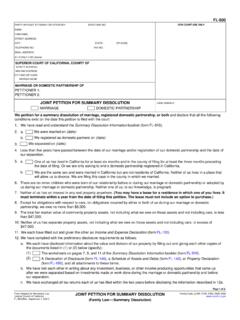
3 The official word for divorce in California is Dissolution . There are two ways of getting a divorce, or Dissolution , in California . The usual way is called a regular Dissolution . Summary Dissolution is a shorter and easier way. But not everybody can use it. Briefly, a Summary Dissolution is possible for couples who1. 6. 5. 4. 3. 2. do not owe very much; do not want spousal or partner support from each other; andWith this procedure, you will not have to appear in court. You may not need a lawyer, but it is in your best interest to see a lawyer about the ending of your marriage or domestic partnership. See page 19 for more details about how a lawyer can help a Summary Dissolution , you prepare and file a Joint Petition for Summary Dissolution (form FL-800), together with a property settlement agreement,* with the superior court clerk in your county. You will also prepare and turn in a Judgment of Dissolution and Notice of Entry of Judgment (form FL-825).
4 Your divorce, ending your marriage and/or your domestic partnership, will be final six months after you file your Joint Petition for Summary Dissolution . During the six months while you wait for your divorce to become final, either of you can stop the process of Summary Dissolution if you change your mind. One of you can file a Notice of Revocation of Petition for Summary Dissolution (form FL-830), and that will stop the divorce. If either one of you still wants to get divorced, then that person will have to file for a regular Dissolution with a Petition Marriage/Domestic Partnership (form FL-100) unless you both agree to start a new Summary Dissolution booklet will tell you1. who can use the Summary Dissolution procedure;2. what steps you must take to get a Summary Dissolution ;3. when it would help to see a lawyer; and4. what risks you take when you use this procedure rather than the regular Dissolution WARNINGIf you are an undocumented person who became a lawful permanent resident on the basis of your marriage to a citizen or to a lawful permanent resident, obtaining a Dissolution within two years of your marriage may lead to your deportation.
5 You should consult a lawyer before obtaining a ! Domestic partners who qualify for a Summary Dissolution can choose to use the process described in this booklet OR a special Summary Dissolution for domestic partners through the California Secretary of State. You can find the California Secretary of State forms at There is no filing fee for this process. If you choose to file to terminate your domestic partnership through the Secretary of State, do not use this guide.* A property settlement agreement is an agreement that the two of you write or have someone write for you after you fill out the worksheets in this booklet. The agreement spells out how you will divide what you own and what you no disagreements about how their belongings and their debts are going to be divided up once they are no longer married to or in a domestic partnership with each not own very much;-1-have no children together;Il. SOME TERMS YOU NEED TO KNOWIn the following pages, you will often see the terms community property, separate property, and community obligations.
6 Those terms are explained in this section. As a married couple or domestic partners, the two of you are, in the eyes of the law, a single unit. There are certain things that you own together rather than separately. And there may be certain debts that you owe together. If one of you borrows money or buys something on credit, the other one can be made to pay. If your marriage or domestic partnership breaks up, you become two separate individuals again. Before that can happen, you have to decide what to do with the things you own as a couple and the money you owe as a couple. The laws that cover these questions contain the terms community property, separate property, and community obligations. To understand what these terms mean, you should have a clear idea of the length of time you lived together as spouses or domestic partners. This is the period between the day you married or registered your domestic partnership and the day you separated.
7 It may not be easy to decide exactly when you separated. In most cases, the day of the separation is the day the couple stopped living together. However, you may want to choose the day when you definitely decided to get a divorce and took some action to show this (like telling your spouse or partner that you wanted a divorce).Community PropertyIn most cases that includes1. money you now have that either of you earned during the time you were living together as spouses or partners; and Separate Property In most cases that includes1. anything either of you owned before you got married or registered your domestic partnership;2. anything either of you earned or received after your separation; and 3. anything either of you received, as a gift or by inheritance, at any ObligationsIn most cases that includes anything you still owe on any debts either of you acquired during the time you were living together as spouses or registered domestic partners.
8 (For instance, if you bought furniture on credit while you were married or domestic partners and living together, the unpaid balance is a part of your community obligations.) It usually does not matter if the debt was in the name of one spouse or domestic partner only, like on a credit card. NOTE: If you have any questions about your separation date or about your property, it would be good to see a lawyer as these issues can be complicated. Also, if you lived together before your marriage or domestic partnership, you may wish to see a lawyer about possible additional rights either of you may property is everything spouses or registered domestic partners own together. 2. anything either of you bought with money earned during that period. It does not matter if only one of you earned or spent the property is everything spouses or registered domestic partners own separately from each obligations are the debts spouses or registered domestic partners owe WHO CAN USE THE Summary Dissolution PROCEDURE?
9 You can use the Summary Dissolution procedure only if all of the following statements are true about you at the time you file the Joint Petition for Summary Dissolution (form FL-800). Check this list very carefully. If even one of these statements is not true for you, you cannot get a divorce in this have both read this booklet, and we both understand have been married or registered as domestic partners five years or less between the date that we got married and/or registered our domestic partnership and the date we separated. (Note that if you are trying to end both a marriage AND a domestic partnership at the same time through a Summary Dissolution , both your marriage and domestic partnership must have lasted five years or less.)No children were born to the two of us together before or during our marriage and/or domestic have no adopted children under 18 years of one of us is of us owns any part of any land or deciding on statements 7, 8, and 9, use the guide on pages 5 least one of us has lived in California for the past six months or longer and has lived in the county where we are filing for Dissolution for the past three months or longer; or We have prepared and signed an agreement that states how we want our possessions and debts to be divided between us (or states that we have no community property or community obligations).
10 We have both signed the joint petition and all other papers needed to carry out this both want to end the marriage and/or domestic partnership because of serious, permanent have both agreed to use the Summary Dissolution procedure rather than the regular Dissolution are both aware of the following facts:There is a six-month waiting period, and either of us can stop the divorce at any time during this the Dissolution becomes final, neither of us has any right to expect money or support from the other except that which is included in the property settlement agreement. By choosing the Summary Dissolution procedure, we give up certain legal rights that we would have if we had used the regular Dissolution procedure. These rights are explained on page 4. The total of our community obligations (other than cars) is $6,000 or less.**Our community property is not worth more than $43,000. (Do not count cars in this total.)Neither of us has separate property worth more than $43,000.