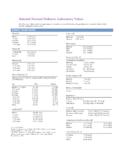
Transcription of FLACC Behavioral Pain Assessment Scale
1 CATEGORIESSCORING01 2 FaceNo particular expression or smileOccasional grimace or frown;Frequent to constant frown, clenched jaw, withdrawn, disinterestedquivering chinLegsNormal position or relaxedUneasy, restless, tenseKicking or legs drawn upActivityLying quietly, normal position, moves easilySquirming, shifting back and forth, tenseArched, rigid, or jerkingCryNo cry (awake or asleep)Moans or whimpers, occasional complaintCrying steadily, screams or sobs; frequent complaintsConsolabilityContent, relaxedReassured by occasional touching, hugging,Difficult to console or comfortor being talked to; distractableHow to Use the FLACCIn patients who are awake:observe for 1 to 5 minutes or longer. Observe legs and body uncovered. Reposition patient or observe activity. Assess body fortenseness and tone.
2 Initiate consoling interventions if patients who are asleep:observe for 5 minutes or longer. Observe body and legs uncovered. If possible, reposition the patient. Touch the body and assessfor tenseness and Score 0 if the patient has a relaxed face, makes eye contact, shows interest in surroundings. Score 1 if the patient has a worried facial expression, with eyebrows lowered, eyes partially closed, cheeks raised, mouth pursed. FLACC Behavioral pain Assessment Scale Score 2 if the patient has deep furrows in the forehead, closed eyes, an open mouth, deep lines around nose and Score 0 if the muscle tone and motion in the limbs are normal. Score 1 if patient has increased tone, rigidity, or tension; if there is intermittent flexion or extension of the limbs.
3 Score 2 if patient has hypertonicity, the legs are pulled tight, there is exaggerated flexion or extension of the limbs, Score 0 if the patient moves easily and freely, normal activity or restrictions. Score 1 if the patient shifts positions, appears hesitant to move, demonstrates guarding, a tense torso, pressure on a body part. Score 2 if the patient is in a fixed position, rocking; demonstrates side-to-side head movement or rubbing of a body Score 0 if the patient has no cry or moan, awake or asleep. Score 1 if the patient has occasional moans, cries, whimpers, sighs. Score 2 if the patient has frequent or continuous moans, cries, Score 0 if the patient is calm and does not require consoling. Score 1 if the patient responds to comfort by touching or talking in 30 seconds to 1 minute.
4 Score 2 if the patient requires constant comforting or is feasible, Behavioral measurement of pain should be used in conjunction with self-report. When self-report is not possible, interpretation of pain behav-iors and decisions regarding treatment of pain require careful consideration of the context in which the pain behaviors are the Behavioral ScoreEach category is scored on the 0 2 Scale , which results in a total score of 0 Relaxed and comfortable4 6 Moderate pain1 3 Mild discomfort7 10 Severe discomfort or pain or bothFrom Merkel, S. I., Voepel-Lewis, T., Shayevitz, J. R., & Malviya, S. (1997). The FLACC : A Behavioral Scale for scoring postoperative pain in young children. Pediatric Nursing,23(3), 293 297. The FLACC Scale was developed by Sandra Merkel, MS, RN, Terri Voepel-Lewis, MS, RN, and Shobha Malviya, MD, at C.
5 S. Mott Children s Hospital,University of Michigan Health System, Ann Arbor, MI. Used with permission.